The Best ETF Portfolio Structures for Conservative, Balanced, and Aggressive Investors
There is no single “best” ETF portfolio for everyone. The right mix depends on four different inputs that people often blur together: risk tolerance, risk capacity, required return, and time horizon.
That distinction matters. Someone may feel comfortable with a volatile portfolio, but not actually have the financial ability to absorb a large loss. Another investor may have plenty of time, but still need a higher return than a conservative portfolio is likely to provide. Good portfolio design starts with those realities, not with a favorite ETF ticker.
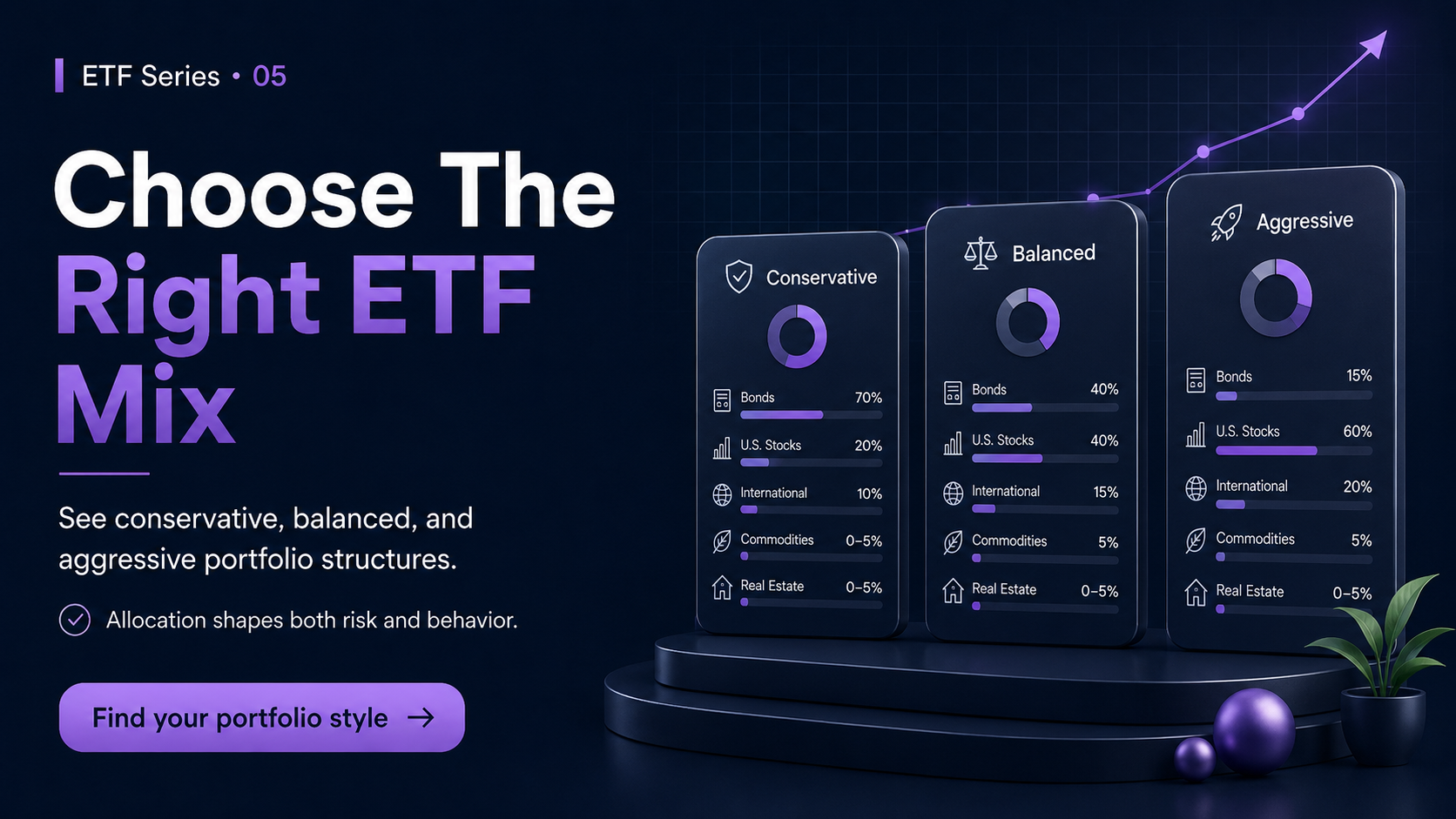
Below is a practical framework for building conservative, balanced, and aggressive ETF structures using plain percentages. These are educational model portfolios, not personalized advice.
First, define the four inputs that should drive the portfolio
1) Risk tolerance
Risk tolerance is your emotional comfort with market swings. If a 20% decline would make you panic-sell, your tolerance is lower than someone who can ignore volatility and stay invested.
2) Risk capacity
Risk capacity is your financial ability to take risk. It depends on cash reserves, income stability, debt, other assets, and whether you can afford a permanent setback. This is often more important than tolerance. You may be brave enough for an aggressive portfolio, but still not able to afford one.
3) Required return
Required return is the minimum growth rate your portfolio needs to help you reach a goal. For example, saving for retirement in 30 years is very different from funding a home purchase in 4 years. If your target return is too high for a conservative portfolio, the answer may be to save more, spend less, or extend the timeline rather than simply take on more risk.
4) Time horizon
Time horizon is how long until you need the money. The longer the horizon, the more volatility you can usually tolerate because you have more time to recover from downturns. Short horizons generally call for more stability.
Simple rule: if any one of these four inputs is low, your portfolio should usually be more conservative than your emotions alone would suggest.
Model ETF portfolio structures
The examples below use broad ETF building blocks such as U.S. stock ETFs, international stock ETFs, high-quality bond ETFs, and short-term Treasury or cash-like ETFs. Bonds are not “safe” in the absolute sense; they can lose value when interest rates rise, credit quality weakens, or inflation stays higher than expected.
Conservative ETF portfolio
- 25% global stock ETFs — for growth, but with limited equity exposure
- 60% high-quality bond ETFs — to reduce volatility and provide income
- 10% short-term Treasury / cash-like ETFs — for stability and near-term spending needs
- 5% inflation-hedging or diversifier ETFs — optional, small diversifying sleeve
Best for: lower risk tolerance, lower risk capacity, shorter time horizon, or investors who need a lot of portfolio stability.
Main trade-off: lower expected growth. If your required return is high, this structure may not be enough on its own.
Balanced ETF portfolio
- 55% global stock ETFs — the main growth engine
- 35% bond ETFs — to soften drawdowns and support rebalancing
- 5% short-term Treasury / cash-like ETFs — for flexibility
- 5% diversifiers — optional, such as inflation protection or alternative exposures
Best for: investors with moderate tolerance for volatility, medium- to long-term horizons, and a need for a mix of growth and stability.
Main trade-off: it will still decline in a bear market, but usually less than a stock-heavy portfolio.
Aggressive ETF portfolio
- 80% global stock ETFs — maximum long-term growth engine
- 15% bond ETFs — a modest shock absorber
- 5% short-term Treasury / cash-like ETFs — liquidity and rebalancing buffer
Best for: high risk tolerance, high risk capacity, long time horizon, and a higher required return.
Main trade-off: large drawdowns are normal. An aggressive portfolio can fall hard and stay below its peak for a long time.
Important: “aggressive” does not mean “all stocks at any cost.” Even very aggressive investors usually benefit from some stabilizers, especially if they may need to sell during a downturn.
Stress test: what happens in a bad year?
One way to evaluate a portfolio is to run a simple stress test. Assume a severe year where:
- Stocks fall 40%
- Bonds fall 10%
- Short-term Treasury / cash-like holdings are flat
Using the model mixes above, the approximate decline would be:
| Portfolio type | Stock weight | Bond weight | Cash/Treasury weight | Approx. stress loss | $100,000 could fall to |
|---|---|---|---|---|---|
| Conservative | 25% | 60% | 15% | -16% | $84,000 |
| Balanced | 55% | 35% | 10% | -24.5% | $75,500 |
| Aggressive | 80% | 15% | 5% | -33.5% | $66,500 |
This is why risk capacity matters. A portfolio that looks fine in a spreadsheet can feel very different when it is down 20% to 35% in real life.
Also remember that bonds are not a guarantee against losses. In some market environments, especially when inflation is high or interest rates rise quickly, stock and bond prices can fall at the same time.
Which structure fits which investor?
| Feature | Conservative | Balanced | Aggressive |
|---|---|---|---|
| Risk tolerance | Low | Medium | High |
| Risk capacity | Low to medium | Medium | High |
| Required return | Low | Moderate | Higher |
| Time horizon | Short to medium | Medium to long | Long |
| Typical investor profile | Near-retirees, cautious savers, capital preservation focus | Long-term investors who want growth with some ballast | Young investors, very long horizons, high savings discipline |
In practice: if your required return is high but your risk capacity is low, the better fix may be a bigger savings rate, a longer timeline, or a smaller goal—not simply a riskier ETF mix.
How to rebalance an ETF portfolio
Rebalancing keeps your portfolio close to the plan you chose. As stocks rise and bonds lag, a stock-heavy portfolio can quietly become much riskier than intended.
Four common rebalancing methods
- Calendar rebalancing — review quarterly, semiannually, or annually and reset to target weights.
- Threshold rebalancing — rebalance only when an asset class drifts beyond a band, such as 5 percentage points or 20% relative drift.
- Cash-flow rebalancing — direct new contributions, dividends, or withdrawals toward the underweight asset class.
- Hybrid method — use calendar reviews plus drift thresholds for larger moves.
Simple default: many long-term investors can do well with an annual review and a 5-point drift band. Taxable accounts may need a more tax-aware approach, especially when selling would create gains.
Tip: rebalancing is not market timing. It is a way to restore your intended risk level.
Quick questionnaire: conservative, balanced, or aggressive?
Answer each question honestly. If most of your answers lean one way, that portfolio style may be the better starting point for the educational model.
- How would you react if your portfolio dropped 20% in a few months?
- Do you need to use this money within 5 years, 10 years, or 20+ years?
- Would a large temporary loss force you to change your life plans?
- Do you have a stable income and a strong emergency fund?
- Is your required return modest, moderate, or ambitious?
- Would you sell during a downturn, or can you stay invested?
- Do you already own other risky assets, such as real estate or company stock?
- Is this money for retirement, a house, tuition, or another near-term goal?
- Would you sleep well with a stock-heavy portfolio, or constantly check the balance?
- Could you keep contributing during a bear market?
Interpretation:
- Mostly conservative answers = conservative structure
- Mostly mixed answers = balanced structure
- Mostly long-horizon, high-capacity answers = aggressive structure
Special circumstances that can change the answer
- Near retirement — sequence-of-returns risk matters more, so many investors need less equity than they used during accumulation.
- Large pension or Social Security backstop — guaranteed income can increase risk capacity because part of future spending is already covered.
- Concentrated employer stock — if your job and portfolio already depend on one company, a separate ETF portfolio may need to be more diversified and less aggressive.
- Irregular income or self-employment — income volatility lowers risk capacity, even if risk tolerance is high.
- Taxable account vs. retirement account — tax rules can affect bond placement, rebalancing, and which ETFs make sense in which account.
- Very long horizon — younger investors with stable cash flow can often accept more equity exposure, but only if they can truly stay invested.
- Need for near-term spending — any money you may need soon should not be exposed to large market swings.
FAQs
Are bonds really safer than stocks?
Usually they are less volatile than stocks, but they are not risk-free. Bond ETFs can lose value from rising interest rates, credit problems, inflation, and liquidity stress.
Is 100% stock always the best aggressive portfolio?
No. For some long-horizon investors, it may be reasonable. For others, a small bond or cash sleeve can reduce the chance of panic selling and make the plan easier to follow.
How often should I rebalance?
A common starting point is once a year, or whenever an allocation drifts far enough away from target to change your intended risk level.
Should I pick a portfolio based on tolerance or capacity?
Use both, but give risk capacity special weight. The portfolio should fit what you can afford to lose, not just what feels exciting today.
What if my required return is higher than a conservative portfolio can likely deliver?
That usually means the goal, savings rate, or timeline should change. Taking more risk is one option, but it is not the only one—and it is not always the smartest one.
Do I need separate U.S. and international stock ETFs?
Often yes, because international exposure can improve diversification. The exact mix depends on the investor and the overall plan.
Bottom line
The best ETF portfolio structure is not the one with the highest return in a good year. It is the one that fits your risk tolerance, risk capacity, required return, and time horizon—and that you can actually stick with through a bad market.
If your situation is simple, a conservative, balanced, or aggressive ETF model can be a useful starting point. If your situation is more complex, the right answer may be a custom mix, a target-date fund, or a more detailed conversation with a qualified financial professional.
Educational disclaimer: This article is for educational purposes only and is not personalized financial, tax, or legal advice. Investing involves risk, including the possible loss of principal. ETF values can rise and fall, and bond ETFs can also lose money. Your goals, taxes, income, time horizon, and risk capacity should all be considered before making investment decisions. If you are unsure, speak with a qualified financial professional.
Sources
- U.S. SEC — Exchange-traded funds (ETFs)
- FINRA — ETFs
- Fidelity — Risk tolerance and time horizon
- Vanguard — Asset allocation
- Vanguard — Rebalancing
- Charles Schwab — Asset allocation
“`json
{
“seo_title”: “The Best ETF Portfolio Structures for Conservative, Balanced, and Aggressive Investors”,
“meta_description”: “Compare conservative, balanced, and aggressive ETF portfolio structures with simple allocations, stress tests, rebalancing methods, FAQs, and a decision questionnaire.”,
“slug”: “best-etf-portfolio-structures-conservative-balanced-aggressive-investors”,
“hero_image_filename”: “https://nappot.com/wp-content/uploads/2026/07/05-choose-the-right-etf-mix-conservative-balanced-aggressive-portfolios.png”,
“social_image_filename”: “social-share-1200×630/https://nappot.com/wp-content/uploads/2026/07/05-choose-the-right-etf-mix-conservative-balanced-aggressive-portfolios.png”,
“source_urls”: [
“https://www.investor.gov/introduction-investing/investing-basics/exchange-traded-funds-etfs”,
“https://www.finra.org/investors/investing/investment-products/etfs”,
“https://www.fidelity.com/learning-center/personal-finance/risk-tolerance-time-horizon”,
“https://investor.vanguard.com/investor-resources-education/education/asset-allocation”,
“https://investor.vanguard.com/investor-resources-education/education/rebalancing”,
“https://www.schwab.com/learn/story/asset-allocation”
]
}
“`