Sending breast milk to daycare can feel like a lot to coordinate: pumping, chilling, labeling, packing and explaining the plan at drop-off. A repeatable routine is usually safer and easier than relying on memory. This checklist is for families sending expressed human milk for a baby in childcare. It supports—not replaces—your baby’s clinician’s advice and your provider’s written policies.
Start with a simple, shared plan
Ask the childcare provider for its current milk-handling policy before the first day. Programs may have specific requirements for container type, labeling, warming, storage location, bottle preparation and what happens to unused milk. A written plan reduces uncertainty for everyone caring for your baby.
For milk expressed at home, the CDC’s current storage guidance is a useful baseline: fresh milk can be at room temperature for up to 4 hours, in a refrigerator for up to 4 days, and in an insulated cooler with ice packs for up to 24 hours. Frozen milk is best used within about 6 months and may be acceptable for up to 12 months. These are maximums, not targets; when in doubt, chill or use the milk sooner. Follow stricter daycare rules when they apply.
Your night-before checklist
1. Start with clean hands and clean equipment
Wash hands before expressing or handling milk. Use clean containers intended for breast milk, and follow the manufacturer’s instructions for cleaning pump parts. If your baby was premature, is medically fragile, or has special feeding needs, ask the baby’s clinician for an individualized plan.
2. Cool and portion the milk
Refrigerate freshly expressed milk promptly if it will not be used right away. Pack the amount your baby normally takes plus any provider-approved backup, using smaller portions when possible to limit waste. If you combine milk expressed at different times, cool the newly expressed milk before adding it to already chilled milk, and date the container by the oldest milk in the combination.
3. Label every container clearly
Use waterproof labels. Include your child’s full name, the date the milk was expressed, and any information the provider requires, such as the time expressed, amount, or feeding instructions. Label each bottle or storage bag—not only the cooler. If the program prepares bottles from a larger container, ask how it records the preparation time and your baby’s name.
4. Pack for a cold handoff
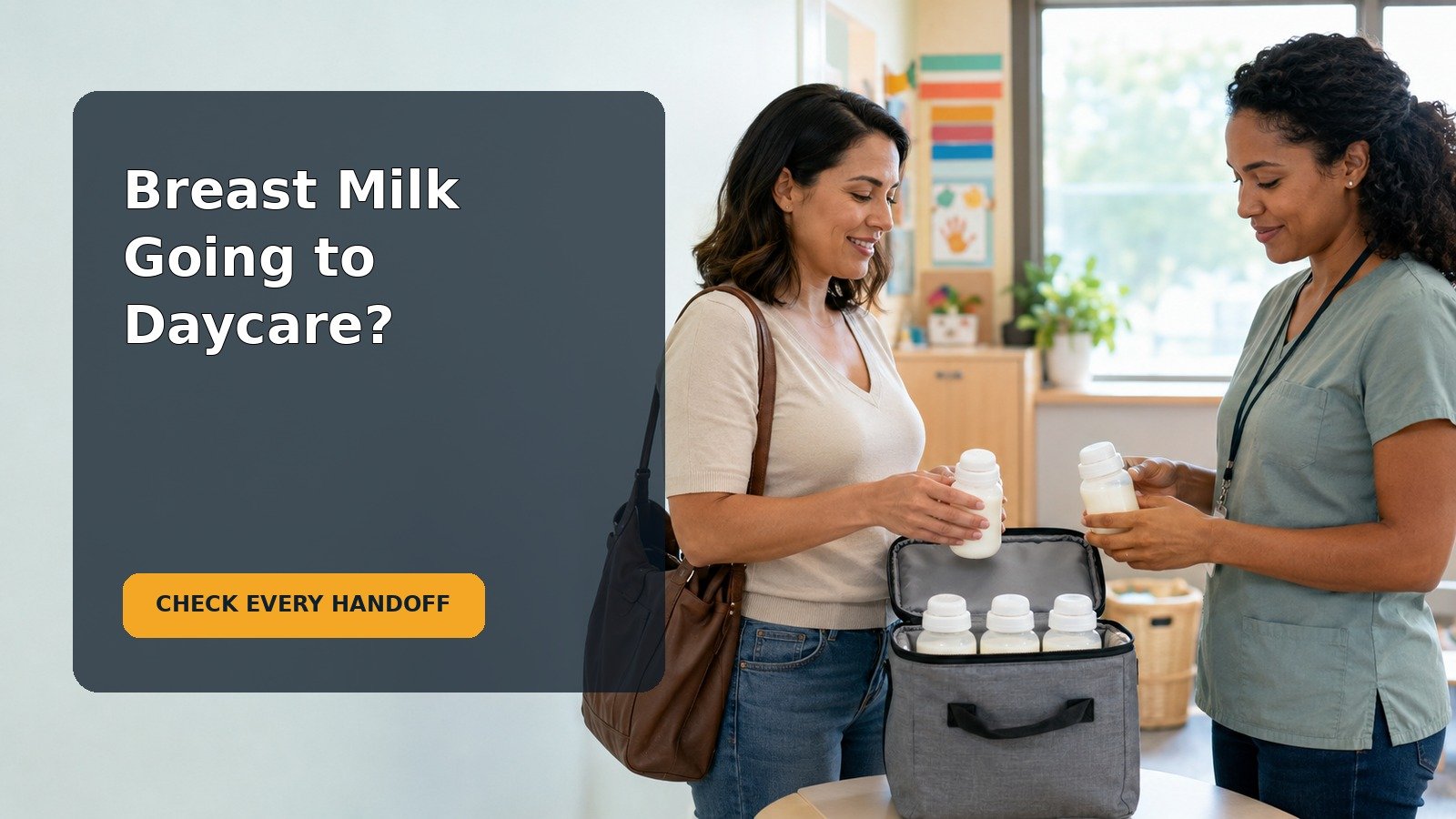
Use an insulated cooler bag with frozen ice packs. Keep the cooler closed during the trip and hand it directly to a staff member rather than leaving it in a warm car or at an unattended desk. At drop-off, confirm where milk goes immediately: refrigerator, freezer, or another designated cold-storage area.
At daycare: make the handoff easy to follow
A short handoff script can prevent mixed messages: “These bottles are labeled with Maya’s name and the expression date. They’re in the cooler with ice packs. Please refrigerate them now; here is the feeding plan we agreed on.”
Ask the provider to show you its storage area on the first day. Milk should be separated and identified so it cannot be confused with another child’s food. Keep a simple note in the diaper bag or provider app about the amount sent, the usual feeding rhythm, and whether there are any temporary instructions from your clinician.
Warming, feeding and leftovers
Breast milk does not need to be warmed to be safe. If your baby prefers warm milk, the caregiver should use the program’s approved method, such as a warm-water bath or bottle warmer, and gently swirl rather than shake. Never microwave breast milk: microwaves can create hot spots and can heat unevenly.
After a feeding begins, CDC guidance says to use the leftover milk within 2 hours and then discard it. This is one reason smaller bottles can be practical. If a bottle has not been offered to your baby, follow the storage plan and your provider’s policy rather than guessing. Do not pour unfinished milk back into a clean container.
Common mix-ups to avoid
- Skipping labels because the cooler is “only for today.” Individual labels protect against mix-ups after bottles are separated.
- Using a loose ice pack or a warm car as storage. Use an insulated cooler and hand milk off promptly.
- Warming milk in the microwave. Choose a provider-approved warming method instead.
- Guessing about medication, donor milk, fortifiers or special diets. Get written guidance from the clinician and program before sending milk.
- Assuming every center follows the same rules. Licensing and provider policies vary; confirm the center’s own requirements.
When to pause and ask for help
Contact the childcare provider promptly if milk was left out longer than its policy allows, was stored in the wrong place, was given to the wrong child, or may have been contaminated. Contact your baby’s clinician for individualized questions about prematurity, illness, medications, special formulas or fortifiers, feeding difficulty, or growth concerns. For an urgent medical concern, seek immediate medical care rather than relying on storage guidance alone.
A one-page morning checklist
- Wash hands; use clean containers and pump parts.
- Confirm milk is chilled, dated and labeled with your child’s name.
- Pack the expected amount in an insulated cooler with ice packs.
- Bring any written feeding instructions the provider needs.
- Hand the cooler directly to staff and confirm refrigeration.
- At pickup, ask what was used and whether any milk remains.
Frequently asked questions
How much breast milk should I send?
Needs vary by baby and by the length of the care day. Start with your baby’s usual feeding pattern, then adjust with the provider and your baby’s clinician if needed. Smaller portions may reduce waste.
Can daycare warm breast milk?
Yes, if the program’s policy allows it, but warming is not required. Use its approved bottle warmer or warm-water method; never microwave breast milk.
What should the label say?
At minimum, include your child’s full name and the date the milk was expressed. Add the time, volume and other details whenever the provider requires them.