Becoming a manager can feel like being handed a map after the journey has already started. You are suddenly responsible for priorities, decisions, feedback, hiring, communication, and the growth of other people—often while still learning your own role. That uncertainty is not proof that you are unqualified. It is the starting point of a skill that can be learned.
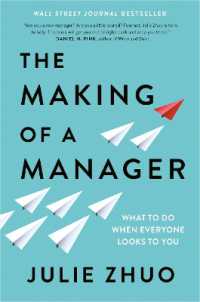
In The Making of a Manager: What to Do When Everyone Looks to You, Julie Zhuo turns the transition into management into a practical field guide. Her central message is reassuring and demanding at once: great managers are made, not born. The work is less about having a commanding personality and more about creating the conditions in which a team can do valuable work consistently.
Why this book matters for wealth
Management is often discussed as a soft skill, but it has a direct economic effect. A manager sets priorities, allocates attention, develops people, and removes bottlenecks. Better decisions can improve the quality of a product, the health of a business, and the earning power of an entire team. Zhuo’s practical approach is useful whether you lead a company, run a small business, or are preparing for your first management role.
The book does not present wealth as status. It presents value creation as the outcome of clear thinking, capable people, and trust that makes coordinated work possible. A manager who helps a team do better work is multiplying effort—a principle that applies to organizations and personal careers alike.
Lesson 1: Management is a learnable craft
New managers commonly worry that they lack an innate leadership presence. Zhuo’s answer is to replace the identity question with a practice question: what behavior would help this team succeed, and how can I improve it? This shifts management from performance to learning.
Apply it: Choose one management behavior to practice for two weeks, such as writing clearer priorities, asking better questions, or giving feedback sooner. After each week, ask a colleague or direct report what became easier and what remained unclear. Specific feedback turns a vague ambition into a skill-building loop.
Lesson 2: Start with the team’s purpose
A team cannot make good trade-offs if it does not understand what it is trying to accomplish. Zhuo emphasizes the importance of connecting daily tasks to a meaningful goal. People need context: who is the customer, what problem are we solving, and how will we know the work is valuable?
Apply it: Write a one-sentence team purpose and three measurable outcomes for the next quarter. In meetings, connect decisions to those outcomes. This reduces busywork and helps people spend their time on work with a higher expected return.
Lesson 3: Build trust through consistency
Trust is not created by one inspiring speech. It grows when a manager listens, keeps commitments, explains decisions, and treats people fairly. Authority may secure compliance for a moment, but trust supports honest information—the kind of information leaders need before making expensive decisions.
Apply it: Make a simple trust audit. Do you cancel one-on-ones repeatedly? Do you change priorities without explaining why? Do you ask for candor and then punish bad news? Pick one inconsistency and correct it publicly. Reliability is a competitive advantage because it lowers the cost of coordination.
Lesson 4: Give feedback that can be used
Feedback is most helpful when it is timely, specific, and focused on behavior and impact. “Be more strategic” is difficult to act on. “In yesterday’s proposal, the customer problem was clear but the next step was missing” gives a person something to improve.
Apply it: Use this sequence: describe what happened, explain the effect, ask for the person’s view, and agree on a next experiment. Balance corrective feedback with recognition of useful behavior. The goal is not to win an argument; it is to help the other person make a better decision next time.
Lesson 5: Hire and develop for capability
A manager’s output includes the people and systems they help create. Hiring should therefore focus on the capabilities the team genuinely needs, not on collecting impressive résumés. Development also requires more than occasional encouragement: people need clear expectations, opportunities to stretch, and coaching while the work is happening.
Apply it: For each role, define the outcomes that matter during the first six months. In regular conversations, ask which skill would make the person more effective and what assignment could build it. Development is an investment, and the return is greater capability that compounds across future work.
Lesson 6: Make decisions with enough clarity
Managers often create drag by leaving decisions ambiguous or by trying to personally solve every problem. Zhuo’s framework favors clear ownership and an appropriate level of involvement. Not every decision needs consensus, but people should know who decides, what information matters, and when the decision will be revisited.
Apply it: For a live decision, write the owner, deadline, options, key constraint, and definition of success. Share that short brief before discussion. After deciding, communicate the “why,” then let the owner execute. Clarity protects time—the resource behind every other form of wealth.
Lesson 7: Turn meetings into value-producing tools
Meetings are expensive when they exist only because a calendar says so. A useful meeting has a purpose, the right participants, a prepared decision or discussion, and a documented next step. The same principle applies to personal productivity: attention should be spent where it changes an outcome.
Apply it: Before accepting a meeting, ask whether you need to decide, contribute expertise, or receive information. If none applies, decline or request notes. For meetings you lead, end with owners and dates. Small improvements in coordination can release hours for learning, selling, creating, or serving customers.
A practical 14-day manager reset
- Day 1: Ask your team what is clear, confusing, or unnecessarily slow.
- Day 2: Publish the team’s top three priorities and what will not be prioritized.
- Days 3–5: Hold focused one-on-ones; listen before prescribing.
- Days 6–7: Give one specific piece of useful feedback to each direct report.
- Week 2: Remove one recurring meeting or process that does not produce value.
- End of week 2: Review outcomes, ask what changed, and choose the next management behavior to practice.
Keep a small scoreboard: priorities completed, decisions unblocked, feedback conversations held, and commitments kept. These are leading indicators of a healthier team and a more valuable organization.
What to question
There is no universal management style. A framework that works for a fast-moving product team may need adaptation in a regulated, creative, public-service, or volunteer setting. Good management is not endless availability, either. Boundaries, recovery, and honest workload conversations protect both performance and people.
The wealth lesson is therefore balanced: build capability and trust, but do not confuse busyness with value. Measure whether the team’s work helps customers, improves the business, or advances a meaningful mission.
Bottom line
The Making of a Manager is a practical reminder that leadership is a craft built through clear goals, useful feedback, good decisions, and consistent care for people. Those habits create value that can compound: stronger skills, better products, healthier businesses, and more opportunities. Start with one team conversation, one clarified priority, and one behavior you are willing to practice until it becomes reliable.
Sources and credits
- Amazon.com product page for the matched Portfolio hardcover, ISBN 9780735219564
- Penguin Random House book page
- Julie Zhuo’s official author page
- Cover image source: Books Kinokuniya image for the matched 2019 edition, ISBN 9780525540427
Article interpretation and practical applications are original commentary by Wealthy I AM. This article is educational and not individualized financial advice.
Wealthy I AM Action Card
Wealthy I AM Pinterest Copy
TITLE
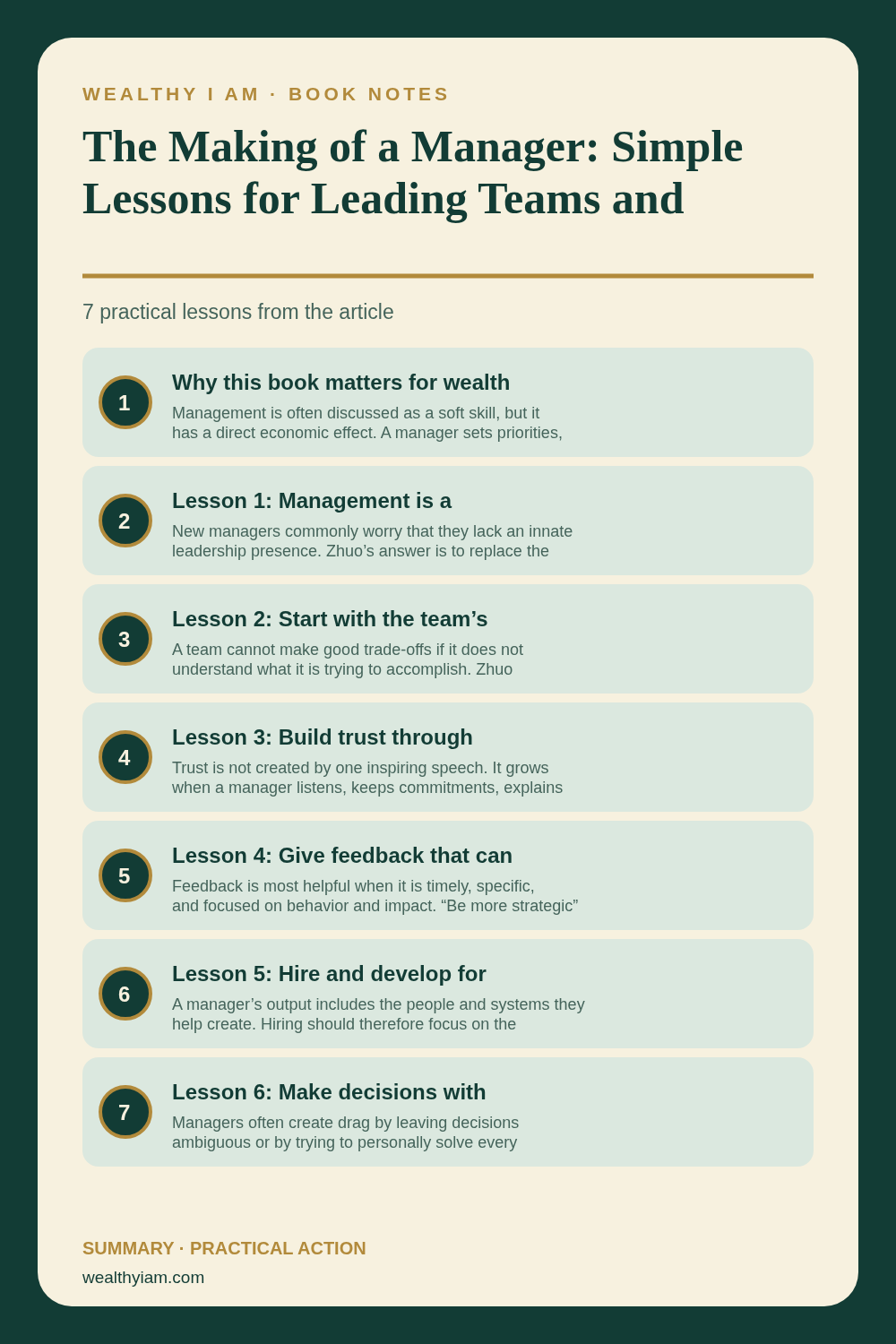
The Making of a Manager: Simple Lessons for Leading Teams and Building Value
DESCRIPTION
Practical management lessons from Julie Zhuo on building trust, clarity, capability, and team.
KEYWORDS
The Making of a Manager book summary, Making Manager lessons, personal development, wealth building, productivity books
ALT TEXT
Wealthy I AM visual summary of The Making of a Manager: Simple Lessons for Leading Teams and Building Value
ARTICLE URL
https://nappot.com/the-making-of-a-manager-simple-lessons-leading-teams-building-value/