Many financial goals begin as a picture in the mind: a business that serves more people, a career with more freedom, or investments that quietly compound. But a large goal can feel unrealistic when today’s circumstances are used as the only evidence of tomorrow’s possibilities. In The Magic of Thinking Big, David J. Schwartz argues that achievement often starts with expanding the way we define what is possible, then translating that belief into practical action.
First published in 1959, this classic is not an investing manual or a promise that positive thoughts produce instant wealth. Its contribution is behavioral. Schwartz explores how confidence, goals, creative thinking, relationships, and consistent action influence the opportunities people notice and pursue. Read thoughtfully, the book becomes a useful guide to replacing self-imposed limits with larger, testable ambitions.

Book facts
- Title: The Magic of Thinking Big
- Author: David J. Schwartz
- First published: 1959
- Edition referenced: Simon & Schuster paperback, ISBN 0671646788
- Core themes: confidence, goal setting, creative thinking, action, leadership, and constructive attitudes
The central idea: your expectations shape your actions
Schwartz’s main message is that people tend to act in ways that match their internal expectations. If a goal is dismissed as impossible, the person is unlikely to search for partners, skills, strategies, or evidence that could make it achievable. A larger expectation does not guarantee success, but it changes the quality and range of actions available.
For wealth building, this distinction matters. “Think big” should not mean taking reckless risks or pretending constraints do not exist. It means asking better questions: What level of value could I create? Which capability would make that possible? Who already knows how to do it? What is the smallest experiment that would test the idea? Ambition becomes useful when it is connected to learning and execution.
Five practical lessons from the book
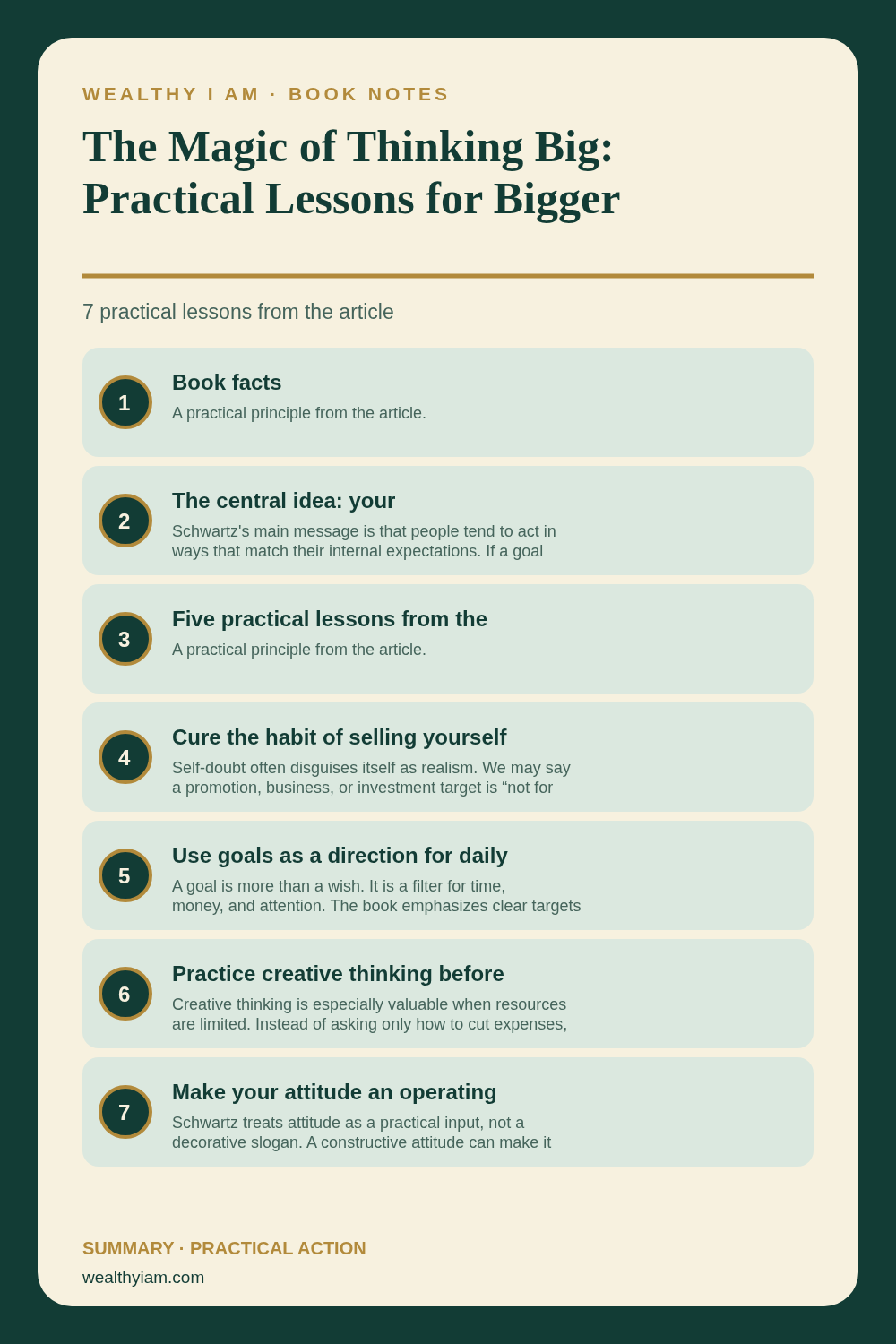
1. Cure the habit of selling yourself short
Self-doubt often disguises itself as realism. We may say a promotion, business, or investment target is “not for people like me” before examining the actual requirements. Schwartz encourages readers to distinguish a genuine limitation from an untested assumption. This is not an invitation to ignore facts; it is an invitation to collect better facts.
Action step: Write one financial or professional goal you have quietly reduced because it seems too large. Under it, list the skills, relationships, capital, and milestones it would require. Replace a vague “I can’t” with a specific learning plan and one conversation with someone who has achieved a comparable result.
2. Use goals as a direction for daily choices
A goal is more than a wish. It is a filter for time, money, and attention. The book emphasizes clear targets because vague desires produce vague behavior. A defined destination helps reveal which activities are progress and which are merely motion.
Action step: Choose a twelve-month target and express it in measurable terms: income earned, debt reduced, savings accumulated, customers served, or an asset purchased. Then define a weekly lead measure—the behavior you control, such as sales conversations, applications, study hours, or automatic contributions. Review it every week without turning one bad week into a new identity.
3. Practice creative thinking before accepting the first answer
Creative thinking is especially valuable when resources are limited. Instead of asking only how to cut expenses, ask how to increase useful output, solve a more valuable problem, or combine existing skills in a new way. Wealth is ultimately connected to value: helping people save time, reduce risk, earn more, or experience something they genuinely want.
Action step: Set a ten-minute timer and write ten possible ways to improve your financial position. Do not judge the first list. Include ideas for earning, negotiating, learning, collaborating, reducing waste, and building an asset. Select one idea that can be tested cheaply within seven days.
4. Make your attitude an operating advantage
Schwartz treats attitude as a practical input, not a decorative slogan. A constructive attitude can make it easier to persist, listen, recover from rejection, and bring energy to a team. It does not erase bad markets or hard circumstances. It changes how quickly you learn from them and how willing others are to work with you.
Action step: Notice the language you use when discussing a setback. Replace “This always happens to me” with “What did this reveal, and what will I change next?” At the end of each workday, record one useful result, one lesson, and one person you can thank. This simple practice trains attention toward evidence and relationships rather than helplessness.
5. Think like a leader by creating value for other people
Leadership in this book is not limited to job titles. It is the habit of taking responsibility, communicating a worthwhile direction, and helping people move toward it. Bigger results usually require cooperation, whether that means customers trusting a business, colleagues supporting a project, or a family agreeing on a money plan.
Action step: Before proposing an idea, describe the benefit from the other person’s perspective. Ask what problem matters most to them, listen without preparing a rebuttal, and make the next step easy to understand. Trust compounds just as surely as money does, and it often creates access to opportunities that technical skill alone cannot unlock.
A seven-day bigger-thinking practice
- Day 1: Define one ambitious but measurable outcome for the next year.
- Day 2: Identify the belief that makes the outcome feel impossible and write the evidence for and against it.
- Day 3: Study one person or business that has solved a similar problem. Focus on process, not celebrity.
- Day 4: Generate ten possible strategies, including low-cost and unconventional options.
- Day 5: Choose the smallest experiment that can produce real feedback.
- Day 6: Ask for advice from someone with relevant experience and listen for what you missed.
- Day 7: Review the evidence, keep what worked, and schedule the next action on your calendar.
Keep ambition grounded in judgment
The book’s motivational language is most useful when paired with financial discipline. Thinking bigger does not mean borrowing money you cannot repay, concentrating your savings in one uncertain idea, or confusing confidence with competence. Preserve an emergency reserve, understand downside risk, learn the basics of any investment, and make decisions that fit your actual time horizon.
Also remember that a bigger life is not defined only by a larger number. The right goal may be more control over your schedule, meaningful work, stronger health, or the ability to support people you love. Money is a tool for those outcomes. The point of expanding your thinking is to choose intentionally, not to chase status for its own sake.
Bottom line
The Magic of Thinking Big offers a straightforward challenge: stop allowing unexamined assumptions to set the ceiling on your effort. Set a clear target, think creatively about value, develop the skills and relationships the target requires, and test your ideas through action. When confidence is paired with evidence, discipline, and sensible risk management, bigger thinking can become a practical engine for career progress, entrepreneurship, and long-term wealth.
Sources and credits
- Penguin Random House: The Magic of Thinking Big — author, edition, publication, and publisher description.
- Amazon.com product page — matched ISBN 0671646788 product reference and cover image.
- Cover image credit: Amazon.com product image for the edition identified above.
Wealthy I AM Action Card
Wealthy I AM Pinterest Copy
TITLE
The Magic of Thinking Big: Practical Lessons for Bigger Goals and Wealth
DESCRIPTION
Practical lessons from David J. Schwartz on confidence, bigger goals, creative thinking, leadership, and building long-term.
KEYWORDS
The Magic of Thinking Big book summary, Magic Thinking lessons, personal development, wealth building, productivity books
ALT TEXT
Wealthy I AM visual summary of The Magic of Thinking Big: Practical Lessons for Bigger Goals and Wealth
ARTICLE URL
https://nappot.com/magic-of-thinking-big-practical-lessons-bigger-goals-wealth/