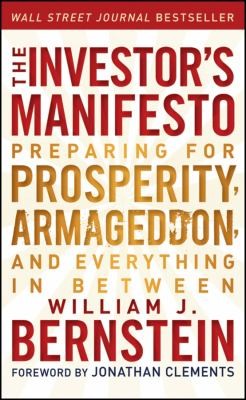
The Investor’s Manifesto by William J. Bernstein is a calm, plain-spoken guide to investing through prosperity, panic, and everything between. Its central promise is not a hot stock tip or a market forecast. It is a durable framework: save enough, diversify intelligently, understand risk, keep costs under control, and behave rationally when markets become frightening.
That makes the book useful for anyone who wants wealth without turning investing into a second full-time job. Bernstein writes for ordinary people who must make decisions about retirement accounts, funds, stocks, bonds, and financial advisers without pretending they can predict the future.
What the book is about
Bernstein organizes investing around a few realities that are easy to forget. Stocks generally offer higher expected returns than safer assets, but they can fall sharply. Bonds and cash can reduce volatility, but they may not grow purchasing power quickly enough on their own. No asset is safe in every situation: inflation, bad timing, high fees, poor diversification, and emotional decisions can all damage a portfolio.
The book treats investing as a lifelong process rather than a series of clever decisions. Build a financial base by saving and avoiding destructive debt. Create a portfolio that matches your time horizon and ability to tolerate loss. Then maintain it with discipline, rebalancing when appropriate instead of chasing whatever recently performed best.
Six lessons worth remembering
1. Risk and return are connected
Higher potential returns come with uncertainty. If an investment appears to offer a generous return with no meaningful risk, something important is probably being hidden. A promised return may depend on leverage, concentration, illiquidity, optimistic assumptions, or permanent loss.
Ask what kind of risk you accept before asking how much you might make. A portfolio can be risky because prices move, but also because it cannot keep up with inflation or is concentrated in one company, country, or industry.
2. Diversification is humility
Diversification means owning different kinds of assets whose results do not all move together. It cannot prevent every decline, but it reduces damage caused by being wrong about one investment. The idea requires humility: even a careful investor cannot know which asset, sector, or nation will lead the next decade.
A diversified portfolio is not exciting every day. That is part of its strength. It replaces the need to identify one winner with the more realistic goal of participating in broad economic growth while limiting avoidable concentration.
3. Costs compound against you
Fees look small when viewed once. A management fee, trading cost, sales charge, or tax inefficiency can seem harmless in one year, but the money paid out no longer compounds for you. Over several decades, the difference can become substantial.
Before buying a fund or hiring an adviser, ask what you will pay, what service you receive, and whether the cost is reasonable. Low cost is not the only quality measure, but unnecessary cost is one of the few disadvantages investors can control directly.
4. Market efficiency changes the default
The efficient-market idea says that public information is quickly reflected in prices, making consistent outperformance difficult. Bernstein does not require readers to believe every market is perfectly efficient. He asks them to recognize how hard it is to beat a market after fees, taxes, mistakes, and competition from professionals.
The sensible default is to use broad, low-cost investments, avoid frequent trading, and depart from that approach only with a clear reason and the discipline to follow it. “I can probably do better” is not the same as having an evidence-based advantage.
5. History is an antidote to panic
Financial history contains bubbles, crashes, wars, depressions, inflation, and long periods when popular investments disappointed. History can make present events less surprising. A dramatic headline feels like the end of the world in isolation; a long record shows that markets have repeatedly endured events that seemed impossible at the time.
This does not mean every crisis resolves quickly. It means your plan should be designed before the crisis arrives. Decide in advance how much volatility you can tolerate, what you own, and when you will rebalance.
6. Behavior is often decisive
Many investors know the rules but abandon them when fear or excitement intensifies. They buy after a strong run, sell after a collapse, or change strategies whenever a prediction becomes popular. Bernstein treats emotional discipline as an investing skill.
Automation helps. So does writing an investment policy, checking accounts less often, and separating a temporary price decline from a permanent change in an asset’s ability to produce value. The aim is not to feel nothing; it is to avoid turning a feeling into an expensive decision.
Simple explanations of key terms
- Asset allocation: the mix of stocks, bonds, cash, and other assets in a portfolio.
- Rebalancing: returning a portfolio to its chosen mix after market movements change the percentages.
- Real return: investment growth after considering inflation.
- Index fund: a fund designed to track a market index instead of selecting investments through frequent trading.
- Sequence risk: the danger that poor returns arrive early while you are withdrawing money.
- Margin of safety: room for error between what you expect and what actually happens.
A practical step-by-step plan
- Define the goal and date. Separate money needed soon from money invested for decades. An emergency reserve should not depend on a stock-market recovery.
- Set a savings rate. Choose a sustainable percentage of income and automate it on payday. Increase it when income rises instead of allowing every raise to become spending.
- List your risks. Review debt, job stability, insurance, dependents, inflation exposure, and the possibility of needing money at the wrong time.
- Choose a simple mix. Use your time horizon and ability to tolerate losses—not a headline—to decide how much belongs in growth assets and stabilizing assets.
- Prefer broad, low-cost vehicles. Compare expense ratios, trading costs, taxes, and diversification. Complexity is not proof of quality.
- Write an investment policy. Record your target allocation, contribution schedule, rebalancing rule, and what would justify a change.
- Rebalance on purpose. Use a calendar or a reasonable percentage band. Do not rebalance because a commentator predicts the next move.
- Review once or twice a year. Check whether your life, goal, or risk capacity changed. Do not confuse a changed price with a changed plan.
What to be careful about
This is a framework, not personalized financial advice. Asset allocation depends on country, taxes, account types, age, obligations, and capacity for loss. A portfolio sensible for one reader may be unsuitable for another. Diversification reduces some risks but does not guarantee profit or prevent loss.
Readers should also resist turning disciplined, broadly diversified investing into a new dogma. The important habit is understanding why a strategy fits your goals and maintaining it through discomfort. If the plan is so aggressive that you will abandon it in a downturn, it is not your plan yet.
Bottom line
The Investor’s Manifesto teaches that successful investing is less about predicting the next event and more about constructing a resilient system. Save consistently, own a diversified portfolio, keep expenses modest, learn enough to recognize bad advice, and prepare emotionally for difficult markets. Those actions are not glamorous, but they are repeatable—and repeatability is a valuable advantage.
Sources and credits
- Wiley publisher page: book description, author, ISBN, and edition details
- Amazon.com product page for The Investor’s Manifesto
- Brooklyn Public Library catalog record
- Cover credit: Open Library cover record for ISBN 9781118073766; the matched Amazon product page is listed above.
Wealthy I AM Action Card
Wealthy I AM Pinterest Copy
TITLE
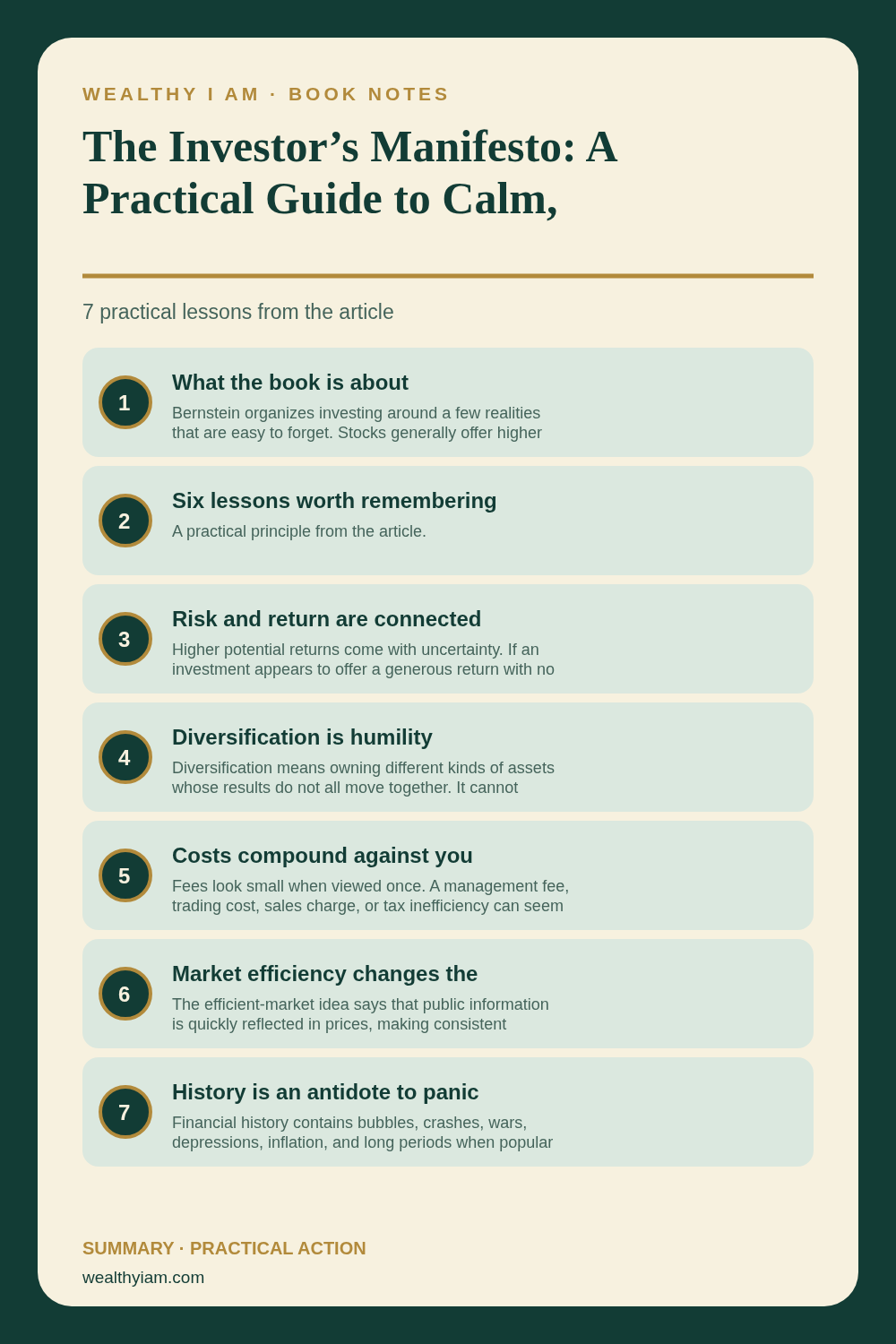
The Investor’s Manifesto: A Practical Guide to Calm, Long-Term Investing
DESCRIPTION
William J. Bernstein’s The Investor’s Manifesto offers a practical framework for saving, diversifying, controlling costs, and staying disciplined through market.
KEYWORDS
The Investor’s Manifesto book summary, Investor’s Manifesto lessons, personal development, wealth building, productivity books
ALT TEXT
Wealthy I AM visual summary of The Investor’s Manifesto: A Practical Guide to Calm, Long-Term Investing
ARTICLE URL
https://nappot.com/investors-manifesto-practical-guide-calm-long-term-investing/