Money management does not have to feel like a punishment. In Stacked: Your Super-Serious Guide to Modern Money Management, Joe Saul-Sehy and Emily Guy Birken bring a practical, humorous voice to the fundamentals many people postpone: spending, saving, debt, investing, protection, and earning more.
The authors’ central promise is refreshingly grounded: financial progress comes from understanding your choices and building a system you can actually live with. There is no shortcut that replaces cash-flow awareness, but there are clear decisions that can make money less mysterious and more useful.
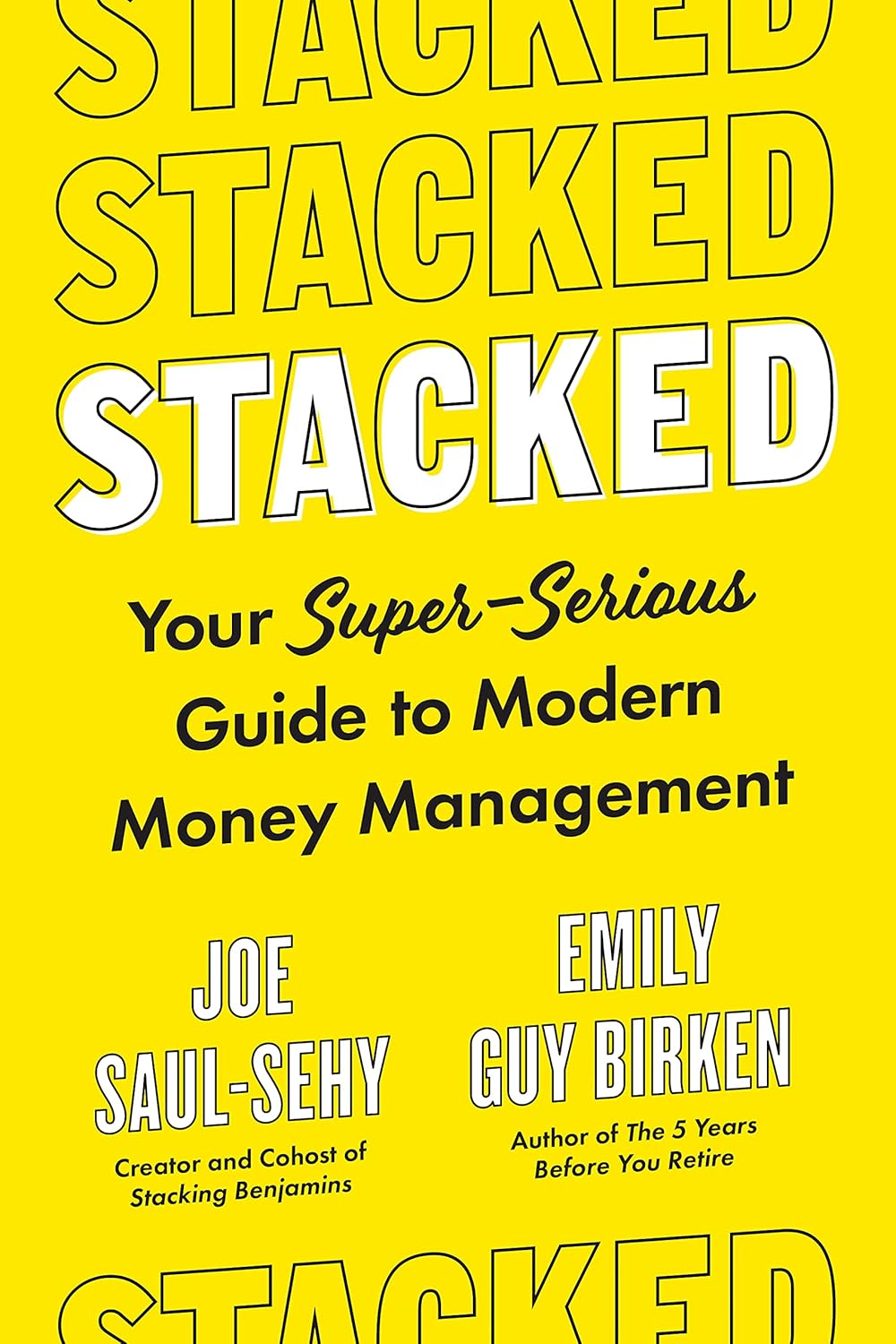
Book facts
- Title: Stacked: Your Super-Serious Guide to Modern Money Management
- Authors: Joe Saul-Sehy and Emily Guy Birken
- Publisher: Avery
- Publication: 2021
- ISBN: 9780593330678 (hardcover edition)
- Focus: Modern personal finance, spending, debt, saving, investing, protection, and income.
The book’s central idea: make money practical
Stacked is not built around shame. Its tone treats financial literacy as a learnable life skill, not a test of character. That matters because embarrassment often causes avoidance: unopened statements, vague goals, and decisions made only when a crisis arrives.
Instead, Saul-Sehy and Birken encourage readers to look at the whole money picture. A strong financial life is not just a high income or a large investment account. It is the interaction of spending choices, emergency planning, debt, insurance, taxes, investing, career decisions, and the ability to enjoy life without sabotaging the future.
Five lessons worth applying
1. Know where your money is going
A budget is not merely a list of restrictions. It is a description of what your income is being asked to do. When spending is visible, you can decide whether it reflects your priorities or simply follows defaults, convenience, and habit.
The useful question is not “Can I eliminate every pleasure?” It is “Which expenses create enough value to deserve their place?” That shift can make a spending plan more honest and sustainable.
2. Build protection before chasing returns
Investing is exciting, but a financial foundation also needs resilience. An emergency reserve, appropriate insurance, and a plan for expensive debt can prevent one surprise from forcing a long-term setback.
The right amount depends on your income stability, household responsibilities, and likely risks. The broader lesson is sequencing: protect the base before taking risks with money you may need soon.
3. Treat debt as a decision, not a moral label
Debt can be useful when it supports a durable asset or opportunity, but interest reduces future flexibility. The authors’ practical approach is to understand the cost, choose a payoff strategy, and make progress visible rather than letting balances remain abstract.
Whether you prefer paying the smallest balance first for motivation or the highest interest rate first for mathematical efficiency, consistency matters. Automating extra payments and directing windfalls toward a chosen balance can turn intention into momentum.
4. Invest simply and consistently
Long-term investing is less about predicting the next headline than about matching a diversified strategy to your goals, time horizon, and tolerance for losses. Costs matter. So does staying invested through ordinary volatility.
Before choosing an account or fund, understand what it owns, what it costs, and when the money may be needed. A simple plan that you can follow is usually more valuable than a complicated plan that depends on perfect timing.
5. Increase the income side too
Cutting waste has limits; earning power can grow. Stacked gives space to side hustles, career development, and thoughtful use of financial tools. That does not mean every reader should launch a business. It means income deserves active attention through skills, negotiation, better positioning, or a service that solves a real problem.
Step-by-step: a seven-day money reset
Use the book’s broad framework as a practical starting point. This is a reset, not a promise of instant wealth.
- Day 1 — Create a clear snapshot. List monthly take-home income, recurring bills, flexible spending, debts, savings, and investments. Use actual statements where possible.
- Day 2 — Separate needs, values, and leakage. Mark each major expense as essential, genuinely meaningful, or easy to forget. Do not aim for perfection; look for the few changes with the largest effect.
- Day 3 — Choose one protection target. Start or strengthen an emergency fund, review basic insurance coverage, or create a plan for an upcoming irregular expense.
- Day 4 — Pick a debt rule. Select a payoff order, set an automatic payment, and remove one source of new high-cost borrowing.
- Day 5 — Write an investing policy. State the goal, time horizon, contribution amount, diversification approach, and conditions under which you will review the plan. Avoid making decisions from a single market day.
- Day 6 — Find one earning experiment. Identify a skill to improve, a compensation conversation to prepare for, or a small service you can test with a real customer.
- Day 7 — Automate and review. Schedule transfers on payday, set a monthly money date, and decide which numbers you will review. A system reduces the number of decisions required later.
How to use the book wisely
One strength of Stacked is its breadth. It helps readers see connections: spending creates room for saving, savings provide resilience, resilience supports investing, and better skills can improve the income that powers the whole system. Its accessible style can make intimidating topics easier to discuss.
Its breadth is also a reason to verify details before acting. Tax rules, investment products, insurance needs, and legal considerations vary by country and personal circumstances. Use the book to form better questions, then consult current official guidance or a qualified professional when the decision is consequential.
Most importantly, do not confuse financial information with financial progress. Progress appears when a useful idea becomes a repeatable behavior: a transfer happens, a balance falls, a fee is removed, a skill improves, or a decision is made deliberately instead of by default.
Bottom line
Stacked offers a friendly tour of modern money management without pretending that wealth is effortless. Its most practical message is to replace avoidance with visibility, then build a sequence: understand cash flow, protect against shocks, manage debt, invest for the long term, and keep developing your ability to earn. Start with one small system you can maintain. Financial confidence grows when your actions begin to match your priorities.
Sources & credit
- Official Stacking Benjamins book page — book description, authors, and subject coverage.
- Amazon.com product page — matched title, authors, and U.S. product listing.
- Publishers Weekly bibliographic listing — edition and ISBN reference.
- Cover image: Amazon.com product listing for Stacked; used as the matched book-cover reference.
Wealthy I AM Action Card
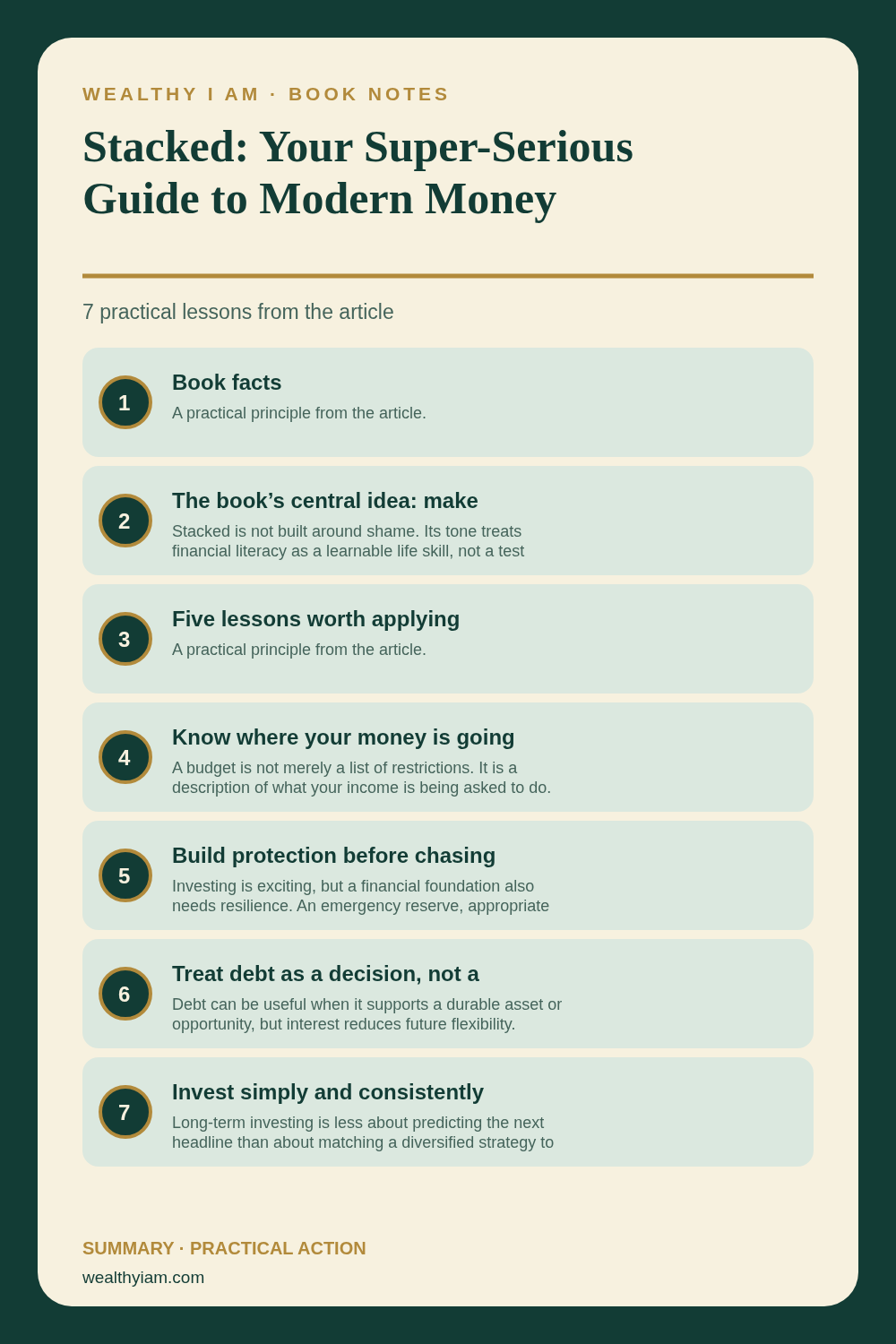
Wealthy I AM Pinterest Copy
TITLE
Stacked: Your Super-Serious Guide to Modern Money Management
DESCRIPTION
A practical guide to the money-management lessons in Stacked by Joe Saul-Sehy and Emily Guy Birken: cash flow, protection, debt, investing, and.
KEYWORDS
Stacked book summary, Stacked lessons, personal development, wealth building, productivity books
ALT TEXT
Wealthy I AM visual summary of Stacked: Your Super-Serious Guide to Modern Money Management
ARTICLE URL
https://nappot.com/stacked-your-super-serious-guide-modern-money-management/