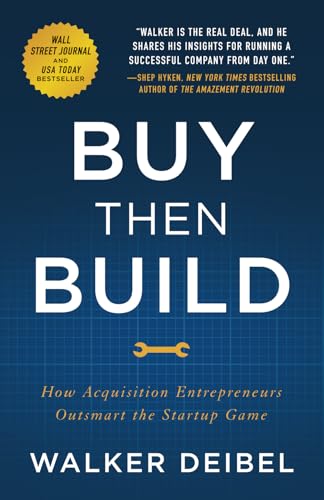
Most entrepreneurship advice starts with a blank page: invent an idea, find customers, build a product, and hope the numbers eventually work. Buy Then Build: How Acquisition Entrepreneurs Outsmart the Startup Game offers a different route. Walker Deibel argues that buying an established small company can give an entrepreneur customers, revenue, employees, and operating history from day one.
That does not make acquisition easy or risk-free. It does, however, change the question from “Can I create demand from nothing?” to “Can I understand, finance, improve, and grow something that already works?” For readers interested in ownership and financial independence, this is a valuable shift in perspective.
What Buy Then Build is about
Deibel presents “acquisition entrepreneurship” as an alternative to the conventional startup path. Rather than spending years proving an untested concept, an acquisition entrepreneur searches for a healthy company, evaluates its economics and risks, arranges a sensible transaction, and then becomes the owner-operator responsible for making it better.
The book’s central insight is that a business is not merely a job or a collection of assets. It is a system of customer relationships, processes, reputation, people, and cash flow. Buying that system can shorten the distance between ownership and useful income—but only when the buyer understands what is being purchased and has the judgment to operate it.
Seven practical lessons from the book
1. Consider ownership as a career path
A salary can be valuable, but employment usually pays for time and contribution. Ownership can also create equity: a claim on the future value of an enterprise. Deibel encourages readers to treat business acquisition as a professional path, not as a lottery ticket or a shortcut to passive income. The owner still has to lead, sell, make decisions, and protect the company’s cash flow.
Action: Write a one-page career plan that compares your current path with owning a small business. Include the skills you would need, the lifestyle you want, and the responsibilities you are willing to accept.
2. Start with a clear acquisition thesis
Searching without criteria turns every listing into a temptation. A thesis defines the kind of company you want: industry, geography, size, customer type, margins, growth potential, and your own role. It also defines what you will refuse. This discipline reduces emotional decisions and helps brokers, lenders, and advisers understand your direction.
Action: Set five non-negotiables before reviewing opportunities. Examples include minimum cash flow, recurring customer demand, manageable concentration risk, and an industry where you can become competent.
3. Learn to read the business behind the numbers
Revenue is not the same as owner benefit, and reported profit is not automatically dependable cash flow. A serious evaluation asks how revenue is produced, how repeatable it is, what customers cost to retain, how much working capital operations require, and whether the company depends too heavily on one client, supplier, or employee.
Action: Build a simple diligence sheet with three columns: what the seller claims, what evidence supports it, and what remains uncertain. Ask for records, then verify important claims independently with customers, contracts, bank statements, tax filings, and operating data.
4. Buy a platform with room to improve
The best opportunity is not necessarily the most broken company. A business should already have a genuine value proposition and a stable enough foundation to support ownership. At the same time, it may have obvious opportunities: weak marketing, outdated systems, poor follow-up, unused capacity, or no documented sales process. Improvement creates value when it solves real constraints rather than adding complexity.
Action: For every opportunity, list the company’s three strongest assets and three fixable bottlenecks. If the “fixes” require heroic assumptions, walk away.
5. Protect downside before chasing upside
Acquisition involves leverage, operational risk, and imperfect information. Deibel’s framework is therefore useful when read conservatively. Price, financing terms, customer concentration, seller transition support, and a cash reserve all affect the margin for error. A deal that only works under perfect growth is not a robust deal.
Action: Model a base case, a difficult case, and a severe-but-plausible case. Include slower sales, the loss of a major customer, higher interest costs, and unexpected repairs or hiring needs. Do not rely on optimistic projections to justify a price.
6. Treat people and culture as part of the purchase
A small company’s value often lives in relationships and know-how that do not appear neatly on a balance sheet. Employees may hold critical operating knowledge; customers may trust particular people; suppliers may extend favorable terms because of history. A new owner who changes everything immediately can destroy value before understanding it.
Action: Create a first-100-days listening plan. Meet key employees and customers, document how work actually gets done, and preserve what already works before introducing major changes.
7. Build systems so the business becomes stronger than its owner
Buying a job is different from building an asset. Repeatable sales, clear responsibilities, documented processes, useful metrics, and regular cash reviews reduce dependence on one person. Systems also make future growth—or a future sale—more credible. The goal is not to remove human judgment; it is to stop every routine decision from requiring the owner’s constant intervention.
Action: Choose one recurring process each week and document its trigger, steps, owner, quality standard, and measurable result. Improve the document as the team uses it.
A simple buy-then-build action plan
- Define your fit: Decide what industries, responsibilities, and locations match your skills and life.
- Build acquisition literacy: Learn basic accounting, cash flow, valuation, financing, contracts, and due diligence before making offers.
- Create your team: Identify a qualified accountant, attorney, lender, broker or deal source, and experienced operator who can challenge your assumptions.
- Develop deal flow: Study listings, contact owners thoughtfully, and build relationships long before you need a transaction.
- Test the thesis: Review several businesses and record why each does or does not fit. Patterns will improve your judgment.
- Underwrite conservatively: Make sure repayment, wages, reinvestment, and reserves work without depending on a miracle.
- Operate before optimizing: After closing, learn the people, customers, and processes first. Then improve one constraint at a time.
What to remember
Buy Then Build is not an argument that every reader should purchase a company. It is an invitation to expand the menu of legitimate paths to entrepreneurship. An existing business can offer a head start, but that head start comes with obligations: careful diligence, adequate capital, operational humility, and responsibility to employees and customers.
The wealth lesson is equally practical. Ownership can create value, but ownership without judgment can destroy it. Start with a clear thesis, verify the economics, protect the downside, and improve a real business through disciplined systems. For the right person, buying then building may be a more grounded way to turn entrepreneurial ambition into durable cash flow and long-term equity.
Sources and credits
- Apple Books record for Buy Then Build
- Amazon.com product page — matched paperback edition
- Google Books bibliographic record
- Walker Deibel’s official website
- Cover image credit: Amazon.com product imagery for ISBN 9781544501130.