Profit is not an afterthought that appears automatically when sales increase. It is the result of a deliberate business design: choosing a customer, creating meaningful value, and finding a way to capture enough of that value to keep the enterprise healthy. In The Art of Profitability, Adrian J. Slywotzky presents this idea through a series of conversations and twenty-three profit-model lessons. The book’s lasting value is not a single formula. It is a way of looking at a business and asking a sharper question: where, exactly, does the profit come from?
That question matters to a founder deciding what to sell, a professional building a side business, and an investor evaluating whether a company has a durable advantage. The practical goal is not to copy another company’s model. It is to understand the economic engine underneath the offer, then improve it through disciplined observation and testing.
What Slywotzky means by a profit model
A profit model is the repeatable logic that turns an organization’s work into financial returns. It includes more than price. It can involve the type of customer served, the timing of payment, the cost structure, the frequency of purchase, the assets required, and the way the company earns trust or creates switching costs.
Two businesses may sell similar products yet make money in completely different ways. One may rely on high volume and low prices. Another may serve a narrow group with specialized expertise. A third may make the initial sale cheaply but earn recurring revenue from service, maintenance, or replenishment. The lesson for wealth builders is simple: revenue is activity; profit is design.
Lesson 1: Start with the customer’s economic problem
Do not begin with “What can I sell?” Begin with “Whose problem is expensive, urgent, or frustrating enough to solve?” Customers do not pay merely for features. They pay for a better outcome, reduced risk, saved time, increased income, convenience, identity, or peace of mind.
Step by step:
- List the customer group you understand best.
- Write down the costs they bear when the problem remains unsolved.
- Interview several real people about what they currently do, not what they say they might do.
- Shape a small offer around one measurable improvement.
- Ask whether the result is valuable enough to support a healthy margin.
This process prevents a common mistake: building something interesting that solves no financially meaningful problem.
Lesson 2: Choose a profit engine before adding complexity
The book’s many models are useful as a menu of questions. A business might profit from scale, specialization, recurring purchases, a valuable installed base, premium positioning, or a powerful network. The right choice depends on the market and on what the company can execute better than alternatives.
For a small venture, choose one primary engine first. If you are offering consulting, that might be specialization and a high-value outcome. If you sell software, it might be recurring subscriptions. If you run an online education business, it might be a core program supported by repeatable distribution. Naming the engine makes trade-offs visible.
Action: Write one sentence in this format: “We create profit by helping this customer achieve this outcome through this distinctive mechanism, while keeping this major cost under control.” If the sentence is vague, the model probably is too.
Lesson 3: Improve the value captured, not only the value created
Many entrepreneurs work hard to create value but fail to capture a fair share of it. They underprice, customize endlessly, offer too many free extras, or accept payment only after delivering a large amount of work. Slywotzky’s framework invites a closer look at the bridge between customer benefit and company economics.
Map the customer journey from first contact to renewal. Mark where time, money, and uncertainty are reduced for the customer. Then compare that benefit with your price and delivery cost. Better value capture might mean packaging the offer more clearly, charging for implementation, introducing a recurring service, shortening payment terms, or removing low-value work that customers do not appreciate.
This is not a recommendation to exploit customers. Durable profitability comes from a fair exchange in which the buyer understands the benefit and the provider can continue delivering it.
Lesson 4: Make the numbers tell a story
Profitability becomes actionable when it is translated into a few operating numbers. Track gross margin, customer acquisition cost, retention, average order value, conversion rate, cash collection time, and the hours required to deliver the promise. The exact list will vary, but the principle is constant: measure the variables that explain the economics.
Use a simple weekly review:
- What changed in revenue, margin, and cash?
- Which customer or product produced the strongest economics?
- Where did work expand without a corresponding increase in value?
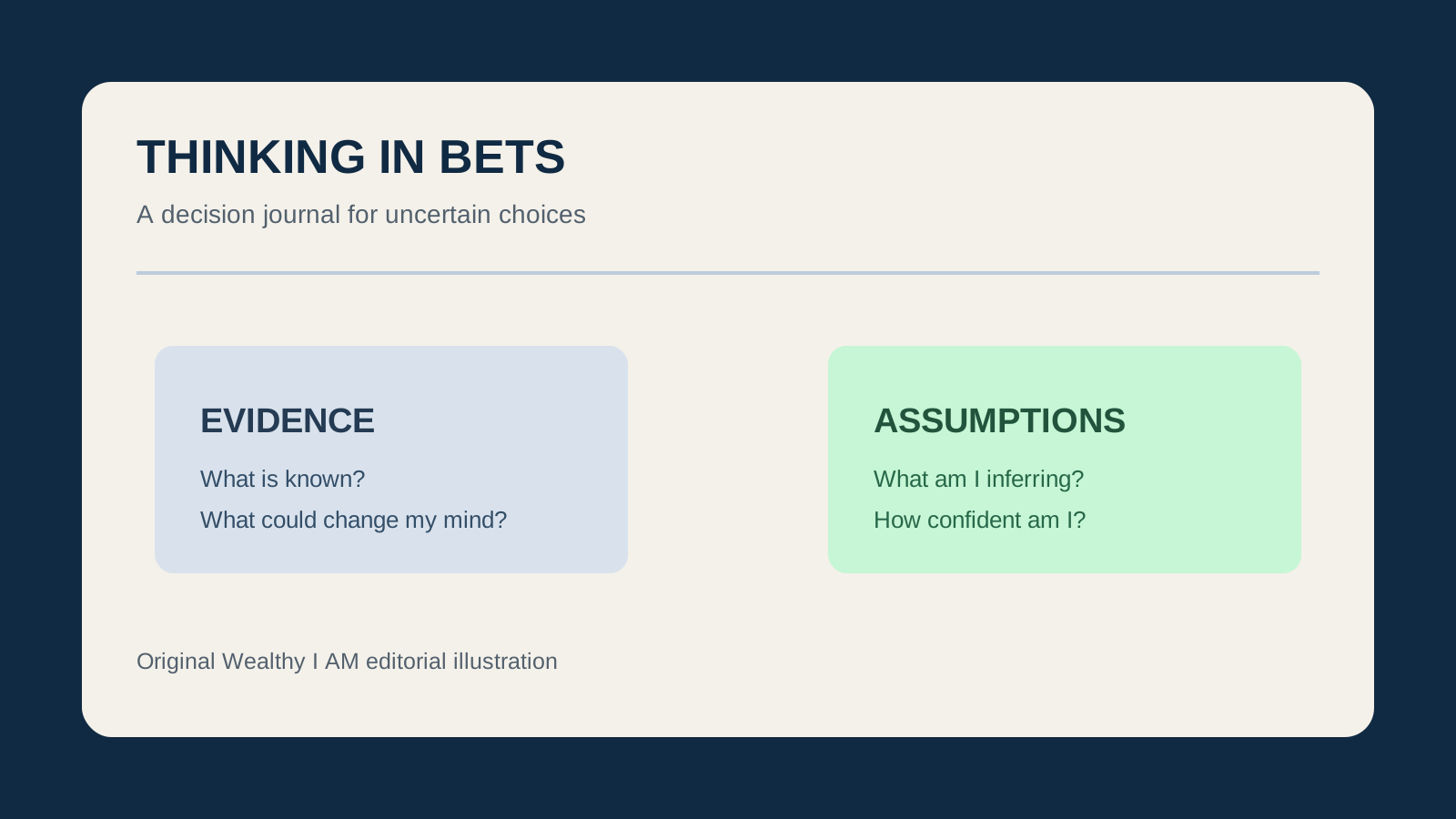
- Which assumption needs a small test next week?
Numbers should lead to decisions, not decorate a dashboard. If a product has high sales but negative contribution after support costs, the answer may be redesign, repricing, or retirement—not celebration.
Lesson 5: Build a position that gets stronger with use
A profitable model is more valuable when its advantage compounds. Learning from customers, developing a trusted reputation, collecting useful data, building a community, or creating efficient processes can make future sales easier and delivery cheaper. These assets are often less visible than equipment, but they can be powerful sources of business value.
Choose one compounding asset to strengthen each quarter. A specialist might publish practical case studies. A retailer might improve its customer list and replenishment reminders. A service firm might document its best process so quality no longer depends on one person. The test is whether today’s work improves tomorrow’s economics.
Lesson 6: Treat strategy as a portfolio of experiments
Slywotzky’s conversational format models curiosity: observe an example, identify the underlying pattern, and ask where else it might apply. Readers can use the same approach without making reckless bets. Develop several hypotheses, but test them cheaply and in sequence.
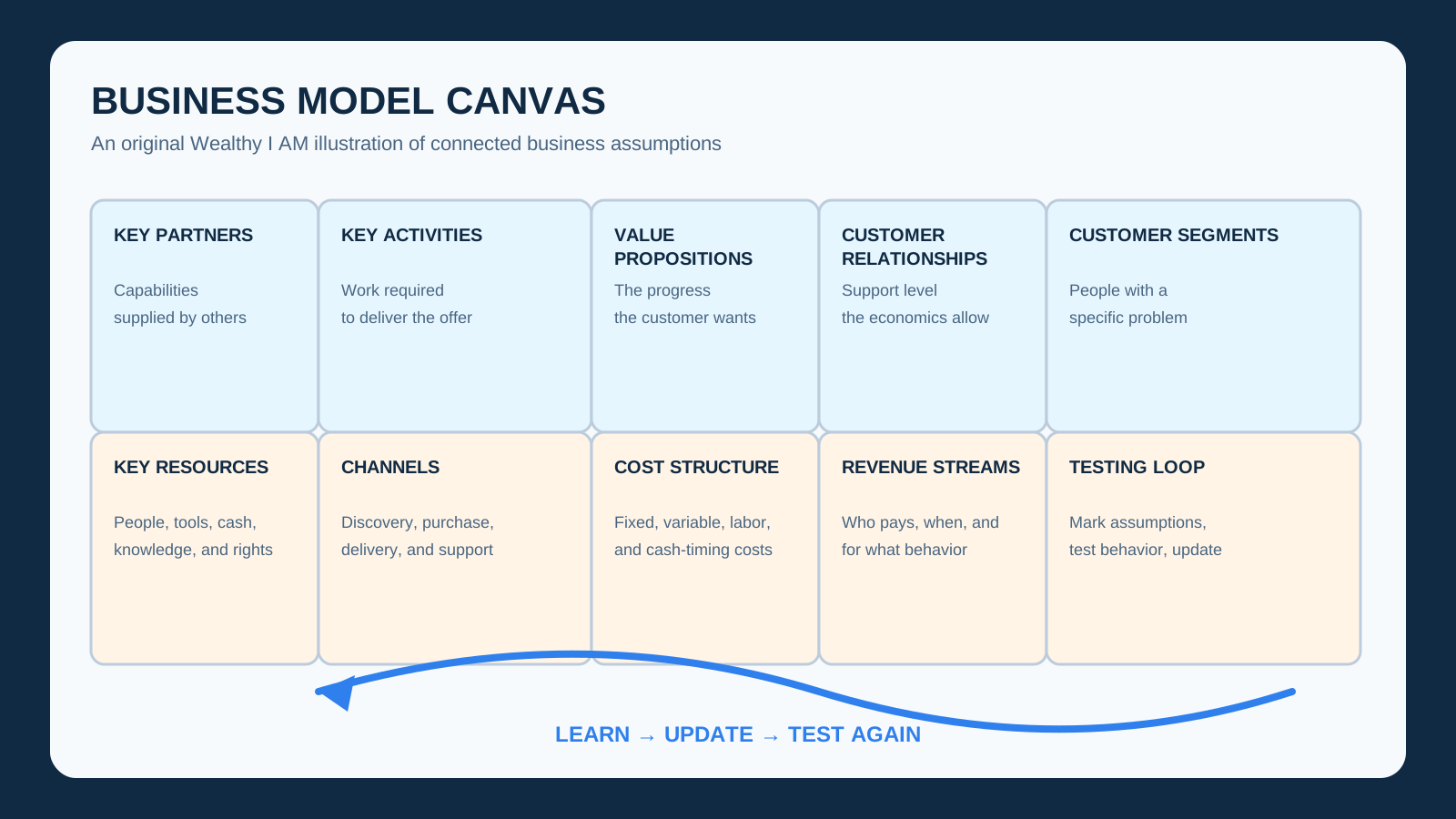
For every experiment, specify the customer, the offer, the expected behavior, the cost, and the success threshold. A test might compare two packages, offer an annual plan, target a narrower segment, or remove an expensive feature. Keep what improves both customer results and business economics. Stop what consumes resources without evidence.
Put the lessons into a 30-day profitability sprint
- Days 1–5: Choose one customer segment and interview five people.
- Days 6–10: Map the current customer journey, costs, payment timing, and delivery effort.
- Days 11–15: Write three possible profit-model improvements and rank them by upside, confidence, and ease of testing.
- Days 16–23: Run the smallest credible experiment with real customers.
- Days 24–27: Review margin, conversion, retention signals, and customer feedback.
- Days 28–30: Keep, revise, or stop the experiment and document the next decision.
The point is not to predict the future perfectly. It is to make the business’s economic logic clearer with each cycle.
Final takeaway
The Art of Profitability is a reminder that wealth-building businesses are designed around value and economics, not just enthusiasm. Find a real customer problem, select a coherent profit engine, measure what drives returns, and keep testing ways to create a fairer and more durable exchange. When those habits become routine, profitability stops being a hopeful outcome and becomes a capability.
Source and credit
- Primary book: The Art of Profitability by Adrian J. Slywotzky, Business Plus, 2003.
- Amazon.com product page for the verified 9780446692274 edition.
- Penn State Libraries catalog record.
- Cover image credit: Open Library cover record for ISBN 9780446692274, matched to the cited edition.
This article is educational and is not financial, legal, or accounting advice.