Money decisions rarely fail because people have no information. More often, they fail because a convincing story arrives before careful analysis. We buy an investment after a recent rise, overestimate our next month’s income, or treat a confident forecast as if it were a fact. In Thinking, Fast and Slow, psychologist and Nobel Prize–winning economist Daniel Kahneman explains why these errors are so persistent—and how to build better decision habits.
Kahneman’s central idea is that the mind uses two interacting modes. Fast thinking is automatic, associative, and efficient; it helps us recognize patterns and act without calculating every detail. Slow thinking is effortful and deliberate; it checks assumptions, compares alternatives, and handles difficult reasoning. Neither mode is “bad.” The practical lesson is to know when a quick impression is useful and when a financial, business, or career decision deserves a deliberate process.

Book facts
- Title: Thinking, Fast and Slow
- Author: Daniel Kahneman
- First published: 2011
- Core topics: judgment, cognitive bias, behavioral economics, risk, investing, and decision-making
The wealth lesson: intelligence does not eliminate bias
Kahneman’s research challenges the idea that people consistently behave like perfectly rational calculators. We can be highly capable and still rely on shortcuts that produce predictable mistakes. A recent price can feel like evidence of future value. A vivid success story can seem more representative than it is. A loss can command more emotional attention than an equivalent gain.
For wealth building, this matters because financial outcomes compound. A single imperfect choice is rarely decisive, but repeated overconfidence, unnecessary trading, lifestyle inflation, or failure to investigate can quietly erode years of progress. The goal is not to remove emotion or intuition. It is to design a process that prevents a momentary feeling from becoming an expensive permanent decision.
Five practical ideas from the book
1. Fast thinking is efficient—but not neutral
Automatic thought lets us navigate ordinary life quickly. It also fills gaps with assumptions. When information is incomplete, the mind often creates a coherent explanation before it has enough evidence. In investing or business, a neat explanation should be treated as a hypothesis, not a conclusion.
2. Confidence is not the same as accuracy
People often feel more certain when a story is simple, familiar, or emotionally compelling. That feeling can be useful for communication, but it is weak proof. Separate “How convincing does this sound?” from “What evidence would show that this is wrong?”
3. Anchors can quietly shape decisions
An initial number can influence later estimates even when it is arbitrary. A target salary, a stock’s previous high, or a seller’s asking price may become a mental reference point. Start important negotiations and valuations from independent facts rather than accepting the first number as the natural center of the discussion.
4. Losses feel heavier than gains
Loss aversion can make people hold a declining investment simply to avoid admitting an error, or sell a sound asset too quickly after a temporary decline. A written allocation and rebalancing rule can reduce the chance that fear changes the plan at the worst moment.
5. The story after the event is not the same as the forecast before it
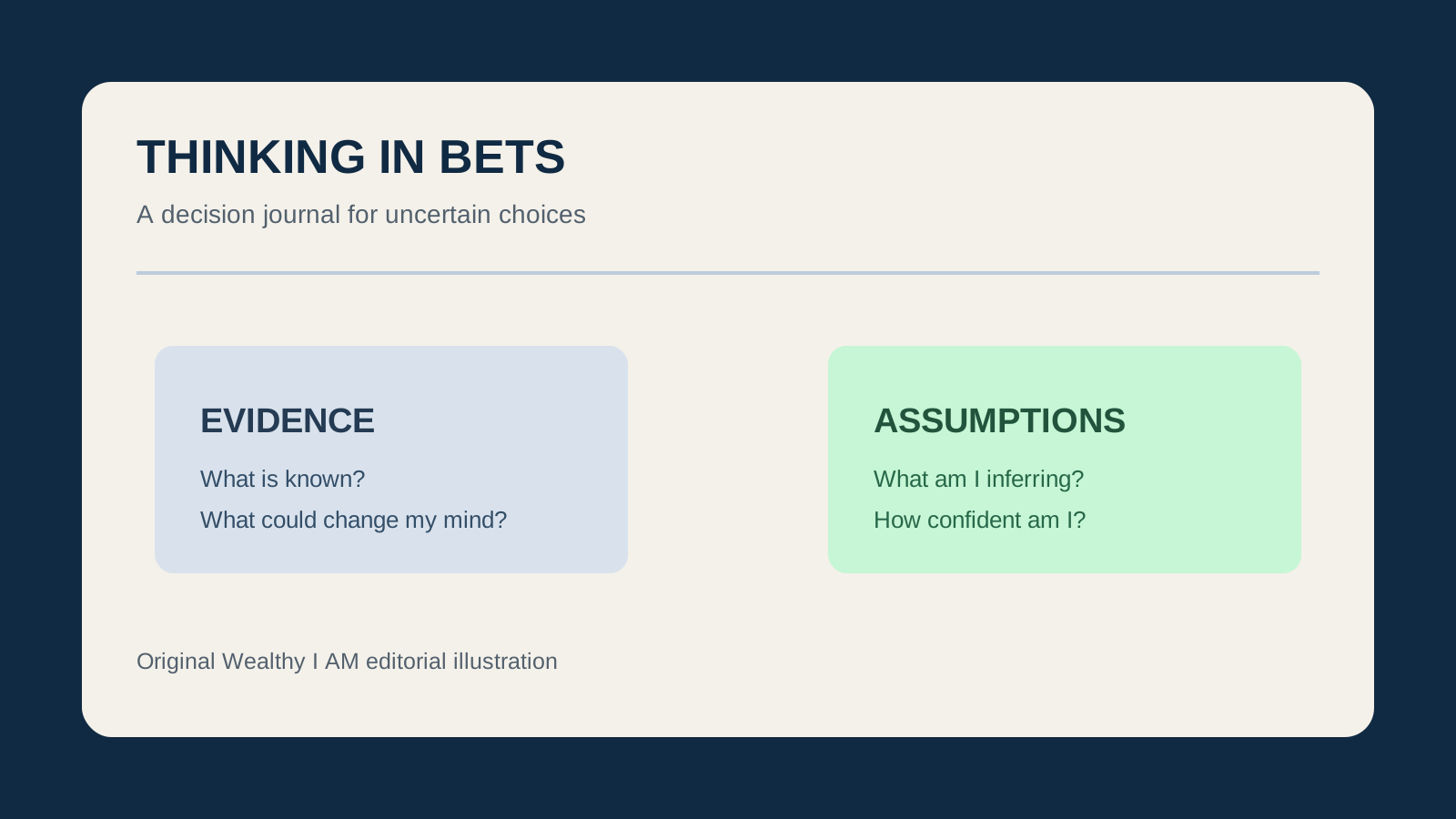
Once an outcome is known, it can appear obvious. This hindsight effect makes luck look like skill and encourages overconfidence. Keep a decision journal: record what you believed, why you believed it, what could go wrong, and what evidence would change your mind.
Step-by-step: build a slower decision process
- Classify the decision. Routine, reversible choices can move quickly. Decisions involving large sums, leverage, reputation, or long commitments deserve more friction.
- Write the question precisely. Replace “Is this a good investment?” with “Does this asset fit my time horizon, risk capacity, diversification plan, and expected return after fees and taxes?”
- Separate facts from interpretation. Create two columns. Put verified numbers and observable events on one side; assumptions, forecasts, and explanations on the other.
- Generate alternatives. Include doing nothing, waiting, choosing a smaller position, or selecting a simpler option. A decision is not genuinely compared if only one path is described in detail.
- Run a premortem. Imagine the decision failed two years from now. List the most plausible reasons: excessive debt, weak demand, concentration, hidden costs, poor execution, or a mistaken assumption.
- Use outside checks. Ask a thoughtful person to challenge the thesis, or use a checklist that forces you to review risk, incentives, downside, and opportunity cost.
- Set a review rule. Decide in advance when you will evaluate the choice and what evidence would justify changing it. Do not let every headline become a new strategy.
- Record the outcome fairly. Distinguish process quality from short-term results. A sound decision can lose money, and a careless decision can get lucky.
Applying the framework to investing
Suppose an investor hears that a company is “the next big thing.” Fast thinking may connect an exciting product with an exciting stock price. A slower process asks different questions: What does the business earn? How durable are its advantages? What is already reflected in the valuation? Which risks could permanently impair capital? How large should the position be if the thesis is wrong?
The same discipline applies to broad-market investing. Instead of predicting the next headline, define an allocation that matches the goal, automate contributions where appropriate, keep costs visible, and rebalance according to a rule. This does not guarantee returns. It reduces the number of emotional decisions required to stay aligned with a long-term plan.
Applying the framework to work and business
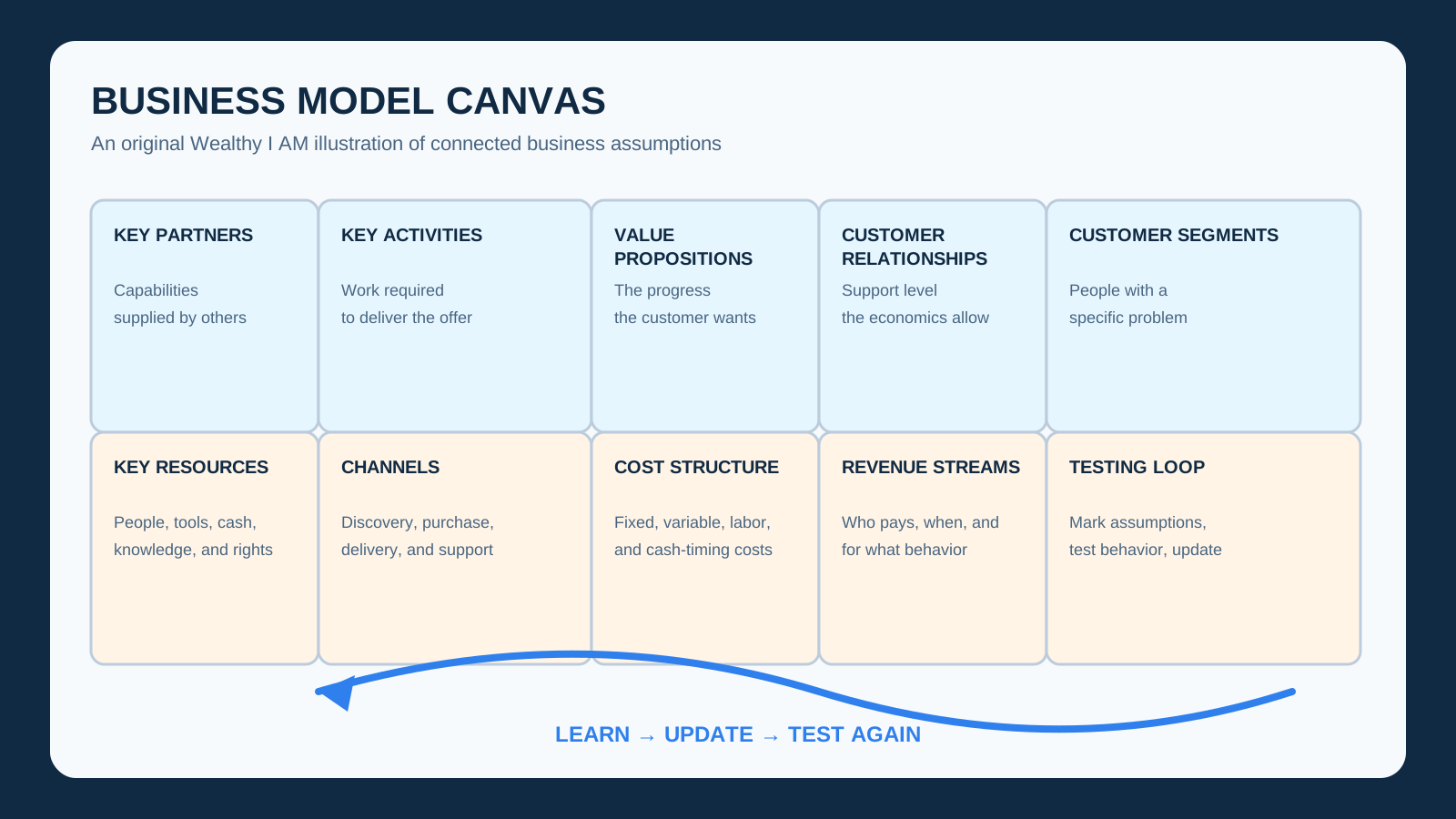
Entrepreneurs and professionals also face bias. A founder may interpret one enthusiastic customer as proof of product-market fit, or a manager may remember a recent mistake more vividly than a year of reliable performance. Use multiple observations, clearly defined metrics, and a time window long enough to reveal patterns. When hiring, evaluate evidence against the role’s requirements rather than allowing charisma or similarity to dominate the assessment.
For personal wealth, the most valuable output may be a few default rules: a waiting period before major purchases, automatic saving, a written investment policy, and a quarterly review. Good defaults protect the future version of you from the urgency felt by the present version of you.
A balanced reading
Thinking, Fast and Slow is not a promise that careful thought will make every choice correct. Slow reasoning is limited by time, information, and its own blind spots. Nor should readers treat every intuition as an enemy; experience can produce valuable pattern recognition in environments where feedback is frequent and reliable. The useful distinction is whether the situation offers trustworthy learning signals or invites a confident story built on noise.
Bottom line
Kahneman’s book turns self-awareness into a financial skill. Notice when a vivid example, first number, recent result, or strong feeling is steering you. Then add a pause, write the assumptions, test alternatives, and use rules that make good behavior easier. Wealth is built not only by finding opportunities, but also by avoiding the repeated decision errors that compound against you.
Sources and credits
- Amazon.com product page — Thinking, Fast and Slow by Daniel Kahneman (ISBN 9780374533557)
- Penguin Random House publisher page
- Cover credit: Amazon.com product image for the matched Daniel Kahneman edition.