Wealth is not built only through money decisions. It is also built through the quality of the conversations, trust, judgment, and responsibility that shape our work. A leader who can handle uncertainty and speak honestly can create more value—for a team, a business, and the people it serves.
Dare to Lead: Brave Work. Tough Conversations. Whole Hearts. by Brené Brown treats courage as a practical leadership skill rather than a personality trait. Brown’s research-based approach asks leaders to stay curious, name difficult realities, build trust, and choose meaningful action over comfortable avoidance. Those capabilities matter to wealth because stronger leadership improves decisions, relationships, execution, and the long-term value of an organization.

Book facts
| Title | Dare to Lead: Brave Work. Tough Conversations. Whole Hearts. |
|---|---|
| Author | Brené Brown |
| Publisher | Random House |
| Publication | October 9, 2018 |
| Core topics | Courage, vulnerability, trust, empathy, feedback, accountability, and organizational culture. |
The central idea
Brown’s premise is that daring leadership is learnable. Leadership is not limited to people with impressive titles; it is the responsibility to recognize potential in people and ideas and then act with enough courage to develop it. That requires more than confidence. It requires emotional honesty, curiosity, clear values, and the willingness to have conversations that may feel uncomfortable.
For wealth builders, this is a useful expansion of the usual definition of success. A profitable business with poor trust may be fragile. A high-income career without honest feedback can stall. A portfolio of assets still depends on the judgment and habits of the person making decisions. Courageous leadership is therefore an economic skill as well as a human one.
Five practical lessons from Dare to Lead
1. Choose curiosity over certainty
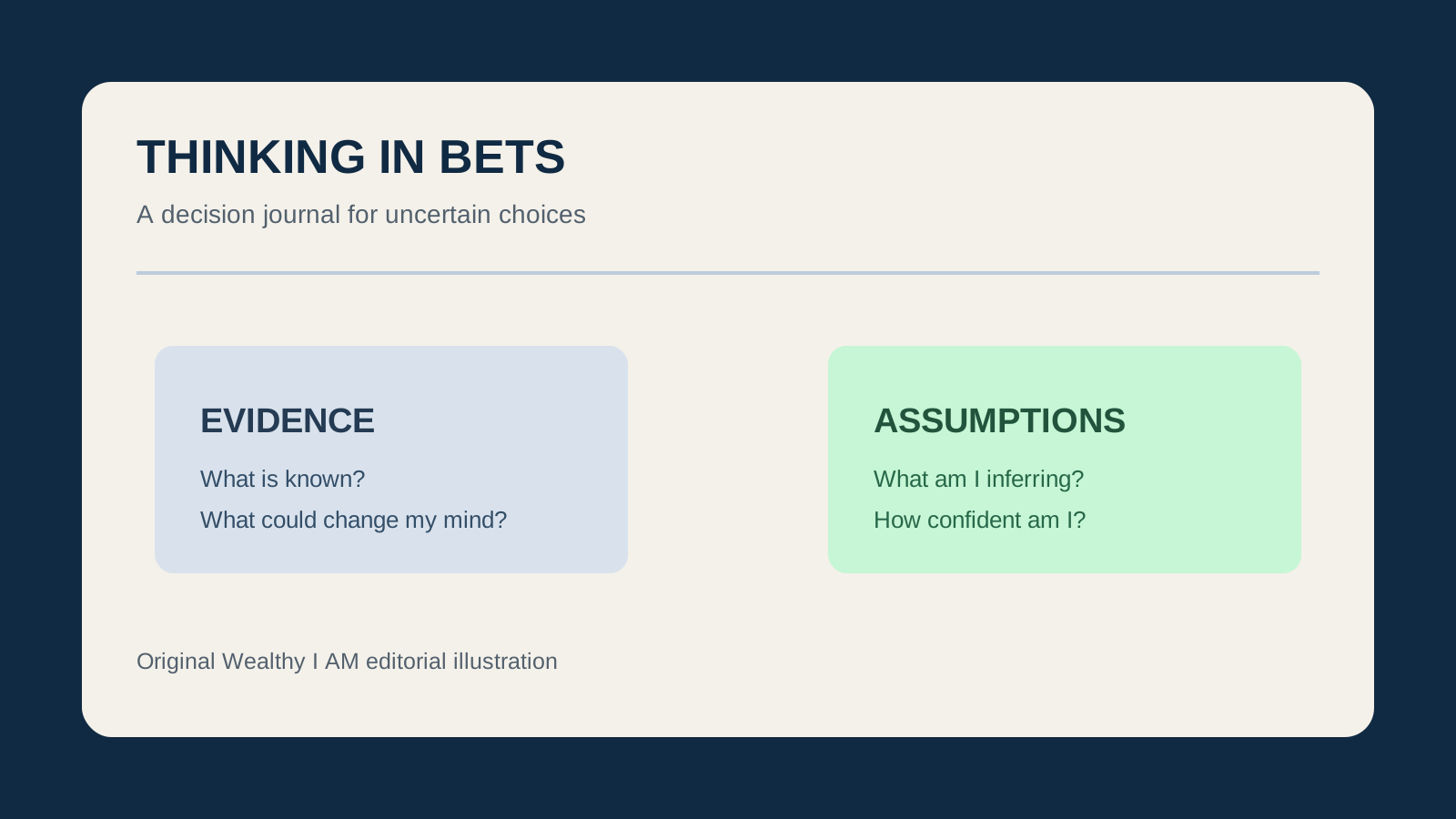
Leaders often create problems when they pretend to know everything. Brown encourages better questions and genuine curiosity. In practice, replace an assumption with an investigation: “What am I missing?” “What would the customer say?” or “What evidence would change my mind?” Better questions reduce expensive blind spots and help teams learn before small issues become costly ones.
2. Make tough conversations specific
Avoidance rarely makes a difficult issue disappear. It usually allows confusion, resentment, or poor performance to compound. A useful conversation names the observable situation, explains its impact, and asks for a clear next step. Focus on the behavior or decision—not a person’s character. Specificity protects relationships while making accountability possible.
3. Build trust in small deposits
Trust is not created by a single inspiring speech. It grows through repeated actions: keeping promises, protecting confidential information, giving credit, admitting mistakes, and following through. Think of trust as working capital. When it is strong, teams can move faster and take intelligent risks. When it is depleted, every decision requires extra friction.
4. Practice vulnerability with boundaries
Vulnerability does not mean sharing everything with everyone or abandoning standards. It means acknowledging uncertainty, asking for help, owning a mistake, or saying what matters when silence would be easier. Used responsibly, vulnerability makes it safer for others to surface problems early. That improves decision quality and prevents a culture where people hide bad news until it becomes expensive.
5. Turn values into observable behaviors
A company may say it values integrity, excellence, or respect, but values matter only when they guide choices. Define what the value looks like in a meeting, a customer interaction, a hiring decision, and a budget review. Observable values make culture practical. They also help leaders decide what to reward—and what behavior is too costly to tolerate.
Step-by-step: apply the lessons this week
- Write your leadership outcome. Choose one result that matters: retaining a key employee, improving customer service, finishing a project, or increasing reliable profit.
- List the avoided conversation. Identify the topic your team or household keeps circling around. Write the facts you know, the story you are telling yourself, and the question you need answered.
- Schedule a 30-minute conversation. Open with shared purpose, describe the specific issue, listen without interrupting, and agree on one action with an owner and date.
- Ask for one piece of feedback. Use a focused prompt: “What is one thing I do that helps our work, and one thing that makes it harder?” Receive the answer without defending yourself.
- Audit one trust commitment. Review a promise you made. Keep it, renegotiate it clearly, or explain why you cannot fulfill it. Reliability is more valuable than vague enthusiasm.
- Connect courage to money. Ask which decision would improve long-term value if you stopped optimizing for short-term comfort. It might be investing in training, ending an unprofitable offering, correcting a pricing problem, or building a healthier operating system.
- Review the result. At week’s end, note what became clearer, what action produced value, and what conversation still needs courage. Repeat the cycle.
How the ideas support wealth building
Courageous leadership does not guarantee financial success, and Brown’s book is not an investing manual. Its contribution is upstream: it improves the human systems that make good financial decisions more likely. Curiosity helps you test assumptions. Trust makes collaboration and customer relationships stronger. Clear accountability improves execution. Honest conversations expose waste, weak offers, and risks that would otherwise remain hidden.
These are compounding advantages. A leader who communicates clearly can retain talent. A team that can disagree respectfully can make better capital-allocation decisions. A founder who listens closely can create a product customers actually value. Over time, those improvements can become durable income, reputation, and business equity.
Important balance
The book’s message should not be confused with “be fearless.” Fear can contain useful information. Courage means acting in alignment with values while fear or uncertainty is present. It also does not mean tolerating harmful behavior in the name of openness. Good leadership combines empathy with boundaries, and vulnerability with responsibility.
Readers should also adapt the framework to their context. A small business, family, nonprofit, and large company have different constraints. The practical test is simple: does a principle help people tell the truth sooner, make better decisions, and take responsible action?
Bottom line
Dare to Lead argues that courage can be practiced, measured, and strengthened. For anyone building wealth through a career, a business, or leadership, the lesson is powerful: your ability to create value depends not only on technical skill, but also on how well you handle trust, uncertainty, feedback, and hard conversations. Choose curiosity, make commitments visible, and do the brave work that protects long-term value.
Sources and credits
- Brené Brown — official Dare to Lead page
- Penguin Random House — publisher details and description
- Amazon.com — matched U.S. product page and cover source
Book cover credit: Amazon.com product imagery for the identified edition. This article is an original educational commentary and is not affiliated with the author or publisher.