Quick answer
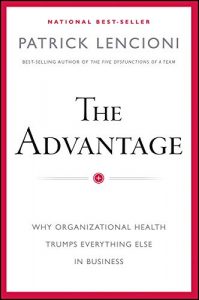
The Advantage: Why Organizational Health Trumps Everything Else in Business argues that a company can gain an important, underused advantage by becoming healthy: its leaders are cohesive, its priorities are clear, its message is consistently reinforced, and its people systems support the culture. The book is not a personal-finance manual or a promise of higher returns. Its wealth relevance is indirect but practical: healthier coordination can reduce costly confusion, improve execution, and protect the time and resources required to build a durable business.
This source-bounded overview takes about seven minutes to read. It is based on the verified bibliographic record and public book notes from Lead With Your Life, not a complete chapter-by-chapter summary. The available sources do not establish every example, quotation, or claim in the full book.
Who this is for: Founders, owners, and managers whose growth is being slowed by unclear decisions, recurring conflict, or work that keeps being redone.
What “organizational health” means
The public notes describe organizational health through wholeness, consistency, cohesion, clarity, and low internal politics. In plain language, healthy organizations make it easier for people to understand the priorities, disagree productively, decide, and act without constantly navigating hidden agendas.
That is different from organizational intelligence. A company may have talented people, a sophisticated strategy, or useful technology and still waste money when responsibilities are ambiguous or decisions do not stick. The book’s public framing places health alongside those capabilities rather than treating it as a substitute for sound products, demand, cash management, or competent operations.
Four source-bounded lessons
1. Build a leadership team that can disagree and commit
The public notes describe a leadership-team discipline centered on building a cohesive team. A team is not merely a list of senior employees. It is a group willing to debate important issues, resolve them, and support the resulting decision.
Why it matters for wealth: unresolved executive conflict consumes payroll, attention, and opportunities. It can also cause employees to pursue incompatible priorities. Faster agreement is not automatically better; the value comes from making the disagreement visible and then creating shared commitment.
Editorial application: At the next leadership meeting, name one decision that has been revisited repeatedly. Give the group a defined period to surface evidence, identify the owner, decide what will happen, and record what would justify reopening it. This is a practical application, not a claim that the author prescribes this exact exercise.
2. Replace vague values with operational clarity
The notes identify clarity as a major discipline and describe critical questions that healthy organizations reinforce. Rather than inventing or attributing a proprietary list, the safe takeaway is to make the organization’s answers explicit: Why does it exist? What does it do? What matters now? Who is responsible? How will progress be recognized?
Why it matters for wealth: clarity makes scarce resources easier to allocate. A small business that cannot say which customer problem it solves may spend on features, marketing, or hiring without a reliable connection to value creation.
Editorial application: Write a one-page operating brief with the current purpose, the most important goal, the three or four priorities supporting it, and a named owner for each. Ask a team member outside the leadership group to explain it back. If the explanation changes materially, the message is not yet clear.
3. Communicate the same priorities repeatedly
The public notes emphasize communication and the need to repeat important messages. Repetition can feel inefficient to leaders who already know the plan, but employees make decisions from what they understand—not from what exists in an executive’s head.
Why it matters for wealth: inconsistent communication creates hidden transaction costs. People duplicate work, delay decisions, and optimize local targets that may harm the company’s broader economics. A consistent message cannot fix a weak business model, but it can reduce avoidable friction.
Editorial application: At the end of each weekly update, state the current priority, what changed, what did not change, and the next decision required. Keep a dated record. This creates an audit trail for learning rather than pretending that every early decision was correct.
4. Align hiring, goals, feedback, and rewards
The notes describe human systems that reinforce clarity, including selection based on values, goal-setting, performance reviews, coaching, and compensation. The underlying idea is that culture is not just a poster or a founder’s intention; systems teach people what the organization actually rewards and tolerates.
Why it matters for wealth: a mismatch can be expensive. Hiring for speed while rewarding only short-term revenue, for example, may create quality problems or customer churn that are not visible in the initial sales figure.
Editorial application: Choose one important value and inspect one related process—hiring criteria, onboarding, performance conversations, or incentives. Ask whether the process rewards the behavior the company says it wants. Change one observable signal, then review the result rather than assuming culture changed immediately.
Meetings as an operating system
One of the most concrete themes in the public notes is that meetings are central to organizational health. The notes distinguish daily check-ins, tactical staff meetings, ad hoc issue meetings, and off-site reviews. The useful principle is not “have more meetings.” It is to give each meeting a clear purpose and avoid forcing administrative updates, urgent problems, and long-range strategy into one unfocused conversation.
A practical meeting map might look like this:
- Brief check-in: Share schedule changes, risks, and urgent information.
- Weekly operating review: Surface priorities, obstacles, and decisions requiring the leadership team.
- Issue meeting: Explore one significant problem until the group reaches a decision or a defined next test.
- Periodic strategy review: Step back from daily work to revisit priorities, assumptions, and organizational health.
This is Wealthy I AM’s editorial application of the source theme, not a verified reproduction of the book’s complete method. Track meeting outcomes, not meeting volume: decisions made, owners assigned, and unresolved issues carried forward.
A step-by-step organizational-health audit
Use this low-risk diagnostic before spending on a new initiative or adding complexity.
- Choose one business outcome. Examples include delivery reliability, customer retention, or profitable revenue—not “improve culture” alone.
- Interview the people doing the work. Ask what the priority is, who decides, what routinely gets delayed, and where rework begins.
- Compare answers. Differences reveal communication or clarity gaps; they are signals to investigate, not proof that a person is failing.
- Observe one decision meeting. Note whether the group debates the real issue, reaches closure, and communicates the result.
- Inspect one people system. Compare stated values with hiring, goals, feedback, promotion, and reward signals.
- Run one small change. Clarify one owner, revise one recurring meeting, or rewrite one priority statement.
- Review evidence after a defined interval. Look for fewer handoff failures, clearer ownership, or better delivery. Do not claim a causal financial result from a short experiment.
What the book does not prove
“Organizational health trumps everything else” is a strong title and source framing, not independent proof that health is always more important than strategy, product-market fit, capital, industry conditions, or technical capability. The available public notes cannot verify a universal ranking of business factors, a guaranteed profit effect, or a particular return on a management practice.
Healthy culture also has limits. A cohesive team can still make a bad decision. Clear priorities can clarify the wrong strategy. Consistent communication can spread an inaccurate assumption more efficiently. Leaders must continue testing customer demand, monitoring cash flow, managing legal and operational exposure, and adapting to competition.
Business and financial-education disclaimer: This article is general educational information, not individualized business, financial, investment, tax, legal, employment, or accounting advice. Organizational changes can affect employees, customers, contracts, and finances. Check applicable rules and records, and consult qualified professionals for consequential decisions. No result, revenue increase, profit, or wealth outcome is guaranteed.
Conclusion: make clarity compound
The source-bounded lesson from The Advantage is that organizational health is an economic capability, not merely a morale project. Cohesive leadership, clear priorities, repeated communication, aligned people systems, and purposeful meetings can make valuable work easier to execute. They cannot replace a viable offer or prudent financial management, but they can reduce the internal friction that quietly consumes both.
Your next step is simple: ask three people what the company’s most important current priority is, who owns it, and what decision is blocking progress. Compare the answers. The gap between them is a practical place to begin.
Sources and scope
- Lead With Your Life, public book notes for The Advantage: https://leadwithyourlife.com/book/the-advantage/
- ThriftBooks, bibliographic record for The Advantage: https://www.thriftbooks.com/w/the-advantage-why-organizational-health-trumps-everything-else-in-business_patrick-lencioni/260376
These sources support the title, author, 2012 publication context, and public-description themes concerning organizational health, cohesion, clarity, communication, human systems, and meetings. They do not establish complete-book coverage, every quotation, chapter detail, study, or guaranteed business outcome. Practical audit steps and examples are editorial applications.