Building wealth begins with learning how ownership works. In Learn to Earn: A Beginner’s Guide to the Basics of Investing and Business, Peter Lynch and John Rothchild make the stock market and business world less intimidating by starting with fundamentals. Their message is encouraging: you do not need to begin as a financial expert. You need curiosity, patience, and a repeatable way to study what you own.
The book is especially useful for new investors because it connects everyday products and companies with the idea of ownership. Instead of treating a stock symbol as a mysterious price chart, Lynch and Rothchild invite readers to ask what a business sells, how it earns money, and whether it can keep creating value. That perspective can turn investing from guessing into informed participation.
What the book teaches
Learn to Earn introduces the language of business, markets, stocks, bonds, mutual funds, and company analysis. It explains why a share represents a fractional ownership interest, why companies raise capital, and why prices can move for reasons that have little to do with a business’s underlying progress in the short run.
The authors also emphasize that an investor should understand the company behind an investment. A familiar product is not automatically a great stock, but familiarity can be a starting point for research. The goal is to move from recognition to evidence: sales, profits, competition, debt, management, and valuation all matter.
One practical benefit of this approach is that it improves the quality of everyday financial conversations. When you understand how a business makes money, you can ask better questions about a retirement fund, a new employer, a side hustle, or a headline promising quick returns. Financial confidence is not certainty; it is the ability to investigate, compare alternatives, and act without pretending to know the future.
Seven practical lessons for building wealth
1. Learn the business before you buy the ticker
A stock is not merely a line moving up and down. It is a claim on a real enterprise. Before investing, explain in plain English what the company does, who pays it, and why customers choose it. If you cannot describe the business simply, your first step is research, not purchase.
2. Start with observation, then verify
Lynch’s accessible approach often begins with noticing businesses in ordinary life. That can help you generate ideas, but observation is only the opening filter. Check annual reports, financial statements, competitive position, debt levels, and the company’s ability to produce cash. A good product can still be a poor investment if the price is unreasonable.
3. Separate a company from its stock price
Businesses and market quotes are related, but they are not identical. A strong company can be overpriced, and a struggling company can temporarily look cheap. Write down your estimate of the business’s earning power before allowing a daily quote to dictate your opinion. This habit encourages independent judgment.
4. Make time your ally
Long-term investing is not passive ignorance; it is active patience. Compounding needs time, and frequent trading creates costs, taxes, and more opportunities for emotional mistakes. Choose a sensible process, diversify appropriately, and give sound decisions enough time to work. No process removes risk, and past performance does not guarantee future results.
5. Know what you own
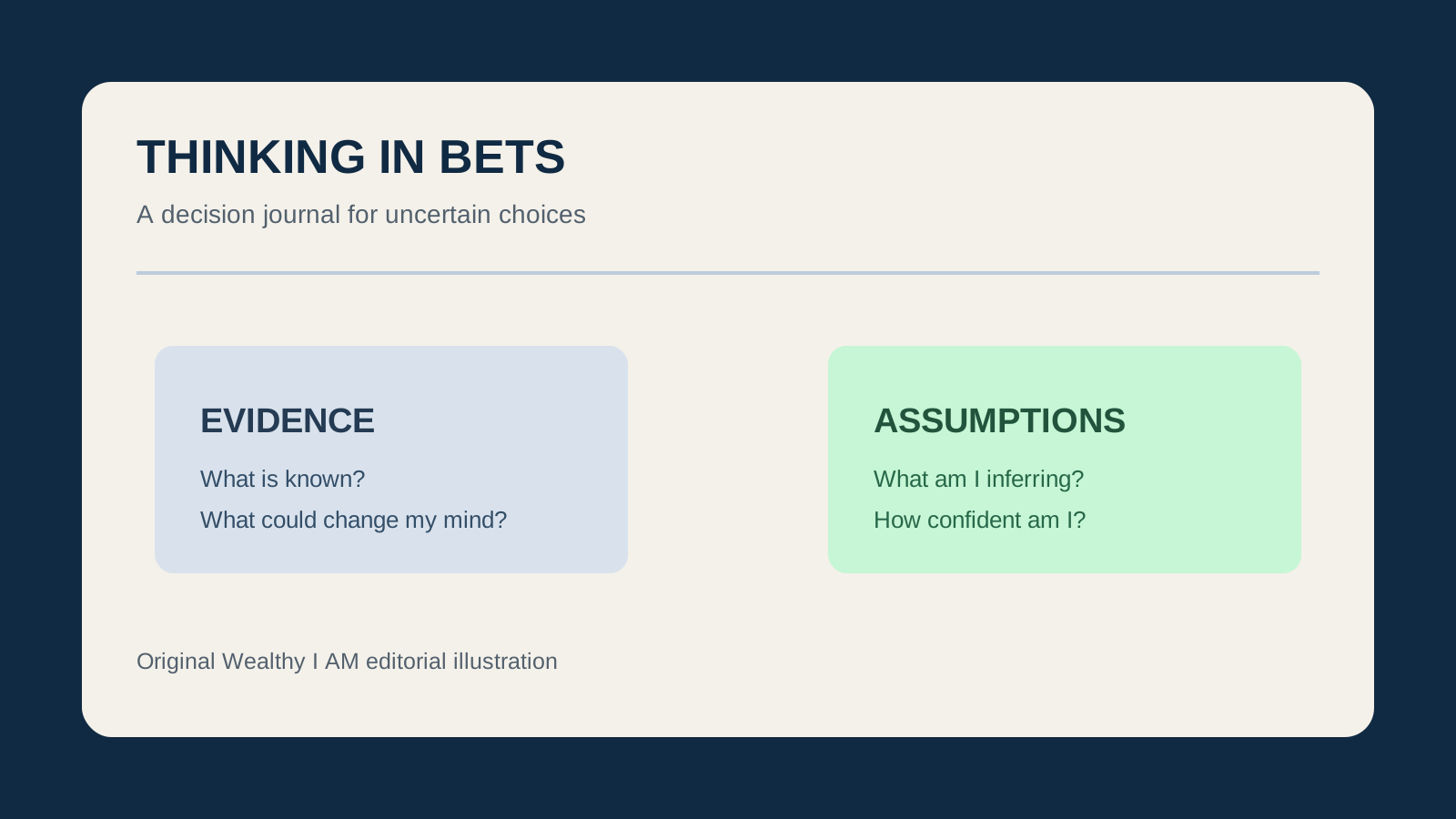
Keep a short written thesis for every investment: what makes the business attractive, what could go wrong, and what evidence would change your mind. Review the thesis when material facts change rather than reacting to every headline. Knowing what you own makes it easier to distinguish business news from market noise.
6. Respect different kinds of risk
Risk is not only a falling price. It can include permanent loss of capital, excessive debt, weak competition, poor management, concentration, and paying too much. A beginner’s portfolio should match the investor’s time horizon, goals, and ability to withstand volatility. Education is valuable, but it is not a substitute for a diversified plan.
7. Build financial literacy beyond investing
The book’s business foundation applies outside the brokerage account. Learn how revenue, expenses, margins, inventory, cash flow, and capital investment work. These concepts help you evaluate employers, side businesses, entrepreneurs, and the economic claims behind financial advice. Better questions lead to better decisions.
A step-by-step beginner’s plan
- Define the goal: Decide whether the money is for retirement, a home, education, or another time horizon. Your goal determines how much volatility may be appropriate.
- Strengthen the foundation: Build an emergency reserve, control high-cost debt, and understand account fees before taking unnecessary market risk.
- Learn the vocabulary: Spend one week learning revenue, earnings, cash flow, valuation, diversification, and expense ratio.
- Study three businesses: Choose companies you understand and write a one-page summary for each. Compare their growth, profitability, debt, competitors, and valuation.
- Choose a repeatable portfolio process: Many beginners benefit from diversified, low-cost investments and regular contributions rather than trying to predict every market move. Consider professional advice for personal circumstances.
- Review on a schedule: Check your allocation and investment thesis quarterly or semiannually. Avoid turning every market headline into an instruction.
What to be careful about
Learn to Earn is an introduction, not a promise of easy profits. A company that looks familiar may face disruption, regulation, competition, or a valuation that already assumes years of success. Markets can fall sharply, and even careful analysis can be wrong. Readers should also remember that a book published in 1995 predates today’s index-fund landscape, online trading tools, and many modern industries. Its principles are useful, but its examples need current verification.
Bottom line
Peter Lynch and John Rothchild’s most valuable lesson is that investing becomes more approachable when you learn to see businesses clearly. Start with questions, not predictions. Study ownership, economics, competition, and price. Then create a diversified, patient process that fits your real life. Financial knowledge compounds too: every annual report understood, fee avoided, and impulsive decision declined can improve the odds of building durable wealth.
Sources & credit
- Amazon.com product page — matched U.S. product listing, ISBN 0684811634 / 9780684811635.
- Open Library bibliographic record — title and author reference.
- Google Books record — edition and bibliographic reference.
- Cover image — exact ISBN-matched cover image; credit to the publisher/rightsholder.