Entrepreneurs often ask whether people like an idea. That question feels natural, but it produces unreliable answers: friends want to encourage you, prospects want to be polite, and everyone is better at describing the past than predicting the future. In The Mom Test, Rob Fitzpatrick offers a practical way to learn what customers actually need before spending months building the wrong product.
The book’s wealth lesson is direct: good customer conversations reduce wasted time and capital. They help a founder find a painful problem, identify buyers who already try to solve it, and design an offer around evidence rather than compliments.

Book facts
- Title: The Mom Test: How to Talk to Customers & Learn If Your Business Is a Good Idea When Everyone Is Lying to You
- Author: Rob Fitzpatrick
- First published: 2013
- Core topics: customer discovery, interviewing, validation, product-market fit, and entrepreneurship
The central idea
Never make the conversation about whether people like your idea. Make it about their life, their current problems, and what they already do. A customer who says “that sounds great” has given you encouragement, not evidence. A customer who explains a recent problem, shows an existing workaround, or commits time and money has given you something you can test.
Lesson 1: Talk about the customer’s life
Ask about routines, frustrations, tools, budgets, and recent events. Do not lead with a pitch. Your first job is to understand the world as it exists now, not to persuade someone to imagine a future product.
Lesson 2: Ask about the past, not the future
“Would you use this?” invites a polite guess. “How did you handle the last time this happened?” reveals behavior. Past actions are stronger evidence than predictions, especially when money and effort are involved.
Lesson 3: Listen for commitment
Real demand usually costs something: time for a follow-up, access to data, an introduction, a trial, or payment. Compliments are easy; commitment is scarce. Treat the difference as a protection for your resources.
Lesson 4: Keep the conversation casual
Use a short list of learning goals, not a rigid questionnaire. Follow interesting details and ask “why?” several times. The best insight may appear in an example the customer mentions casually.
Step-by-step customer discovery plan
- Choose a narrow customer group. Start with people who share a context and a problem, rather than “everyone.”
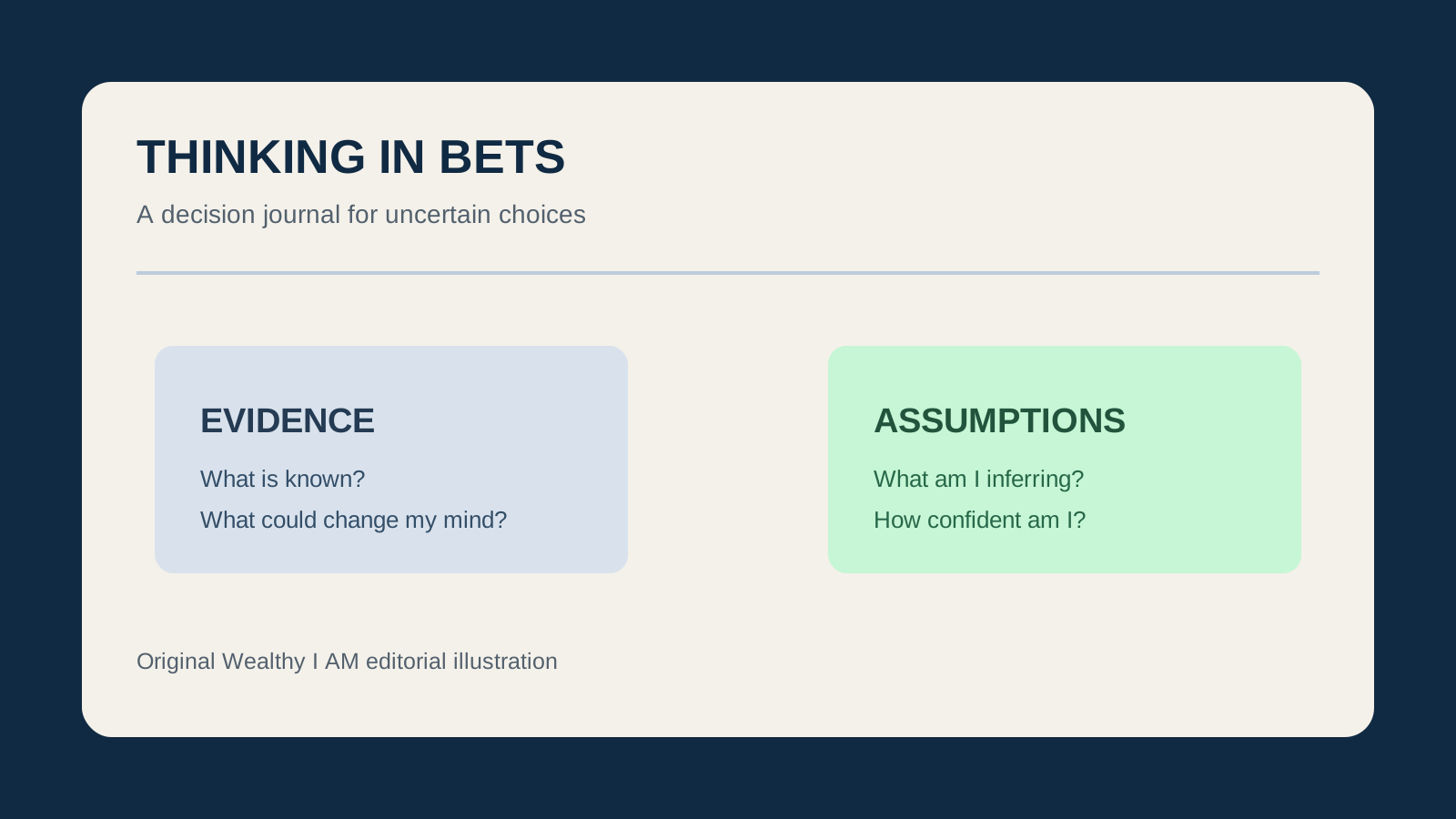
- Write three learning goals. Decide what must be true for the business to make sense. Include questions that could disprove your idea.
- Recruit recent problem-havers. Look for people who encountered the problem recently, not just people who say it sounds interesting.
- Ask for stories. What happened last time? What did they try? What did it cost? Who decided? Listen more than you speak.
- Record facts separately from interpretation. Note exact behavior, existing alternatives, urgency, and spending before writing your conclusion.
- Test a small next step. Offer a manual pilot, paid consultation, prototype, or other reversible experiment. Measure action, not enthusiasm.
- Update the offer. If the problem is weak or the customer already has a good solution, change direction early. Learning that prevents a bad investment is a win.
How this builds wealth
Customer discovery is not only a startup technique. It is a capital-allocation habit. Every hour and dollar spent on an untested assumption has an opportunity cost. Better conversations increase the odds that a product earns revenue, a service finds repeat buyers, and a small business grows from genuine value rather than expensive promotion.
The method also improves careers. Before creating a course, freelancing offer, or side business, speak with people who have the problem. Their language can sharpen your positioning, reveal what outcomes matter, and help you invest in a skill with a real market.
What to be careful about
The book is a guide to learning, not a guarantee of product-market fit. Customers can still be mistaken, markets can change, and a small sample can mislead. Use conversations alongside observation, competitive research, pricing tests, and financial discipline. Do not treat one enthusiastic interview as proof.
Bottom line
The Mom Test teaches a simple but valuable discipline: replace compliments with evidence. Ask about real behavior, listen for pain and urgency, and request a meaningful next step. For a founder or professional building wealth, that discipline can prevent wasted effort and turn customer understanding into a more durable business.
Sources and credits
- Google Books bibliographic page — title, author, 2013 edition, and ISBN 1492180742.
- Amazon.com product page — matched U.S. product reference.
- Official Mom Test website — author and book context.
- Cover credit: Google Books cover image for the matched 2013 edition.
This is an original educational article about the book and is not affiliated with the author, publisher, or Amazon.