Building wealth does not require predicting every market move. It requires making a small number of understandable decisions, protecting yourself from permanent loss, and having the patience to let good choices compound. In The Dhandho Investor, Mohnish Pabrai presents a value-investing framework built around that idea: seek situations where the downside is limited and the upside is meaningfully larger.
The title comes from “dhandho,” a Gujarati word associated with business. Pabrai uses the success of entrepreneurial Patel families in the motel business as a starting point for discussing capital allocation: buy understandable assets at attractive prices, keep risks visible, and avoid unnecessary complexity. The book is not a promise of easy returns. It is a disciplined way to ask what can go wrong before asking how much can be made.

Book facts
- Title: The Dhandho Investor: The Low-Risk Value Method to High Returns
- Author: Mohnish Pabrai
- First published: 2007
- Verified edition: Wiley hardcover, ISBN 9780470043899
- Core subjects: Value investing, intrinsic value, margin of safety, concentration, arbitrage, and capital allocation.
The central idea: heads I win, tails I do not lose much
Pabrai’s memorable phrase captures the Dhandho mindset. A good investment does not need a guaranteed outcome. It needs an attractive balance between possible gain and possible loss. If the downside is protected by a low purchase price, durable cash flow, or valuable assets, the investor can tolerate uncertainty without making a reckless bet.
That is different from buying something merely because it is popular or rising. Price matters because it creates a buffer between what you pay and what the business may ultimately be worth. That buffer is called a margin of safety: a cushion that gives you room for imperfect forecasts, bad luck, or ordinary business setbacks.
Five practical lessons from the book
1. Prefer simple businesses you can understand
Complexity can hide risk. Pabrai encourages investors to focus on businesses whose products, customers, economics, and competitive position can be explained in plain language. If you cannot describe how a company makes money, what could damage it, and why customers return, you may not have enough understanding to invest confidently.
Action: Write a one-page business summary before buying any investment. Include the revenue engine, major costs, competitive advantages, key risks, and the conditions that would prove your thesis wrong.
2. Demand a margin of safety
Intrinsic value is an estimate of what an asset is worth based on its future cash generation and assets. Because that estimate is uncertain, paying the full optimistic value leaves little room for error. A lower price can improve the odds even when the future is not perfectly predictable.
Action: Create a conservative valuation range rather than one precise number. Use cautious assumptions, compare the price with the low end of your range, and pass when the cushion is too small.
3. Look for asymmetric outcomes
An asymmetric opportunity has an uneven payoff: a manageable loss if the thesis fails and a substantial gain if it works. This is the practical meaning of “low risk, high return.” It does not mean there is no risk; it means the potential reward is large relative to the capital placed at risk.
Action: Before investing, write three scenarios—bad, ordinary, and good. Estimate not only returns but also how much capital could be permanently lost in the bad case. Reject opportunities where a bad outcome could seriously damage your finances.
4. Make few bets, but make them thoughtful
The book challenges the idea that owning more names automatically makes an investor safer. Pabrai discusses “few bets, big bets, infrequent bets,” emphasizing that an investor should act only when the opportunity is unusually attractive and understandable. Concentration can increase risk when used casually, so this lesson requires strong preparation and honest self-knowledge.
Action: Separate your “research list” from your “buy list.” Study widely, but invest only when a company clears your written standards for quality, price, downside, and position size. Never concentrate money you may need soon.
5. Let time and temperament do the work
Value investing often looks inactive. The investor may wait while prices move, ignore exciting stories, and allow a sound business to grow. Pabrai’s framework rewards patience because frequent action creates fees, taxes, mistakes, and emotional decisions.
Action: Define the conditions that would make you sell before you buy. Review the business and thesis on a schedule, not every time the market becomes noisy. A long holding period is not a virtue if the original facts have changed, but needless trading is not sophistication.
How to apply Dhandho thinking beyond stocks
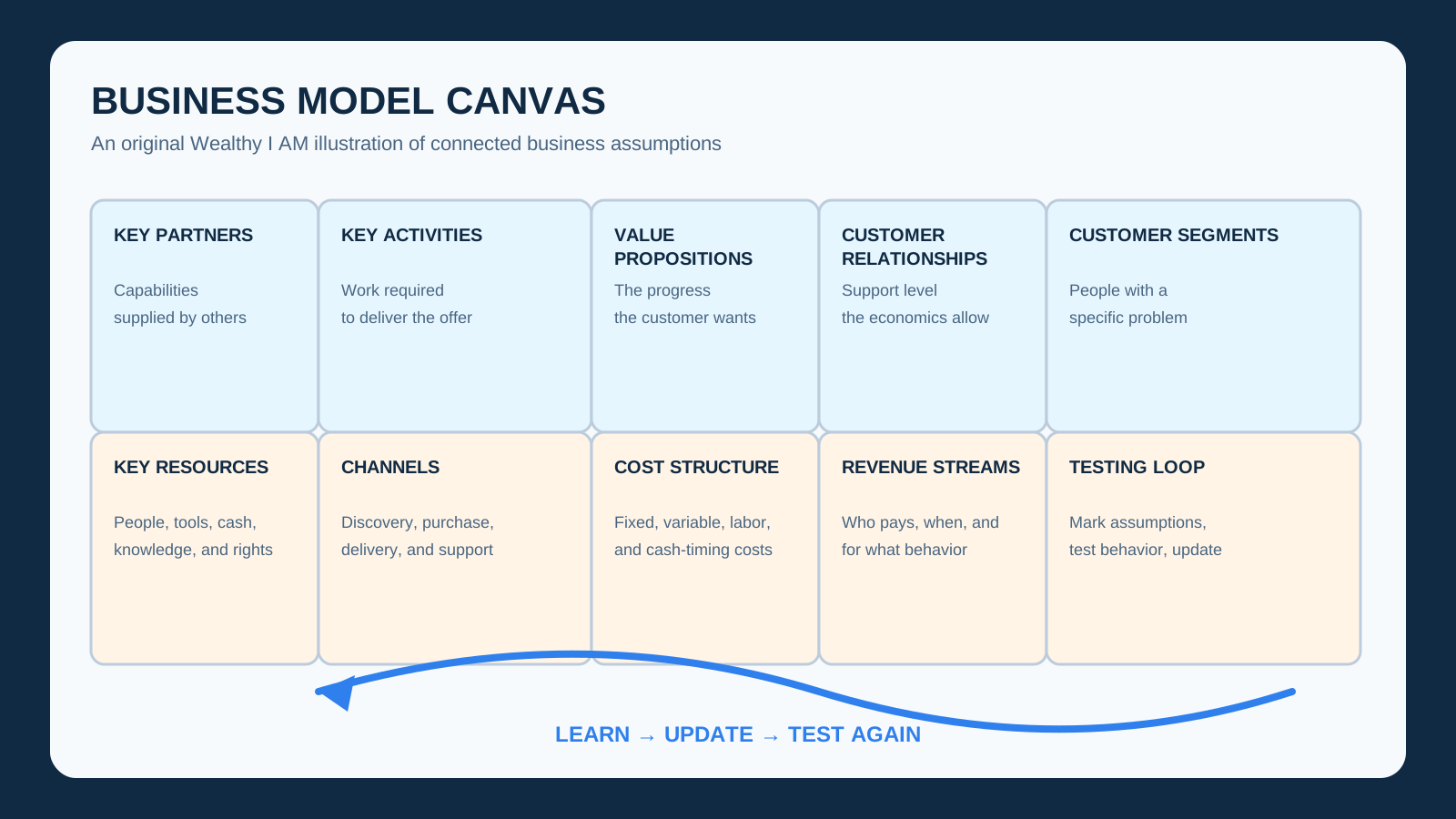
The same logic can improve everyday wealth decisions. When choosing a business idea, test demand with a small experiment before committing significant money. When changing careers, build a financial runway and develop a skill that increases your options. When taking on debt, ask whether the payment remains manageable under a bad-income scenario.
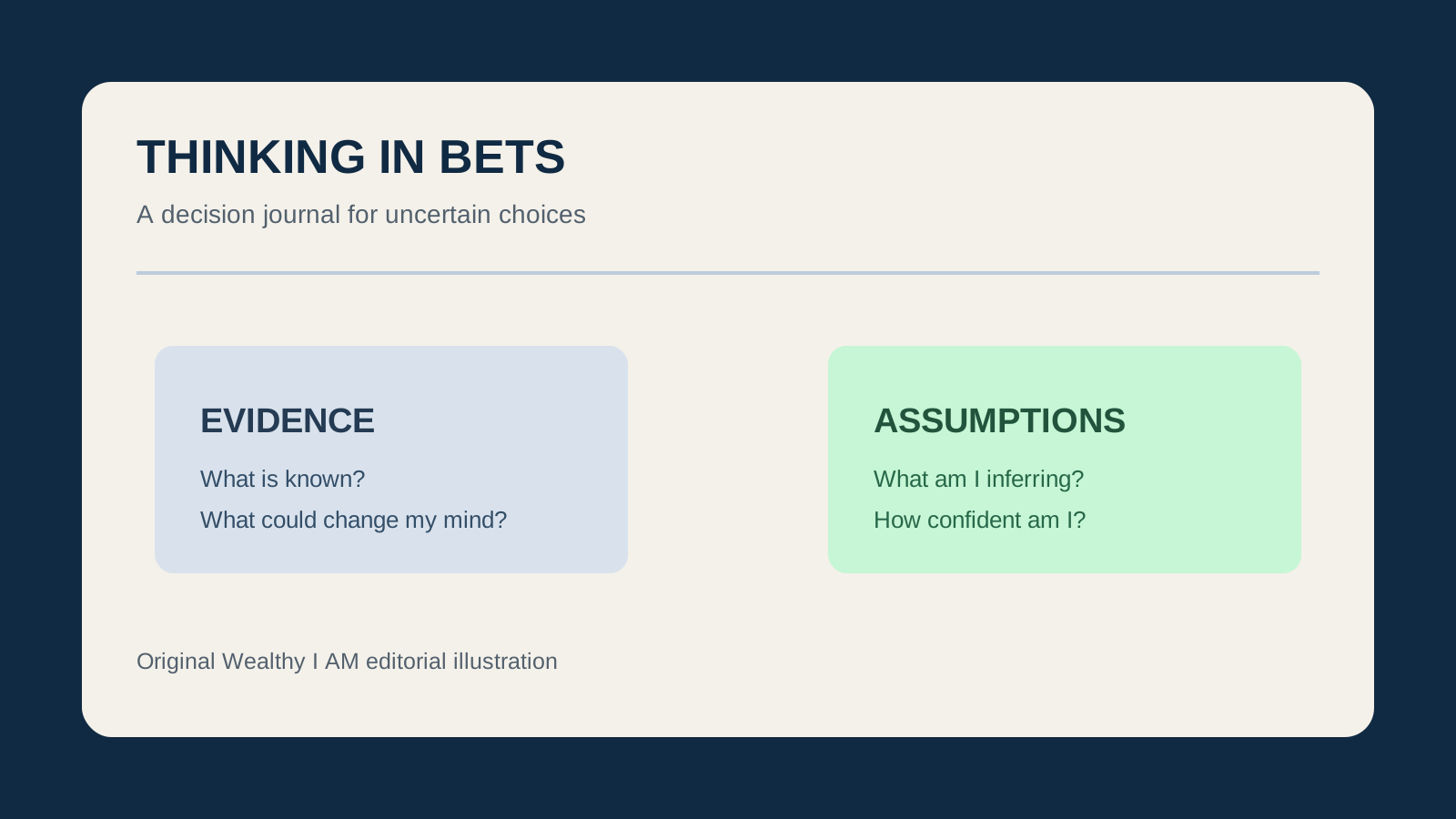
In each case, the questions are similar: What do I know? What am I assuming? What is the worst realistic outcome? Can I survive it? What would make the upside worth taking the risk? This is capital allocation applied to a household or a small business—not just a stock portfolio.
Important cautions
Pabrai’s ideas should not be mistaken for a shortcut or personal financial advice. Intrinsic value is an estimate, and concentrated investing can produce large losses. A person with high-interest debt, no emergency reserve, or a short time horizon may need basic financial stability before researching individual companies. Diversified, low-cost investments may be more appropriate for many long-term savers.
The book also discusses the Kelly formula, a mathematical approach to sizing bets. Position-sizing theories depend on assumptions about probabilities and outcomes that are difficult to estimate in real markets. Treat them as concepts to study, not as permission to risk money you cannot afford to lose.
A simple Dhandho checklist
- Can I explain how the asset or business creates value?
- What is my conservative estimate of intrinsic value?
- What protects me if my estimate is wrong?
- What is the realistic worst-case permanent loss?
- Is the upside large enough to justify the risk?
- Would I still own it if the market closed for a year?
- Does this decision fit my cash needs, diversification, and temperament?
Bottom line
The Dhandho Investor offers a clear, memorable framework for thinking about risk and reward. Its deepest lesson is not to chase high returns in isolation. It is to seek favorable odds, pay less than value when possible, protect against permanent loss, and wait for opportunities that deserve your capital. Used with humility, diversification where appropriate, and careful research, Dhandho thinking can make wealth-building decisions more deliberate and resilient.
Sources & credit
- Wiley publisher page — title, author, publication details, ISBN, and book description.
- Google Books record — bibliographic verification and synopsis.
- Amazon.com product page — matched U.S. product listing.
- Cover image — Amazon.com product image for ISBN 9780470043899; credit to the publisher/rightsholder.