Quick answer
The Long Game: How to Be a Long-Term Thinker in a Short-Term World argues that meaningful progress usually comes from strategic patience: making deliberate investments in relationships, skills, experiments, and opportunities even when they do not produce an immediate payoff. Dorie Clark contrasts this approach with the pressure to optimize every decision for speed, certainty, or visible results.
The book is relevant to wealth because careers and businesses create economic options over time. A stronger skill, trusted relationship, or tested business idea may improve future choices, but none guarantees income, customers, profit, or investment returns. This article uses the public description available from the book listing and the supplied bibliographic record; it does not claim to reproduce every chapter, story, framework, or exercise in the full book. The applications below are original Wealthy I AM interpretations.
Who this is for: professionals, founders, freelancers, and investors who are busy responding to immediate demands but want a safer way to build capabilities and options for the future.
Contents
- The central problem: short-term urgency
- Five lessons for building durable options
- A 90-day long-game experiment
- Limits and risks
- Sources and evidence boundary
The central problem: short-term urgency
Short-term thinking is not always irrational. A bill is due, a client needs an answer, and a business may need cash this month. The danger appears when every decision is judged only by immediate payoff. Under that rule, learning, relationship-building, preventive maintenance, and careful experimentation look wasteful because their benefits are delayed or uncertain.
The public description of The Long Game compares this personal problem with companies that emphasize quarterly results while neglecting strategic investment. The useful interpretation is not that short-term results never matter. It is that a healthy plan needs both operating needs and investments that preserve future choices.
For personal finance, an option is a future path you could take: a skill that qualifies you for better work, a cash reserve that lets you reject a bad opportunity, or a small validated service that might become a business. An option is not an asset with guaranteed value. It is a possibility whose usefulness depends on execution, timing, resources, and demand.
Five lessons from the book’s public description—and how to apply them carefully
1. Trade some urgency for deliberate investment
The book’s broad premise is that small actions repeated over time can have disproportionate future effects. That is a claim about a way of thinking, not a promise that every small action compounds financially.
Practical application: divide your weekly capacity into three buckets:
- Maintenance: essential work, bills, health needs, and responsibilities.
- Current value: work that serves existing customers, employers, or commitments.
- Future capacity: learning, relationship-building, process improvement, or a bounded experiment.
The percentages should fit your circumstances. Someone with unstable income, high-interest debt, or urgent caregiving responsibilities may need to emphasize maintenance. The point is to make future capacity visible without pretending it can replace essentials.
2. Build relationships before you need them
Long-term progress often depends on trust, not only individual effort. A useful professional relationship can lead to information, collaboration, feedback, or an opportunity. But treating people as a pipeline for personal gain is a poor version of relationship-building and can damage trust.
Try a contribution-first practice. Each week, contact one person with a relevant question, useful resource, thoughtful introduction, or sincere acknowledgment. Do not promise that networking will produce a job or client. Track whether conversations improve your understanding and whether the relationship becomes more reciprocal over time.
A simple boundary helps: respect the other person’s time, privacy, and ability to decline. Relationship-building is not permission to pressure, misrepresent expertise, or offer financial products without appropriate authorization.
3. Choose experiments that buy information, not fantasies
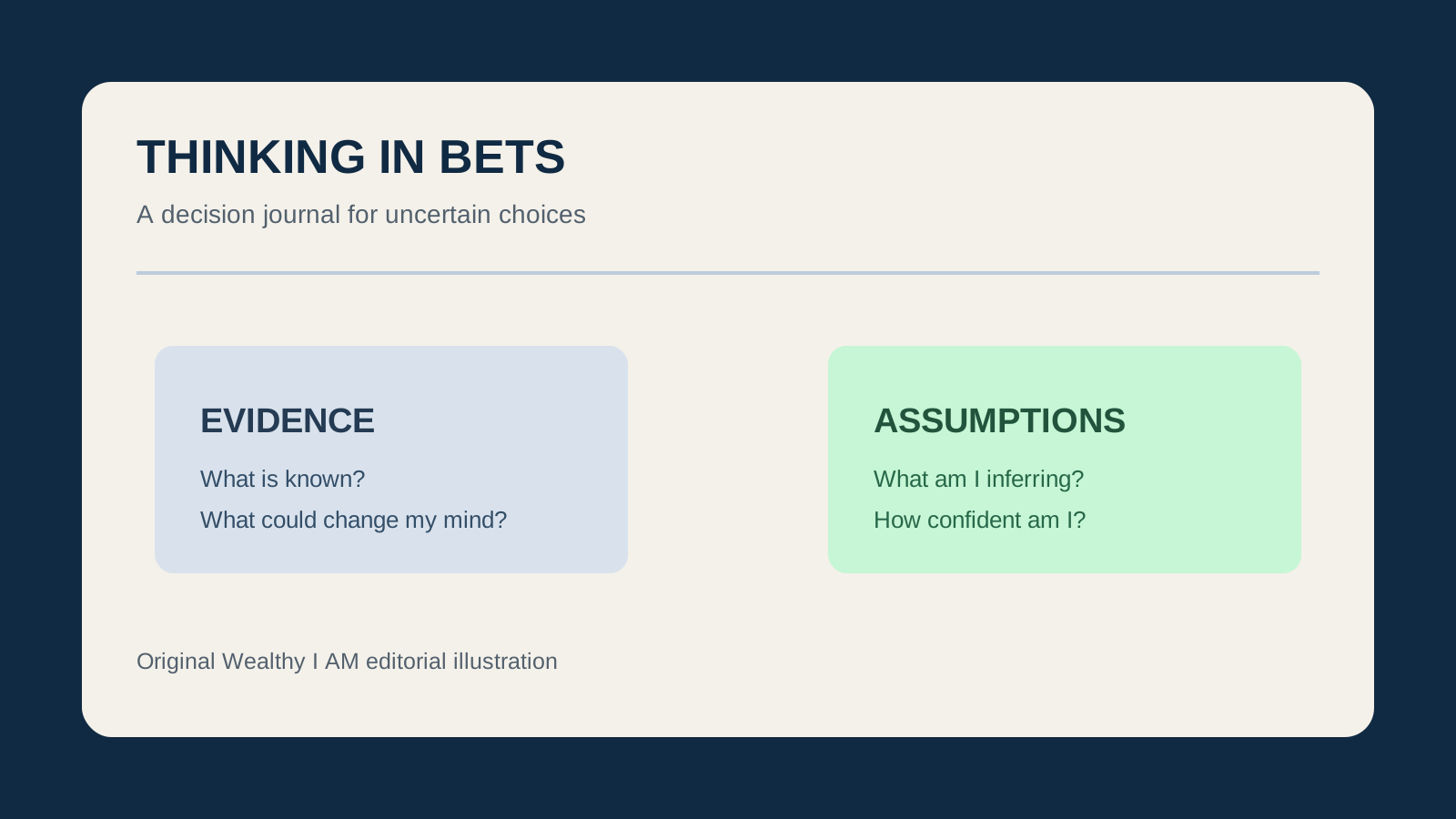
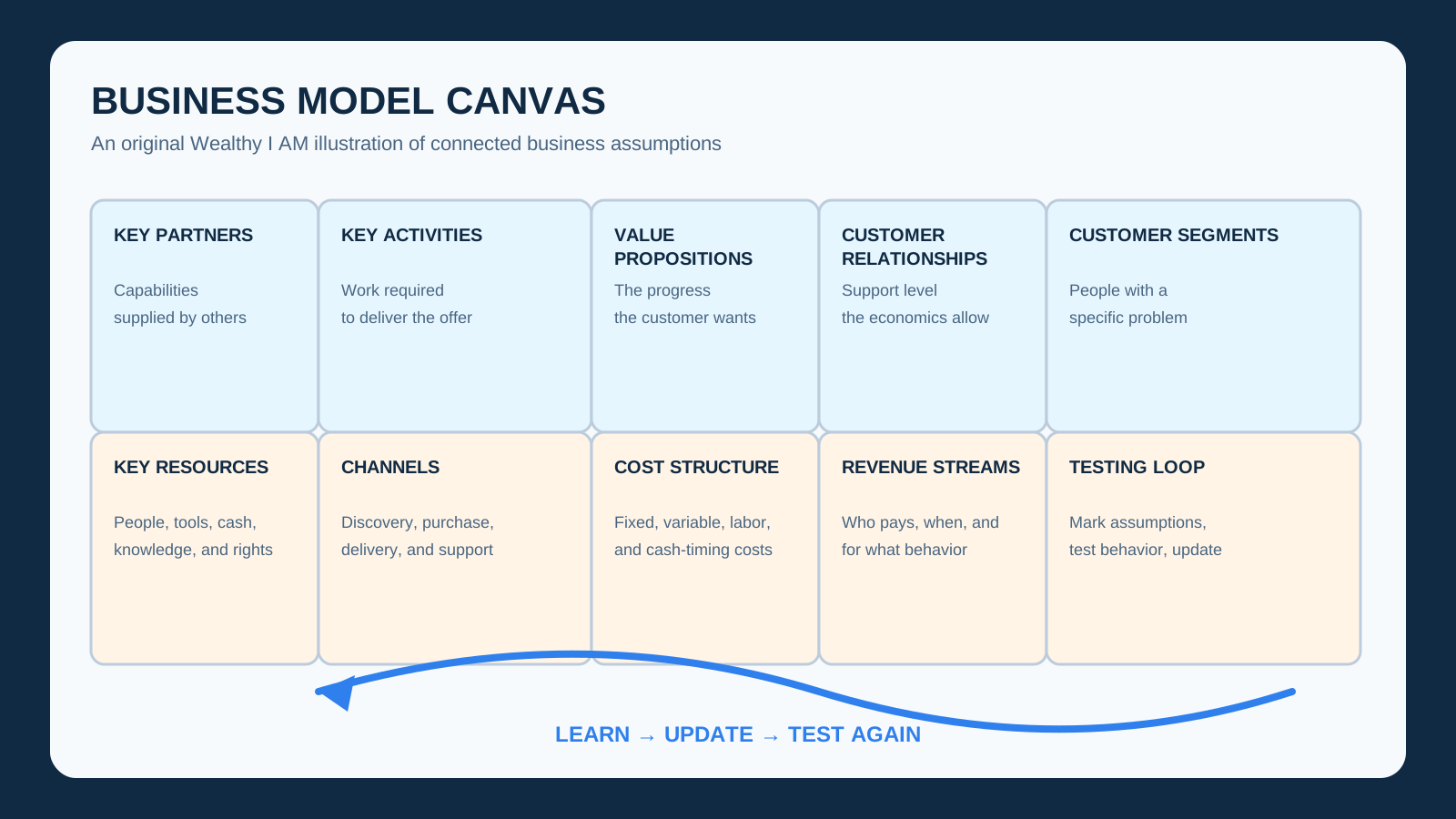
Long-term plans are exposed to uncertainty. A person may spend months preparing a product that nobody wants, or pursue a credential that does not improve their options. A small experiment can test an assumption before more time or money is committed.
Use this sequence:
- Write the assumption: “A defined group has this problem and may value this help.”
- Identify the cheapest responsible test that could change your mind.
- Set a time, money, and effort limit before beginning.
- Choose evidence in advance, such as completed interviews, repeat requests, or a paid pilot with clear terms.
- Decide whether to continue, revise, pause, or stop.
For example, a hypothetical freelance analyst could interview several potential users, publish a short sample, and offer one tightly scoped pilot before buying software or leaving employment. Any payment, taxes, licensing, privacy obligations, and employment restrictions must be handled appropriately. Early interest is evidence to examine, not a forecast of revenue.
4. Let your strategy survive boring seasons
The public description emphasizes persistence when progress feels pointless, boring, or hard. Persistence can be valuable, but it is not the same as refusing to update a bad plan. A long game needs a feedback loop.
Define a process measure and an outcome measure. A process measure might be hours of deliberate practice, applications sent, customer conversations, or monthly savings. An outcome measure might be qualified interviews, repeat demand, reduced costs, or improved work quality. Process measures are more controllable; outcome measures are often noisy.
Review both at a fixed interval. If effort is consistent but evidence remains weak, change the hypothesis or stop. If the outcome improves but the cost is harming sleep, health, relationships, or financial stability, redesign the process. A long horizon does not justify unlimited sacrifice.
5. Protect the ability to keep playing
A long-term strategy is fragile if one setback forces an irreversible decision. Financial resilience means preserving room to respond: avoid taking on obligations you cannot service, maintain appropriate liquidity for your situation, and distinguish speculative experiments from money needed for rent, debt payments, emergency needs, taxes, insurance, or health care.
This is not a recommendation for a specific savings amount or investment. Risk capacity differs by income stability, dependents, debt, legal obligations, and access to support. Before committing capital, ask what happens if the experiment earns nothing and takes twice as long as expected.
The same principle applies to career decisions. Test a new path through a portfolio project, conversation, course, or part-time pilot where feasible before making an irreversible move. A reversible step can preserve both learning and choice.
A 90-day long-game experiment
This is a Wealthy I AM application, not a stated program from Clark’s book.
Days 1–7: Select one option. Choose one capability, relationship, or business hypothesis that could improve your future choices. Write why it matters, what it will cost, and what would make it worth continuing.
Days 8–30: Establish a modest cadence. Schedule two or three realistic sessions per week. Keep the commitment small enough to protect essential work and health. Record time, direct spending, and what you learned.
Days 31–60: Test contact with reality. Share a sample, ask informed questions, seek feedback, or run a limited pilot. Use clear expectations and protect confidential information. Do not present hypothetical benefits as results.
Days 61–83: Improve or narrow. Keep what produces useful evidence. Remove activities that create motion without learning. If money is involved, calculate revenue separately from direct costs, taxes, fees, and the value of your time; revenue is not profit.
Days 84–90: Make a portfolio decision. Continue, modify, pause, or stop. Write the evidence behind the decision and the downside you are accepting. The experiment succeeds if it improves your decision quality, even if the answer is no.
What the book’s message leaves out
A long-game framework can sound more available than it is. People differ in health, safety, immigration status, family responsibilities, discrimination, capital, time, networks, and access to education or markets. Strategic patience cannot erase those constraints, and advice to wait for a payoff may be inappropriate when immediate income is necessary.
The public listing supports the book’s identity and broad themes, but it does not independently verify every claim about research, named examples, chapter structure, or outcomes. Readers who need the complete framework should consult the full book rather than treating this article as a substitute.
Long-term investing also carries market, inflation, liquidity, concentration, and loss risks. This article does not recommend a security, asset allocation, business, or tax strategy. Financial, tax, legal, accounting, employment, medical, and mental-health decisions depend on individual circumstances and jurisdiction; consult a qualified professional when appropriate. This is general education, not individualized financial advice.
Conclusion: make one choice your future self can still use
The practical value of The Long Game is its challenge to automatic urgency. Meet today’s obligations, but reserve a realistic amount of attention for the skills, relationships, experiments, and resilience that may expand tomorrow’s choices.
Start with one 90-day option. Cap the downside, define evidence, review honestly, and stop or redesign if the cost becomes unacceptable. Strategic patience is not waiting passively or predicting wealth. It is making careful investments in future flexibility while staying solvent, healthy, and willing to learn.
Sources and evidence boundary
- Amazon Books listing: The Long Game by Dorie Clark — identifies the title and author and provides the public description about long-term strategy, small changes, persistence, and resisting short-term pressure.
- O’Reilly bibliographic listing: The Long Game — supplied inventory source for the book’s bibliographic record and publication context.
These sources support bibliographic identity and broad public-description themes only. They do not establish every detail of the full book. No quotation, statistic, personal story, chapter claim, or guaranteed financial outcome is presented as verified here.
Safety note: Do not risk money required for essentials on an uncertain experiment. Get qualified, jurisdiction-specific advice for financial, tax, legal, accounting, employment, health, or mental-health decisions.