Quick answer
The Great CEO Within: The Tactical Guide to Company Building is an operating manual for founders and managers who need to turn a growing company into a coordinated organization. Matt Mochary’s central idea, as described in the public book listing, is that leadership can be trained through repeatable systems for accountability, problem-solving, feedback, and decision-making. The practical takeaway is not “work harder” or “grow at any cost.” It is to make important work visible, resolve obstacles deliberately, and build a company that does not depend on one person remembering everything.
This article is an original, source-bounded synthesis. Scope: about 1,800 words, focused on the book’s broad operating themes and cautious workplace applications—not a chapter-by-chapter reconstruction. The available evidence verifies the book’s identity, collaborators, and broad description, but does not establish every chapter, story, exercise, quotation, or prescription in the full text. The frameworks below are Wealthy I AM applications unless explicitly attributed to the public description.
Who this book may help
The book is most relevant to a founder whose business has outgrown informal coordination, a manager inheriting a team, or an operator trying to improve execution without adding needless complexity. It may be less useful as a first priority for someone who is still trying to establish a viable offer, meet essential personal expenses, or recover from a serious cash-flow problem. Management systems cannot substitute for demand, adequate resources, or sound judgment.
Contents
- The central problem: growth multiplies coordination costs
- Lesson 1: Make accountability observable
- Lesson 2: Treat problems as systems to solve
- Lesson 3: Make feedback specific and safe
- Lesson 4: Improve decisions without pretending to know the future
- Lesson 5: Build an operating rhythm that protects cash and people
- A low-risk 30-day implementation
- What the book’s public description does not prove
- Conclusion
The central problem: growth multiplies coordination costs
A small team can rely on context, memory, and quick conversations. As people, customers, projects, and commitments multiply, those informal methods become fragile. Priorities compete, decisions are revisited, weak signals stay hidden, and the founder becomes the default escalation point. The cost is not only frustration. Delays, rework, missed customer commitments, and unclear ownership can reduce the money left after expenses.
Mochary’s public description frames the book as guidance for scaling from startup to corporation through accountability, problem-solving, and transparent feedback. A cautious interpretation is that a company needs an operating system: a small set of shared practices that help people know what matters, who owns it, how problems are surfaced, and when decisions are revisited. This is a management application, not a promise of revenue or valuation growth.
Lesson 1: Make accountability observable
Accountability is not blame. In plain language, it means that a commitment has a clear owner, a definition of done, and a review point. “Improve marketing” is an aspiration. “Publish the approved customer interview summary by Friday and record three follow-up conversations” is an observable commitment.
A practical weekly commitment card can contain:
- Outcome: What must be different by the review date?
- Owner: One person responsible for moving it forward, even when others contribute.
- Evidence: What document, customer response, delivery, or measurement will show progress?
- Constraint: What budget, time, legal, privacy, or quality boundary applies?
- Next review: When will the team decide whether to continue, change, or stop?
For a small business, this may be a shared document rather than specialized software. The point is to reduce ambiguity. Do not use a metric as a substitute for judgment: a higher number of leads, calls, or hours does not automatically mean a healthier business. Pair activity measures with quality, customer, cash, and workload checks.
Lesson 2: Treat problems as systems to solve
When a deadline slips, the fastest emotional explanation is often that someone is careless. A problem-solving approach asks what made the failure likely. Was ownership unclear? Did approval wait in one person’s inbox? Was the estimate based on an untested assumption? Did the process require information nobody had?
A simple problem-solving loop is:
- Describe the gap between the expected and actual result without exaggeration.
- Identify the immediate cause and the condition that allowed it to recur.
- Choose the smallest process change likely to prevent a repeat.
- Assign an owner and a test date.
- Review the result and revise the process if the problem returns.
This is not an argument for endless meetings. A useful solution may be a checklist, a decision rule, a clearer handoff, or a limit on work in progress. The financial connection is indirect: fewer avoidable errors may protect time and cash, but no process change guarantees profit. A new system also has a cost, so test whether it saves more effort than it consumes.
Lesson 3: Make feedback specific and safe
Transparent feedback is valuable only when people can act on it. “Be more strategic” is difficult to use. “In yesterday’s client meeting, the proposal changed before the pricing assumption was confirmed; next time, state the assumption and ask for confirmation before presenting the final number” is more actionable.
A feedback conversation can follow this sequence:
- Ask permission to discuss the event.
- Describe what was observed, separating facts from interpretation.
- Explain the effect on the customer, team, schedule, quality, or risk.
- Ask how the other person saw the situation.
- Agree on one behavior to repeat or change.
- Set a follow-up point.
Psychological safety does not mean avoiding standards. It means people can raise a concern, admit uncertainty, or report a mistake without expecting humiliation or retaliation. Leaders must also respect privacy, employment obligations, cultural differences, and applicable law. A feedback system should not become covert surveillance or a reason to collect sensitive personal information unnecessarily.
Lesson 4: Improve decisions without pretending to know the future
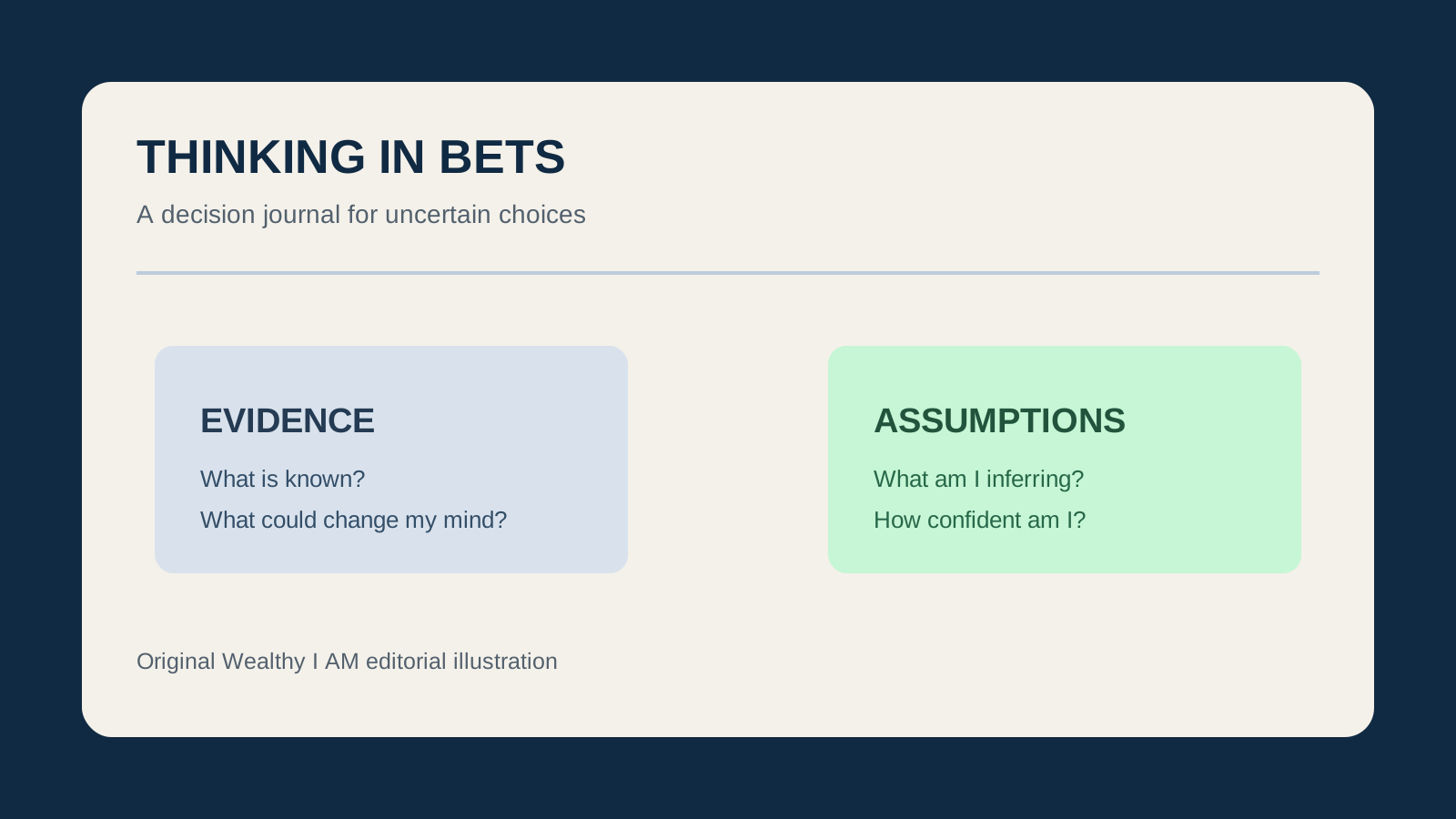
A company makes decisions with incomplete information. The goal is not to eliminate uncertainty; it is to make assumptions visible and keep mistakes proportionate to the stakes.
Before a significant decision, write a short decision record:
- What choice is being made, and by when?
- What facts are verified?
- Which assumptions are uncertain?
- What is the downside if the decision is wrong?
- Is the decision reversible, and what would trigger a review?
- Who has authority to decide and who needs to be consulted?
For a reversible choice—such as a limited customer test—speed may be useful. For an irreversible choice—such as signing a major lease, taking on debt, dismissing staff, or committing essential household funds—slow down and obtain appropriate professional advice. Do not confuse confidence with evidence, and do not use a book’s framework as a substitute for legal, tax, accounting, employment, or financial review.
Lesson 5: Build an operating rhythm that protects cash and people
A management system should help a company notice reality early. A lightweight rhythm might include a weekly priority review, a short cash check, a customer or quality signal, an unresolved-issues list, and a monthly review of what the team should stop doing.
A useful dashboard separates three kinds of information:
- Inputs: work the team controls, such as completed customer conversations or shipped improvements.
- Intermediate signals: evidence that the work may be helping, such as qualified requests, retention conversations, or cycle time.
- Outcomes: revenue, profit, cash balance, customer retention, or other results that are influenced by many variables.
Revenue is money received or earned from sales; profit is what remains after relevant costs, and cash timing can differ from both. Tracking one number alone can create false confidence. Include taxes, fees, refunds, payroll, debt obligations, concentration risk, and liquidity needs where relevant.
Protecting people is part of operating discipline. A process that improves output by sacrificing sleep, health, safety, or lawful working conditions is not a durable success system. Set workload boundaries and review whether the cadence is helping the team think clearly rather than merely creating more reporting.
A low-risk 30-day implementation
Do not attempt to install every management practice at once. For the first week, choose one recurring failure—missed handoffs, unclear approvals, or unresolved customer issues—and document the expected result, owner, evidence, and review date.
In week two, run the problem-solving loop on that failure. Keep the change small and reversible. In week three, hold one feedback conversation using observed behavior rather than character judgments. In week four, review evidence: what improved, what did not, what did the process cost, and what should be modified or stopped?
Set boundaries before starting. Use no essential household funds, do not borrow for this experiment, and do not leave employment or make an irreversible business commitment merely because a management book recommends action. If the business has immediate payroll, tax, debt, safety, or legal obligations, address those with qualified help first. A 30-day test can improve a process; it cannot validate an entire business model.
What the book’s public description does not prove
The public listing supports the book’s identity and broad themes of accountability, problem-solving, feedback, and scaling leadership. It does not independently verify a complete chapter list, exact sequence, named case studies, quotations, research findings, or the effectiveness of every tool. Those claims require the full text or an authoritative preview.
The book’s tactical orientation may also understate constraints that managers cannot solve with better meetings: weak demand, inadequate capital, discrimination, unstable employment, health limitations, family responsibilities, regulatory duties, or a market that does not support the offer. Organizational systems are aids to judgment, not guarantees of growth, wealth, or wellbeing.
Conclusion
The most useful lesson from The Great CEO Within is a shift from heroic management to visible, repeatable operating practices. Clarify ownership, investigate recurring problems, make feedback actionable, record assumptions, and review both results and human cost. Start with one costly coordination failure and run a bounded test for 30 days. Keep the change only if the evidence shows that it improves the work without creating larger financial, legal, privacy, or health risks.
Financial and health safety note
This article is general education, not individualized financial, investment, legal, tax, accounting, employment, medical, or mental-health advice. Business and investing decisions can lose money; consult appropriately qualified professionals for circumstances that require specialized guidance. Protect essential funds, personal data, sleep, health, safety, and legal obligations.
Sources and evidence boundary
- Google Books, The Great CEO Within: The Tactical Guide to Company Building by Matt Mochary: https://books.google.com/books/about/The_Great_CEO_Within.html?id=Y3abywEACAAJ
- Inventory record used for bibliographic identity and broad description: the internal bibliographic inventory
- The practical frameworks, 30-day implementation, dashboard distinctions, and risk controls in this article are original Wealthy I AM applications, not presented as verified quotations or as the book’s exact complete method.