Quick answer
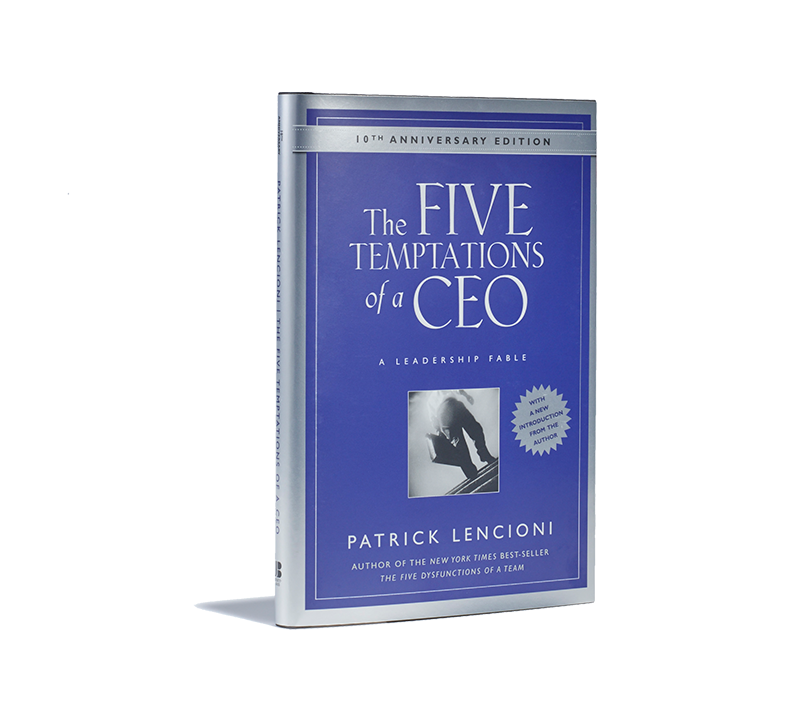
The Five Temptations of a CEO: A Leadership Fable presents executive leadership as a set of choices between self-protection and responsibility for organizational results. The public model on The Table Group’s book page identifies five temptations, in order: Status, Popularity, Certainty, Harmony, and Invulnerability. It pairs them with five strategies: Focus on results, Hold people accountable, Provide clarity, Establish productive conflict, and Build trust.
In plain language, the model asks a CEO to resist protecting rank, approval, the feeling of knowing, superficial peace, or an image of strength when doing so harms the organization. The five labels and pairings above are a summary of the public model, not quotations from the book. The plot, exact chapter wording, dialogue, and any named exercises are outside this article’s verified evidence. The decision tools and examples below are original Wealthy I AM applications, not tools presented as having been created by Patrick Lencioni.
Who this book may help
The book may help a founder, executive, or small-business owner who makes decisions under pressure and wants a compact way to notice self-protective behavior. It is especially relevant when a leader is focused on looking successful, avoids a difficult accountability conversation, waits for certainty before choosing, suppresses disagreement, or treats vulnerability as a threat to authority.
It is not a substitute for market research, cash-flow management, professional advice, or a realistic assessment of whether a business has a viable offer. Better leadership processes can support organizational health, but they do not guarantee revenue, profit, career advancement, or wealth.
Contents
- The framework: five temptations and five strategies
- Temptation 1: Status versus focusing on results
- Temptation 2: Popularity versus holding people accountable
- Temptation 3: Certainty versus providing clarity
- Temptation 4: Harmony versus establishing productive conflict
- Temptation 5: Invulnerability versus building trust
- A practical trade-off review
- Limits and evidence boundaries
- Conclusion
The framework: five temptations and five strategies
A chief executive has unusual authority, but also unusual exposure. Employees may soften bad news, customers may receive promises the business cannot keep, and the leader’s identity may become tied to being right. The public model can be read as a warning that the CEO’s personal incentives may pull attention away from the organization’s needs.
The temptations are not claims that status, popularity, certainty, harmony, or confidence are always bad. They become risks when a leader protects those things at the expense of the corresponding responsibility: results, accountability, clarity, productive conflict, or trust. The practical question is: What am I trying to protect, and what responsibility might that protection be displacing?
Temptation 1: Status versus focusing on results
Status can make leadership feel like a personal scorecard. A CEO may prioritize looking important, preserving authority, receiving credit, or avoiding work that seems beneath the role. That focus can distract from whether the organization is serving customers, meeting commitments, improving quality, and meeting its obligations.
The public strategy paired with Status is Focus on results. Results need careful definition. Revenue is money from sales; profit is revenue minus relevant costs; cash timing is when money enters or leaves the account. These measures can move in different directions. Celebrating sales while ignoring refunds, taxes, payroll, debt obligations, or liquidity needs may protect an image rather than the business.
Wealthy I AM application: the organization-first review
Review a consequential decision through three layers:
- Purpose: Who is the organization serving, and what problem is it responsible for addressing?
- Durability: What must remain true for the business to meet obligations over time?
- Signals: Which customer, quality, process, cash, and people indicators deserve attention before headline results?
This is a management prompt, not investment or asset-allocation advice. Demand, regulation, taxes, financing terms, and concentration risk can change the consequences of a decision. Seek qualified legal, tax, accounting, employment, or financial advice when needed.
Temptation 2: Popularity versus holding people accountable
A CEO may avoid holding someone accountable because the conversation could damage the relationship or reduce the leader’s approval. Short-term popularity can then replace clear standards. The public strategy paired with Popularity is Hold people accountable.
Accountability is not humiliation or public blame. It means making the expected result, owner, evidence, and follow-up visible—and applying the standard consistently. A respectful conversation can name the gap, ask what caused it, identify support or constraints, and agree on a review date. The leader should also examine whether the standard was clear and achievable.
Accountability should respect employment obligations, privacy, disability, culture, and applicable law. It also requires distinguishing a performance problem from inadequate resources, unclear authority, unsafe conditions, discrimination, or a process that makes the desired result difficult to achieve.
Wealthy I AM application: the commitment ledger
For an important commitment, record the owner, promised outcome, evidence of completion, constraints, support needed, and review date. Use the record to make follow-up less personal and more specific. Keep sensitive personnel information restricted to people with a legitimate need to know; this is an editorial management prompt, not a replacement for employment advice or a formal human-resources process.
Temptation 3: Certainty versus providing clarity
Executives often want enough information to feel safe before acting. Some decisions deserve careful analysis, especially when they involve debt, safety, legal duties, essential funds, or irreversible commitments. But waiting for certainty can also hide an unwillingness to choose and learn.
The public strategy paired with Certainty is Provide clarity. Clarity means people understand the decision, the reason, the owner, the constraints, and the condition that would trigger a review. It does not mean the leader knows the future or can eliminate legitimate uncertainty.
Wealthy I AM application: the clarity memo
Write five sentences:
- The outcome the organization is trying to protect is ___ .
- The choice we are making now is ___ .
- The strongest reasonable objection is ___ .
- The immediate cost or uncertainty is ___ .
- We will review the decision when ___ changes or on ___ date.
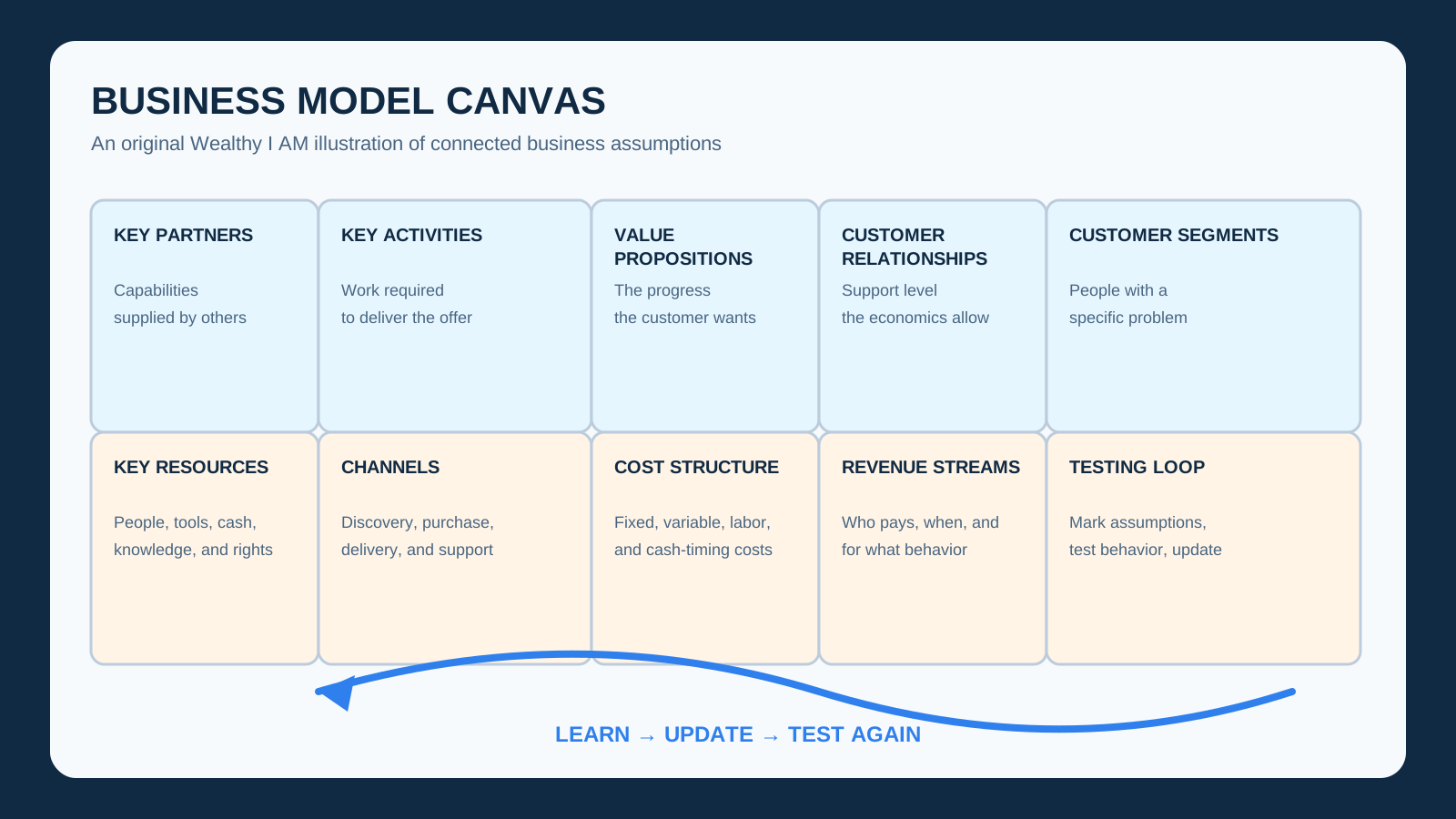
For a reversible proposal, pair the memo with a bounded test: name the uncertain assumption, smallest responsible test, maximum time and money, evidence that would be encouraging or negative, and stop date. Treat numerical outcomes as hypothetical until observed. Do not borrow money, spend essential household funds, or make a binding commitment merely to demonstrate decisiveness.
Temptation 4: Harmony versus establishing productive conflict
A team can be polite while making poor decisions. If people do not question assumptions, surface risks, or disagree about priorities, the group may confuse quiet with alignment. The public strategy paired with Harmony is Establish productive conflict.
Productive conflict is structured disagreement about goals, evidence, constraints, and consequences—not personal hostility. Invite dissent early, summarize the strongest opposing case fairly, and separate a person’s contribution from the decision’s outcome. Psychological safety does not mean every proposal survives. It means people can raise a concern, admit uncertainty, or report a mistake without humiliation or retaliation.
Wealthy I AM application: the dissent-first meeting sequence
- State the decision and deadline.
- Ask each participant for one fact, assumption, and concern.
- Separate disagreements about evidence from disagreements about values or risk tolerance.
- Identify who has authority to make the call.
- Record the decision and its review condition.
This sequence is original editorial material. It should not be attributed to Lencioni as a named exercise without full-text evidence.
Temptation 5: Invulnerability versus building trust
A leader may believe that showing uncertainty or admitting a mistake will weaken authority. The public strategy paired with Invulnerability is Build trust. If people cannot see a leader acknowledge limits, they may hide problems and offer less accurate information. Trust does not require oversharing or abandoning appropriate authority. It requires enough honesty for people to raise risks and correct mistakes.
Wealthy I AM application: the trust-opening statement
Before a consequential discussion, state:
- What I know.
- What I do not know.
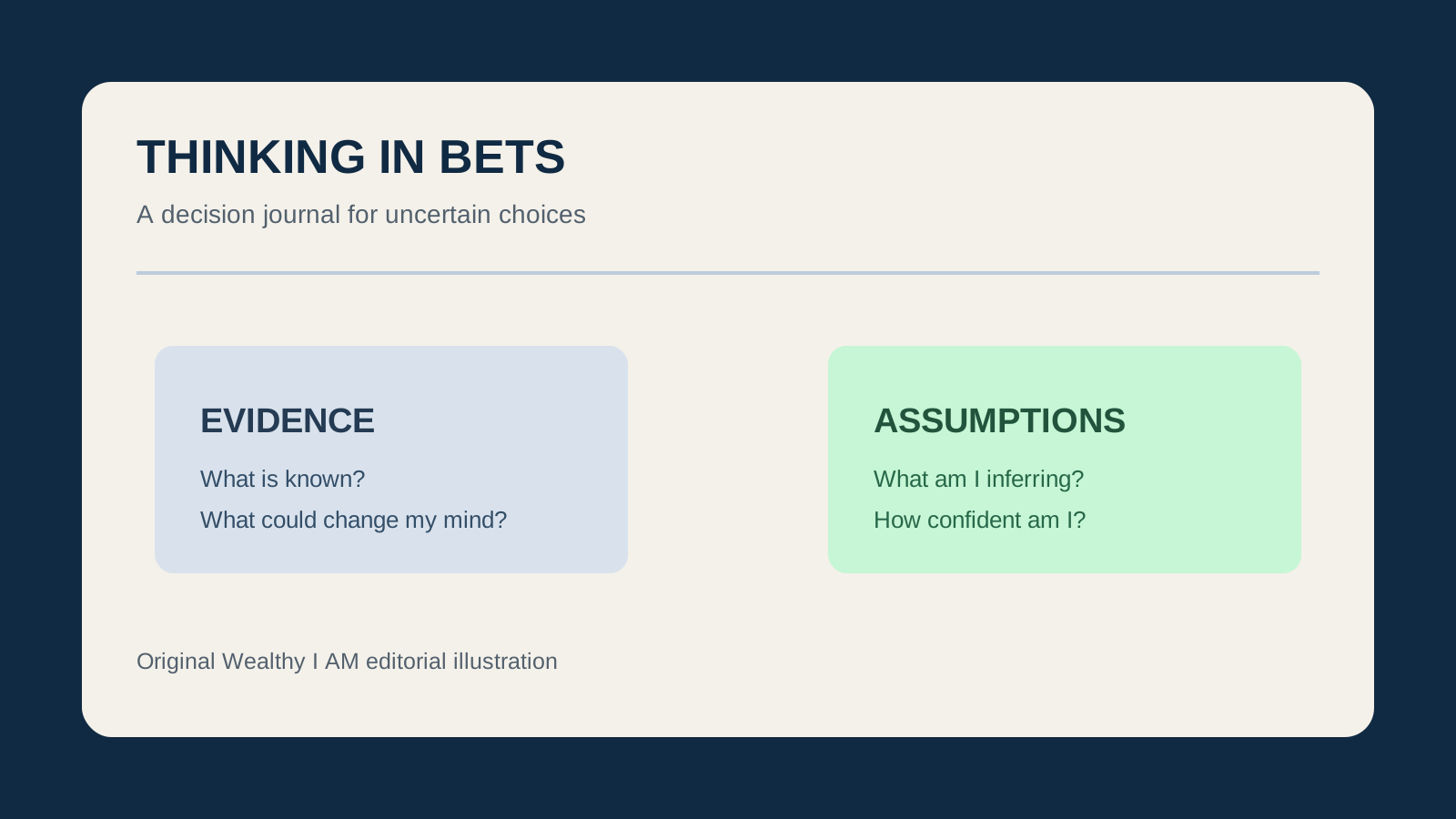
- The assumption most likely to be wrong.
- The information I need from the team.
- When and how the decision will be revisited.
This is not a promise that every suggestion will be adopted. It is a way to make useful disagreement safer and reduce the pressure to perform certainty. It is an original Wealthy I AM application, not presented as a verbatim book tool.
A practical 30-day trade-off review
Week 1: Notice the temptation. Choose one recurring leadership decision. Write what you wanted to protect—status, approval, certainty, harmony, or invulnerability—and what the organization may have needed instead: results, accountability, clarity, productive conflict, or trust.
Week 2: Make the choice explicit. Use the organization-first review, commitment ledger, clarity memo, dissent-first sequence, or trust-opening statement as appropriate. Ask one trusted colleague to identify an assumption or downside you may be missing. Protect confidentiality and do not solicit unnecessary sensitive information.
Week 3: Run one bounded action. Clarify an owner, invite dissent before a decision, test an assumption, follow up on a commitment, or review a neglected obligation. Keep essential household funds, borrowing, health, safety, and lawful working conditions outside the experiment’s risk budget.
Week 4: Review evidence and cost. Record what changed, time and money consumed, human effects, and whether the decision should continue, change, or stop. A disappointing result may be useful information; a favorable early signal is not proof that the approach will produce wealth.
Limits and evidence boundaries
The Table Group’s official product page verifies the book’s public five-part model and its strategy pairings. It does not, by itself, verify every interpretation, application, plot detail, dialogue exchange, exercise, chapter sequence, or full-text formulation. The labels and pairings in this article are therefore presented as a summary of that public model, while the practical tools are clearly labeled as original Wealthy I AM editorial material.
The book’s fable format can make a leadership lesson memorable, but a story is not a controlled test of an intervention. A decision framework may be helpful in one organization and poorly suited to another. Industry, ownership structure, team size, labor conditions, culture, disability, family responsibilities, financial position, and legal duties all affect responsible leadership. No causal claim is made here that using the framework improves revenue, profit, retention, wellbeing, or wealth.
Conclusion
The practical value of The Five Temptations of a CEO is the invitation to notice when a leader’s easiest choice is also the most self-protective one. When status pulls attention away from results, popularity weakens accountability, certainty delays clarity, harmony suppresses productive conflict, or invulnerability blocks trust, the leader can name the trade-off and choose a more responsible process.
Start with one decision this week. Write the outcome, strongest objection, safeguards, owner, and review date. Use the result to improve judgment—not to claim guaranteed business success.
Financial and health safety note
This article is general education, not individualized financial, investment, legal, tax, accounting, employment, medical, or mental-health advice. Business decisions can lose money and create legal or personal risks. Protect essential funds, personal data, sleep, health, safety, and lawful obligations, and consult appropriately qualified professionals when needed.
Sources and evidence boundary
- The Table Group, “The Five Temptations of a CEO” product page and public model: https://www.tablegroup.com/product/temptations/
- University of Wisconsin–Madison Libraries catalog citation record for The Five Temptations of a CEO: https://search.library.wisc.edu/catalog/999848316702121/cite
- Open Library live search record used as an identity/date cross-check: https://openlibrary.org/search.json?q=The%20Five%20Temptations%20of%20a%20CEO&limit=3
- Inventory record used for identity and broad description: the internal book inventory record
- Amazon listing supplied in the inventory; access was not treated as independent confirmation when unavailable: https://www.amazon.com/Five-Temptations-CEO-Patrick-Lencioni/dp/0787944335
- The organization-first review, commitment ledger, clarity memo, dissent-first meeting sequence, trust-opening statement, bounded-test guidance, and 30-day review are original Wealthy I AM editorial material, not presented as verbatim book content.