Money is built through value, but value rarely travels on its own. People must understand an idea, trust an offer, choose a partner, approve a proposal, or decide to act. That is why communication is not a soft extra in wealth building. It is an economic skill.
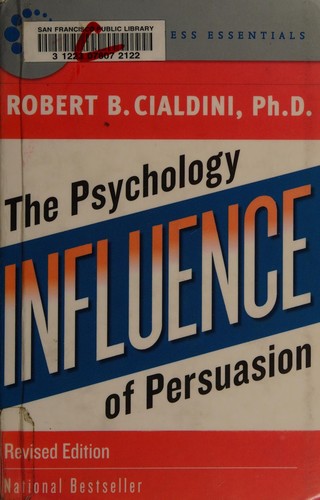
In Influence: The Psychology of Persuasion, psychologist Robert B. Cialdini explains why people say yes and how persuasion works in ordinary situations. The book is not a license to manipulate. Its most useful lesson is more responsible: understand the mental shortcuts people use, apply them honestly, and recognize when someone is using them against you. Used well, the principles can improve sales, negotiation, leadership, marketing, and everyday relationships—the activities through which many people create and earn value.
The core idea: make value easier to recognize
Persuasion should begin with a genuine exchange of value. If your service solves a real problem, your job is to make the benefit clear enough for another person to evaluate it. Cialdini’s principles explain the signals people use when making decisions, especially when time, attention, or information is limited. They do not replace a good product, sound judgment, or consent.
Six practical lessons from Influence
1. Give first—but give something useful
Reciprocity is the pull to respond when someone provides value. In business, the ethical version is simple: help before asking. A useful checklist, thoughtful introduction, sample analysis, or clear explanation can lower friction and demonstrate competence. The gift must be relevant and freely given, not a hidden invoice.
Action step: list one problem your ideal customer faces and create a small resource that helps solve part of it. Share it without pressure. Then invite feedback rather than demanding a sale. Over time, generosity can create trust, but only if the value is real.
2. Turn commitments into visible progress
Commitment and consistency describe our desire to act in ways that fit what we have already said or done. This can help with personal wealth as well as sales. A vague intention to save is easy to forget; a written target, automatic transfer, and monthly review make the commitment concrete.
Action step: choose one financial behavior—saving, debt repayment, investing, or skill development. Write the reason, the weekly action, and the date of your review. In a business, let customers make small, informed steps before a larger purchase. Never manufacture confusion or trap someone with a prior “yes.”
3. Use social proof carefully
When uncertain, people often look at what similar people do. Testimonials, case studies, customer counts, and referrals can reduce uncertainty. But social proof is only valuable when it is truthful and relevant. A celebrity endorsement does not prove that a product works for an ordinary customer, and a large number of users does not guarantee quality.
Action step: collect specific feedback from real customers. Ask what changed, for whom, and under what conditions. Publish permission-based examples with enough context for readers to judge whether the result applies to them.
4. Build liking through respect, not performance
People are more open to those they like, and liking often grows from familiarity, shared interests, and sincere appreciation. The wealth lesson is not to pretend to be someone else. It is to listen well, keep promises, show curiosity, and communicate in a human way.
Action step: before a sales or networking conversation, learn one relevant fact about the other person’s situation. Ask a good question and listen to the answer. Do not flatter, mirror, or create artificial closeness merely to gain compliance.
5. Treat authority as evidence, not decoration
Credentials and expertise can help people make decisions, especially in complex areas such as investing, tax, law, or health. They can also be abused. A title, logo, or confident tone is not the same as relevant evidence.
Action step: when evaluating advice, check the person’s specific experience, incentives, supporting evidence, and limits. When presenting your own expertise, state what you know, what you do not know, and when a specialist should be consulted. Credibility compounds when honesty survives inconvenient questions.
6. Explain scarcity without manufacturing it
Limited time, capacity, or inventory can make an opportunity more valuable because delay has a real cost. False countdowns and invented shortages are different: they pressure people by hiding the truth. Sustainable businesses use scarcity to communicate genuine constraints, not to bypass reflection.
Action step: define the real constraint behind your offer. If you have ten consultation slots, say ten. If a price changes on a stated date because costs change, explain that clearly. Give people enough information to make a voluntary decision.
A seven-day ethical persuasion practice
Day 1: write the problem your work solves and the evidence that it solves it. Day 2: create one useful free resource. Day 3: ask three customers or colleagues for specific feedback. Day 4: rewrite one message so the benefit is clear in plain language. Day 5: review your credentials, claims, and disclosures. Day 6: identify every deadline or scarcity statement and verify it is accurate. Day 7: audit your own decisions: where did you say yes because of evidence, and where did a shortcut do the thinking for you?
Protect your money and attention
The principles are also defensive tools. Pause when an offer combines urgency with emotion. Separate the quality of an opportunity from the charm of its presenter. Look for independent evidence instead of relying on a crowd. Ask what happens if you do nothing, what the total cost is, and who benefits from your decision. A short delay can restore deliberate thinking.
For investors and entrepreneurs, this discipline matters because persuasion often arrives before due diligence. A compelling story can attract attention, but cash flow, incentives, risk, and terms determine whether an opportunity deserves capital. Influence helps you communicate value; it does not excuse skipping the numbers.
The wealth takeaway
Influence teaches that decisions are shaped by context and human psychology. The practical wealth advantage comes from using that knowledge with integrity: create real value, explain it clearly, support claims with evidence, and make it easy for people to say no. Those habits strengthen reputation, relationships, and repeat business—assets that can compound for years.
Start with one conversation this week. Give something useful, ask a better question, make one honest claim, and leave the other person’s freedom intact. Ethical persuasion is not about winning every interaction. It is about making good decisions easier to see and good value easier to exchange.
Source and credit
- Book: Influence: The Psychology of Persuasion, revised edition, by Robert B. Cialdini, Harper Business, ISBN-10 006124189X.
- Book details and cover reference: Amazon.com product page.
- Additional bibliographic reference: Google Books.
- This article is an original educational interpretation and is not affiliated with or endorsed by the author or publisher.
Wealthy I AM Action Card
Wealthy I AM Pinterest Copy
TITLE
Influence: The Psychology of Persuasion — Ethical Lessons for Building Trust and Wealth
DESCRIPTION
Robert Cialdini’s Influence explains the psychology of ethical persuasion and offers practical lessons for communication, business, and wealth.
KEYWORDS
Influence book summary, Influence lessons, personal development, wealth building, productivity books
ALT TEXT
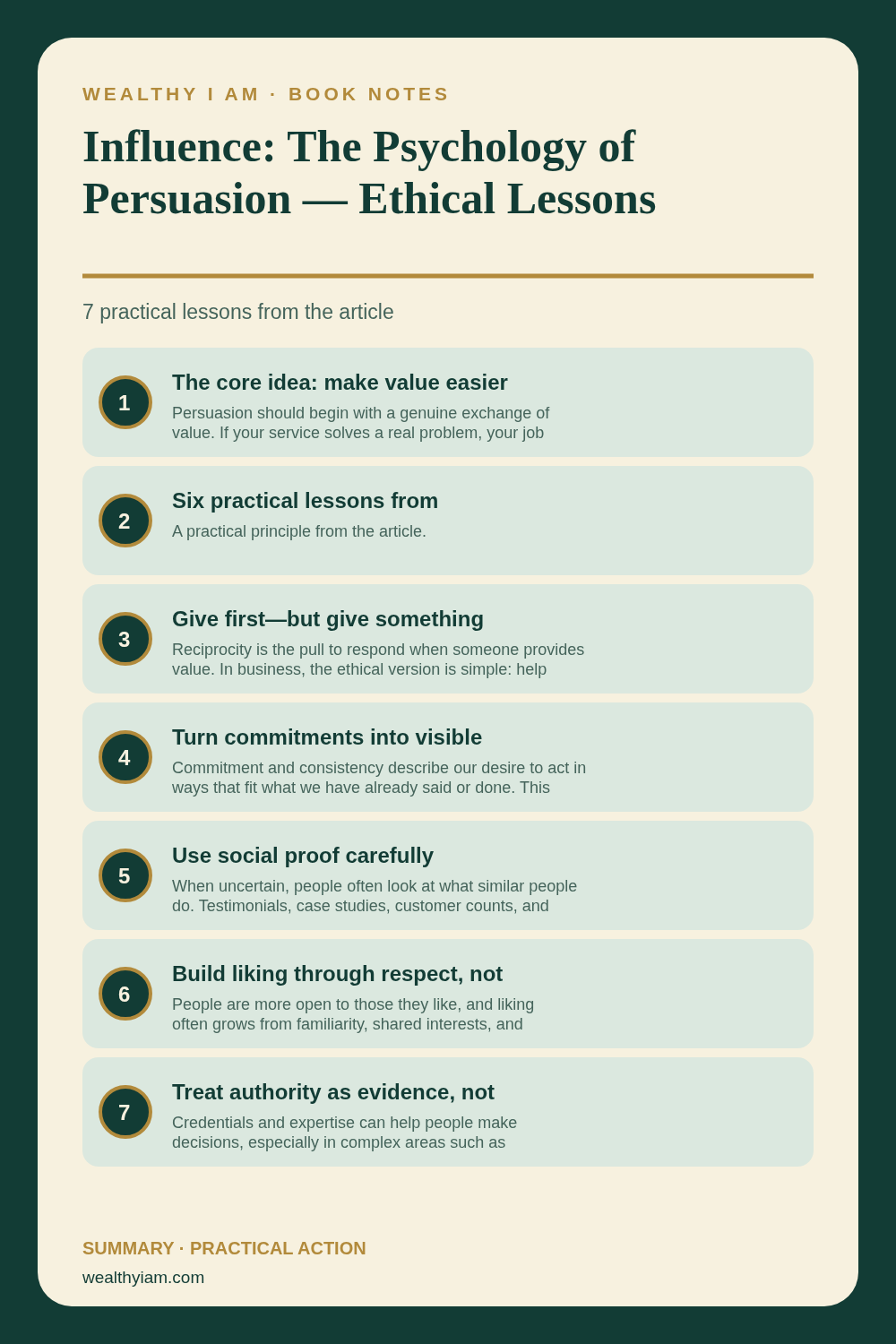
Wealthy I AM visual summary of Influence: The Psychology of Persuasion — Ethical Lessons for Building Trust and Wealth
ARTICLE URL
https://nappot.com/influence-psychology-persuasion-ethical-lessons-trust-wealth/