Every raise, sale, partnership, purchase, and boundary involves negotiation. In Never Split the Difference, former FBI hostage negotiator Chris Voss, with Tahl Raz, explains why listening and emotional intelligence often outperform pressure. The book’s lessons matter to wealth because income, prices, contracts, partnerships, and trust all compound financially.
Voss argues that negotiation is not a contest to win by overpowering someone. It is a process of discovering what matters, lowering defensiveness, and designing a workable agreement. Your goal is not to split the difference automatically; it is to reach a result that is informed, ethical, and sustainable.

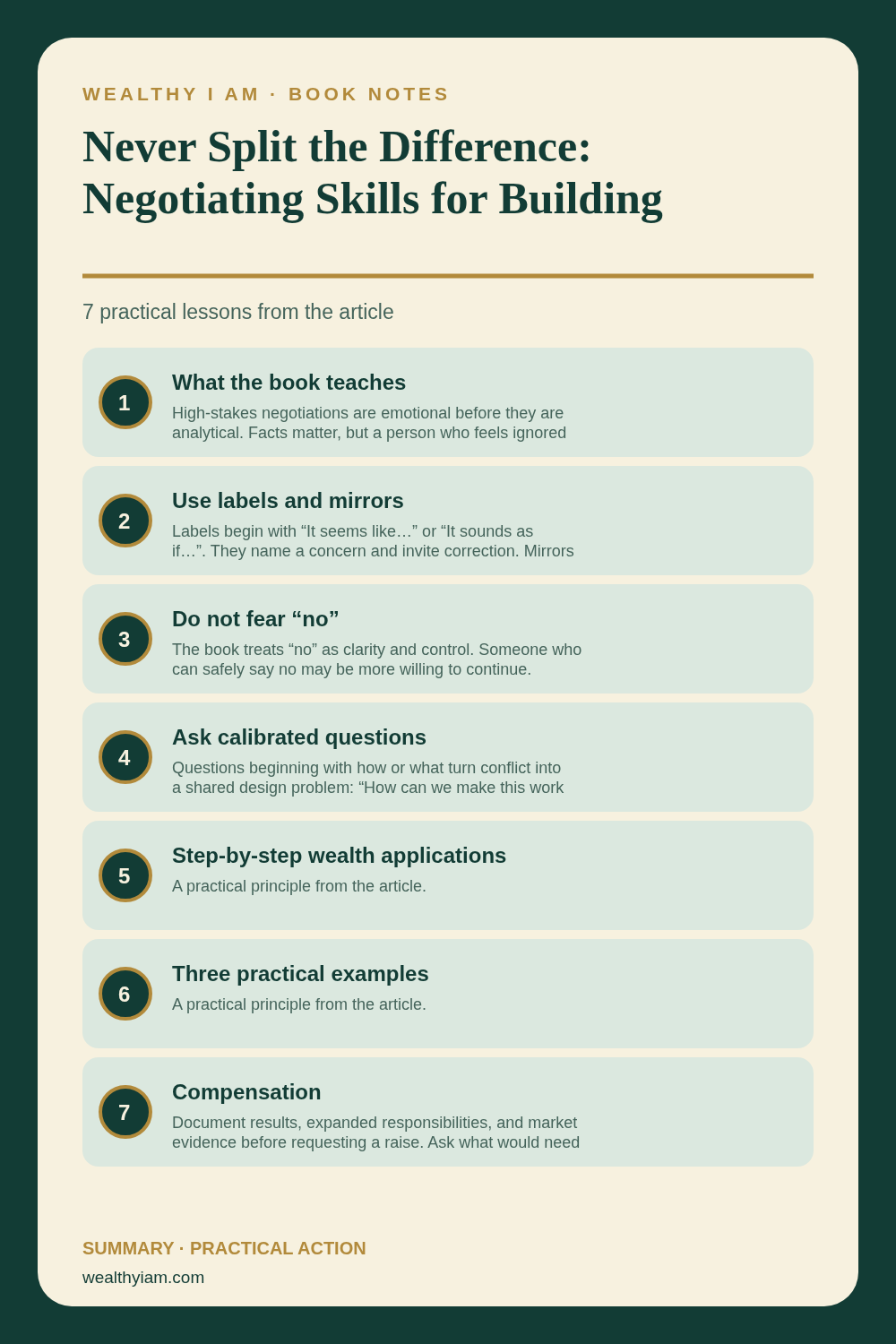
What the book teaches
High-stakes negotiations are emotional before they are analytical. Facts matter, but a person who feels ignored may reject a reasonable proposal. Tactical empathy means recognizing another person’s feelings and viewpoint without necessarily agreeing. A phrase such as “It sounds like protecting your budget is important” can open a better conversation.
Use labels and mirrors
Labels begin with “It seems like…” or “It sounds as if…”. They name a concern and invite correction. Mirrors repeat a few important words, then pause. Used naturally, both tools encourage the other person to reveal information.
Do not fear “no”
The book treats “no” as clarity and control. Someone who can safely say no may be more willing to continue. Replace pressure with questions that clarify boundaries, timing, risk, and alternatives.
Ask calibrated questions
Questions beginning with how or what turn conflict into a shared design problem: “How can we make this work within the budget?” or “What would a fair next step look like?”
Step-by-step wealth applications
- Prepare. Define your desired outcome, minimum acceptable terms, alternatives, and evidence. Preparation prevents emotion from deciding your bottom line.
- Map the other side’s constraints. Ask what they are responsible for, what risks they face, and how success is measured. Price may not be the only issue; certainty, timing, workload, and reputation can matter more.
- Listen first. Invite their view. Mirror a key phrase or label a concern, then pause. Silence can reveal useful information.
- Summarize accurately. Explain their perspective until they respond, “That’s right.” This is stronger than pushing for a quick “You’re right.”
- Ask “how” and “what.” Turn an objection into a problem both sides can solve.
- Make terms precise. Put numbers, dates, deliverables, and responsibilities in writing. Clarity protects cash flow and relationships.
- Review. Record what worked, which assumptions were wrong, and what you will try next time. Negotiation skill compounds through practice.
Three practical examples
Compensation
Document results, expanded responsibilities, and market evidence before requesting a raise. Ask what would need to be true for the target to be approved. If the answer is no today, clarify milestones and a review date.
Business cash flow
Instead of discounting immediately, ask what problem a customer is solving. You may adjust scope, timing, payment schedule, or support while protecting the value of your work.
Household money
Label the concern before debating a purchase: “It sounds like you want more freedom this year.” Then state your own concern without blame. A shared plan for saving, travel, debt, or giving lasts longer than one person winning an argument.
What to be careful about
These techniques should never be used to deceive, exploit vulnerability, or pressure someone who cannot freely choose. Hostage negotiation is a dramatic context, and not every tactic transfers perfectly to family or long-term partnerships. Ethical negotiation preserves consent and trust.
A negotiation checklist for your next conversation
Before the conversation, write down the outcome you want and the outcome you can accept. List your alternatives if no agreement is reached. This is especially important when the discussion affects rent, employment, debt, or a business contract. Knowing your alternatives lets you stay calm and prevents a short-term concession from becoming a long-term financial burden.
During the conversation, separate the person from the problem. You can respect someone’s position while still asking for different terms. Watch for signs that the stated demand is only a starting point. A deadline may hide a scheduling problem; a price objection may hide uncertainty about value; a refusal may hide a fear of risk. A patient question often produces more progress than a stronger argument.
Afterward, confirm the agreement in plain language. State who will do what, by when, for how much, and what happens if circumstances change. Clear documentation is a wealth habit because misunderstandings can consume time, revenue, and trust. When you keep your side of the agreement, your reputation becomes an asset that may create future opportunities.
Practice without making it awkward
Start with low-stakes situations. Ask a service provider what options are available, request clarity about a fee, or practice summarizing a colleague’s concern before responding. The aim is not to sound like a scripted negotiator. It is to become more attentive, less reactive, and more willing to search for the information beneath a position.
Over time, keep a short negotiation journal. Record the context, your assumptions, the questions you asked, the result, and what you would change. Review it monthly. This turns everyday conversations into deliberate practice and helps you notice recurring patterns in your decisions.
One final principle is to protect the relationship after the agreement. Thank the other person for the information they shared, deliver what you promised, and revisit the arrangement when the facts change. Negotiation is not a single event; it is a repeated game. Reliable conduct can lower future friction and make better opportunities easier to access.
A negotiation checklist for your next conversation
Before the conversation, write down the outcome you want and the outcome you can accept. List your alternatives if no agreement is reached. This is especially important when the discussion affects rent, employment, debt, or a business contract. Knowing your alternatives lets you stay calm and prevents a short-term concession from becoming a long-term financial burden.
During the conversation, separate the person from the problem. You can respect someone’s position while still asking for different terms. Watch for signs that the stated demand is only a starting point. A deadline may hide a scheduling problem; a price objection may hide uncertainty about value; a refusal may hide a fear of risk. A patient question often produces more progress than a stronger argument.
Afterward, confirm the agreement in plain language. State who will do what, by when, for how much, and what happens if circumstances change. Clear documentation is a wealth habit because misunderstandings can consume time, revenue, and trust. When you keep your side of the agreement, your reputation becomes an asset that may create future opportunities.
Practice without making it awkward
Start with low-stakes situations. Ask a service provider what options are available, request clarity about a fee, or practice summarizing a colleague’s concern before responding. The aim is not to sound like a scripted negotiator. It is to become more attentive, less reactive, and more willing to search for the information beneath a position.
Over time, keep a short negotiation journal. Record the context, your assumptions, the questions you asked, the result, and what you would change. Review it monthly. This turns everyday conversations into deliberate practice and helps you notice recurring patterns in your decisions.
Bottom line
Never Split the Difference teaches that strong negotiators are often strong listeners. Recognize emotions, ask better questions, and make agreements specific. Those habits can improve earning power, reduce unnecessary costs, and build relationships that create opportunities over time.
Sources and credits
- Amazon.com product page — ISBN 9780062407801
- HarperCollins publisher page
- Black Swan Group official resource
- Cover credit: matched hardcover product image for ISBN 9780062407801.
Wealthy I AM Action Card
Wealthy I AM Pinterest Copy
TITLE
Never Split the Difference: Negotiating Skills for Building Wealth and Better Relationships
DESCRIPTION
Richard Rumelt’s practical guide to turning vague goals into focused strategy, real advantage, and durable.
KEYWORDS
Never Split the Difference book summary, Never Split Difference lessons, personal development, wealth building, productivity books
ALT TEXT
Wealthy I AM visual summary of Never Split the Difference: Negotiating Skills for Building Wealth and Better Relationships
ARTICLE URL
https://nappot.com/never-split-the-difference-negotiating-skills-building-wealth-relationships/