Most people approach investing as if the main challenge were finding the next winning stock. Richer, Wiser, Happier offers a more durable idea: the real advantage is learning to think clearly, manage risk, and behave well over a very long period. William Green built the book from conversations with more than forty accomplished investors, including Warren Buffett, Charlie Munger, Howard Marks, Jack Bogle, Joel Greenblatt, and Mohnish Pabrai. Their methods differ, but their habits repeatedly converge on patience, independence, humility, and disciplined decision-making.
The result is not a hot-tip manual. It is a practical guide to improving the quality of your choices in markets—and in the rest of life. Here are seven lessons worth turning into a personal wealth practice.
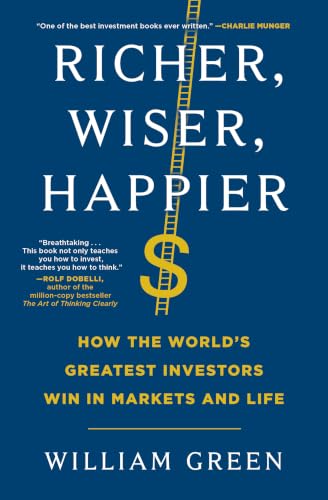
Book facts: Author: William Green · First published: 2021 · Focus: investing, judgment, risk, resilience, and living well.
1. Think in probabilities, not certainties
Great investors do not need to know exactly what will happen. They ask a better question: given what I know now, which choice gives me the best odds over time? This shift is liberating. It replaces the impossible demand for perfect forecasts with a repeatable process of weighing evidence, downside, incentives, and alternatives.
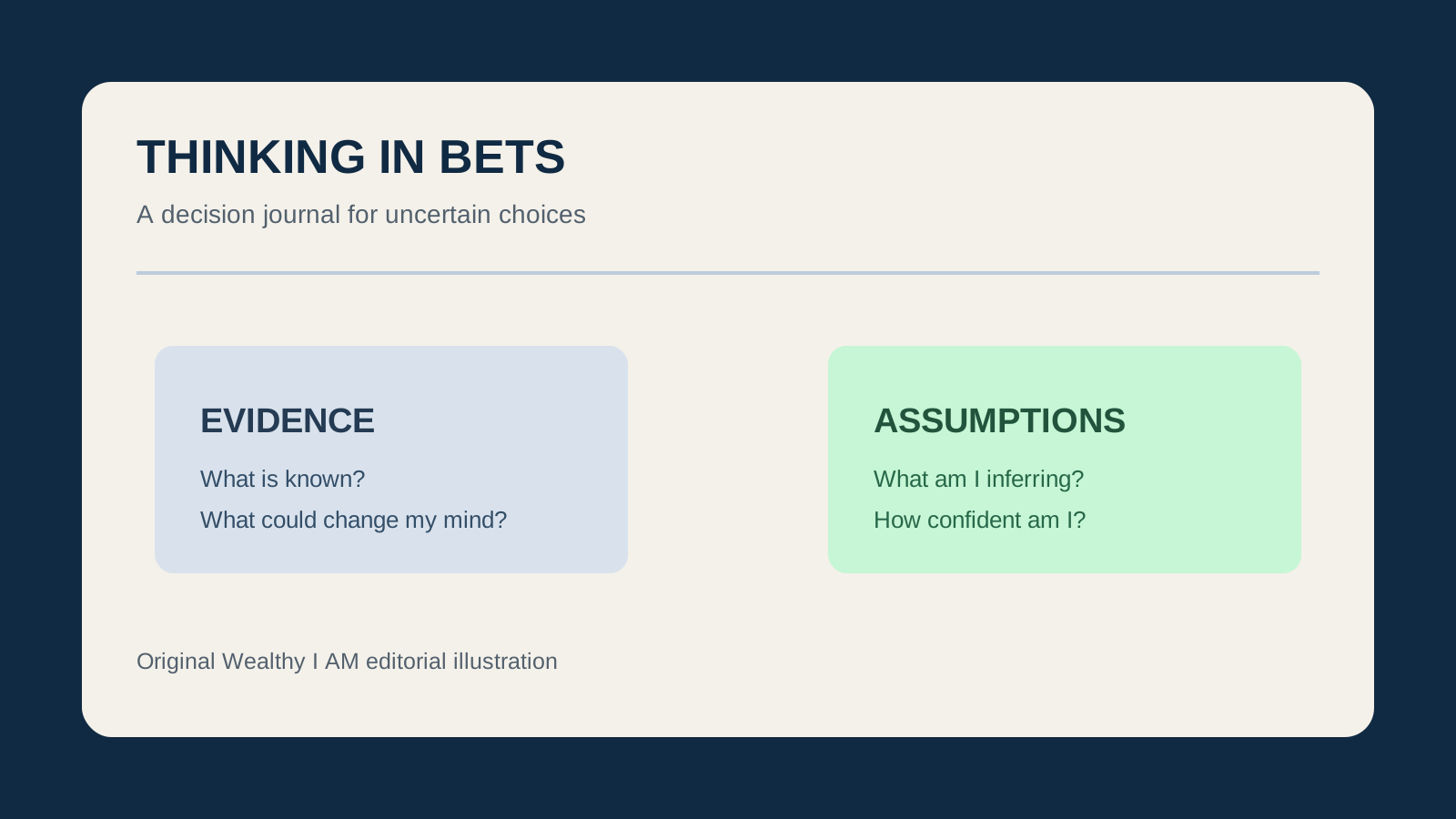
Put it into practice: Before a major investment or business decision, write three cases—upside, base case, and downside. Assign rough probabilities and identify what evidence would change your mind. You are not trying to manufacture precision; you are making uncertainty visible.
2. Protect against permanent loss
The investors Green profiles are more concerned with avoiding ruin than with appearing brilliant. A temporary price decline can be uncomfortable, but a permanent loss of capital can destroy years of compounding. That distinction changes how you evaluate debt, concentration, leverage, fees, and business quality.
Put it into practice: Create a “never again” list of risks that could permanently damage your finances: high-interest debt, an emergency fund that is too small, an investment you do not understand, or a portfolio concentrated in one fragile bet. Solve those vulnerabilities before reaching for more return.
3. Let time do the heavy lifting
Compounding is not merely a mathematical feature of investing. It is a behavioral reward for staying in the game. The book’s investors understand that frequent action creates taxes, fees, mistakes, and emotional noise. A sound decision held for years can be more powerful than a clever decision repeated every week.
Put it into practice: Automate a sustainable contribution to diversified, low-cost investments appropriate for your goals and risk tolerance. Then schedule a calm review—perhaps quarterly or twice a year—rather than reacting to every headline. Time in the market is not a guarantee, but unnecessary activity is rarely a strategy.
4. Borrow the best ideas
One of the book’s most useful themes is that originality is overrated when a proven principle is available. Investors such as Mohnish Pabrai deliberately study people who have already solved similar problems. Borrowing does not mean copying blindly; it means shortening the learning curve by examining what works, why it works, and where it may fail.
Put it into practice: Choose three people whose judgment you respect. Read their primary work, collect the principles that recur, and translate each into a behavior. For example, “be patient” becomes “do not sell solely because a headline is alarming.” A principle becomes valuable when it changes a decision.
5. Make temperament an advantage
Intelligence helps, but emotional steadiness often matters more. Markets reward people who can remain rational when others are euphoric or afraid. Green’s conversations show that successful investors build systems that reduce the number of times emotion gets to make the final call.
Put it into practice: Write an investment policy before you feel pressured: your time horizon, diversification rules, contribution plan, and conditions for selling. When volatility arrives, consult the document before consulting social media. Calm is not passivity; it is the ability to act from a prepared framework.
6. Stay inside your circle of competence
Humility is a wealth-building skill. You do not need to understand every industry, strategy, or financial product. Knowing what you do not know protects you from persuasive stories, fashionable complexity, and risks hidden behind impressive language. A smaller area of understanding can be enough if you stay curious and disciplined.
Put it into practice: For every proposed investment, explain in plain English how it makes money, what could impair it, and what you would need to monitor. If you cannot explain those points, label the opportunity “not yet understood” instead of forcing a decision.
7. Define wealth more broadly
The title’s final word matters. The investors in this book are not presented as successful merely because they accumulated money. Their better lessons involve freedom, relationships, health, learning, and principles. Money can increase your choices, but it cannot decide what is worth choosing.
Put it into practice: Write a personal definition of “enough.” Include a financial target, but also the time, people, work, and experiences you want that target to support. A wealth plan without a life plan can become an endless scoreboard.
A simple 30-day action plan
- Week 1: List your financial risks, debts, cash reserve, and recurring investment contributions.
- Week 2: Draft your one-page decision policy: goals, time horizon, diversification, and rules for reacting to volatility.
- Week 3: Study one investor whose process fits your temperament. Extract three behaviors, not three predictions.
- Week 4: Review your definition of enough and automate one action that supports it.
These steps are intentionally ordinary. Richer, Wiser, Happier argues that extraordinary outcomes often grow from ordinary disciplines repeated for an unusually long time. The goal is not to become a different person overnight. It is to become a little more rational, patient, and resilient each time money asks you to make a choice.
Bottom line: The book’s strongest message is that wealth is built twice—first in the quality of your thinking, and then in the results that patient behavior allows to compound.
Sources and credits
- Simon & Schuster official publisher page — author, edition, premise, and featured investors.
- William Green’s official book page — book details and themes.
- Amazon.com product page — matched U.S. product listing and cover reference.
Cover credit: the featured cover image is the corresponding Richer, Wiser, Happier edition associated with the verified Amazon product listing above.