Businesses often spend heavily on strategy, technology, and talent while overlooking the environment in which all three must work. In The Advantage: Why Organizational Health Trumps Everything Else in Business, Patrick Lencioni argues that a company’s greatest underused advantage is organizational health: the degree to which its people, priorities, systems, and culture fit together.
Lencioni’s point is not that intelligence or strategy are unimportant. A healthy organization must still be “smart” about its market and operations. But even excellent ideas become expensive when leaders do not trust one another, decisions remain unclear, or departments protect themselves instead of serving the whole. Organizational health turns knowledge into coordinated action—and coordinated action is one of the foundations of sustainable wealth.

The central idea: healthy beats merely smart
Lencioni describes a healthy organization as whole, consistent, and complete. Management, operations, strategy, and culture reinforce one another rather than sending contradictory messages. In practice, that means people understand what matters, can raise difficult issues, know who decides, and see the same priorities reflected in meetings and rewards.
This matters financially. Confusion creates rework, delays, defensive behavior, bad handoffs, and customer frustration. Health reduces that friction. It helps a company use more of the knowledge it already owns, retain capable people, and make mistakes visible while they are still affordable.
The four disciplines of organizational health
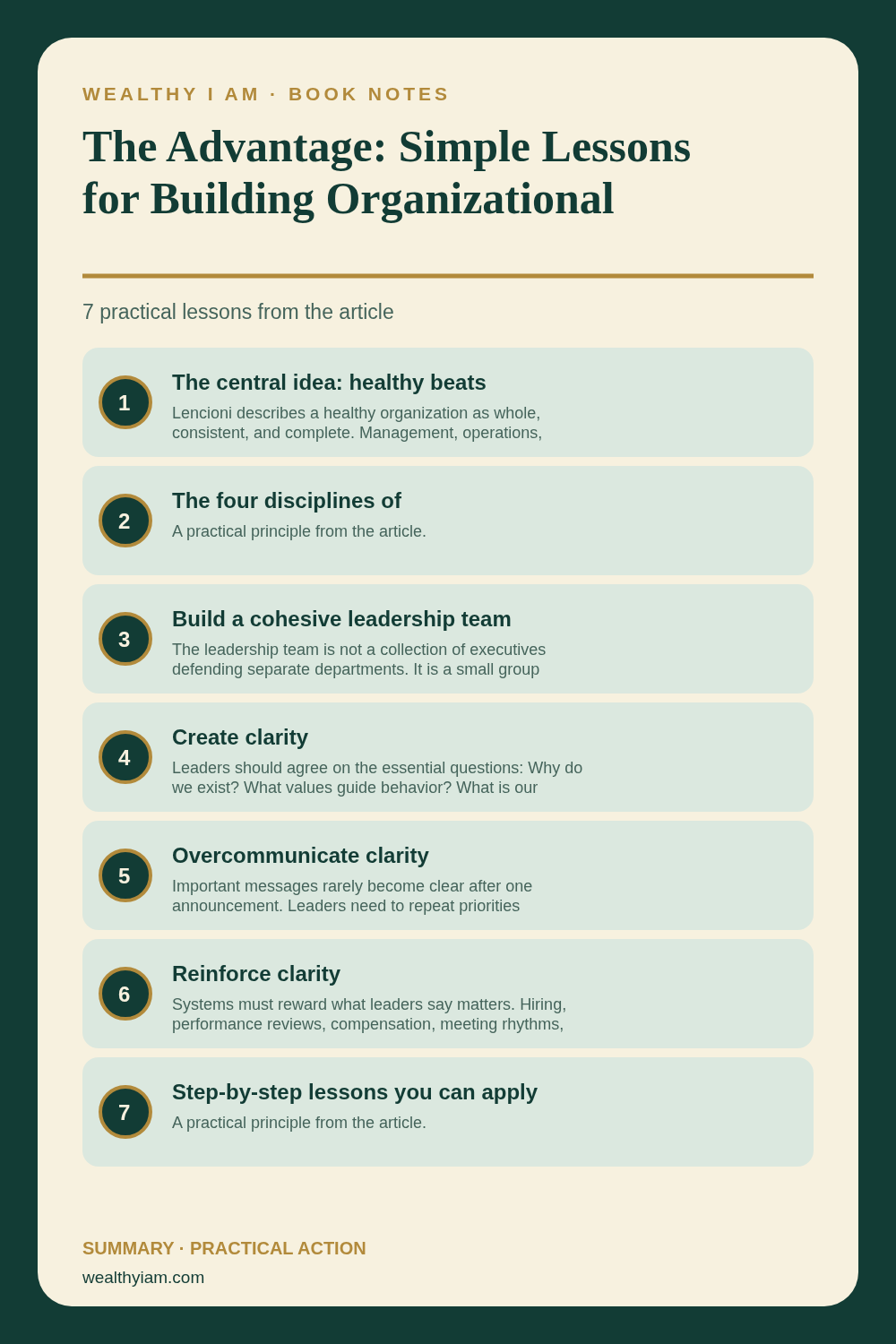
1. Build a cohesive leadership team
The leadership team is not a collection of executives defending separate departments. It is a small group collectively responsible for the organization’s success. That requires trust, productive conflict, commitment to decisions, and peer-to-peer accountability.
Trust here is practical rather than sentimental. Leaders must be able to say, “I was wrong,” “I need help,” or “I disagree,” without turning the conversation into a political contest. When leaders hide uncertainty, the organization pays for it later through slow decisions and surprises.
2. Create clarity
Leaders should agree on the essential questions: Why do we exist? What values guide behavior? What is our strategy? What is most important right now? Who is responsible for which decisions? How will we define success?
Clarity does not mean predicting everything. It means reducing avoidable ambiguity. A team can adapt to changing facts more effectively when it shares a clear starting point.
3. Overcommunicate clarity
Important messages rarely become clear after one announcement. Leaders need to repeat priorities consistently and explain the reasoning behind them. If one department hears “protect quality” while another hears “ship at any cost,” employees will spend energy interpreting the conflict.
Repetition is not empty noise when it helps people make independent decisions. A clear message, repeated through meetings, one-to-ones, written updates, and customer decisions, becomes a useful operating guide.
4. Reinforce clarity
Systems must reward what leaders say matters. Hiring, performance reviews, compensation, meeting rhythms, organizational structure, and accountability should support the same values and priorities. Otherwise, employees learn that the official culture is less important than the actual incentives.
Step-by-step lessons you can apply
Step 1: Define the organization’s one-sentence purpose
Complete this sentence: “We exist to help ______ achieve ______.” Keep it specific enough to guide choices. Then test it against recent decisions. If the purpose cannot help you choose between two opportunities, it is probably too vague.
Step 2: Name three behaviors that prove your values
Replace abstract words with observable actions. “Customer trust” might mean giving realistic delivery dates and admitting limitations early. “Excellence” might mean checking important work before release. “Ownership” might mean bringing a proposed solution with every problem.
Step 3: Make meetings produce decisions
For each important meeting, write the issue, the decision needed, and the person responsible for making it. Invite disagreement before the decision. At the end, record the choice, owner, deadline, and what will be communicated. This simple discipline prevents repeated debates and hidden assumptions.
Step 4: Mine for conflict respectfully
Ask, “What concern has not been voiced?” or “What could make this plan fail?” Thank people who surface risks. Productive conflict is about issues and ideas, not personal attacks. It improves judgment because it exposes the information a comfortable meeting might miss.
Step 5: Practice direct accountability
When a commitment is missed, discuss it with the person responsible rather than immediately building another layer of bureaucracy. Use facts: What was agreed? What happened? What support or change is needed? Direct accountability is faster and more respectful than allowing resentment to accumulate.
Step 6: Communicate the same priorities in every channel
Review your website, onboarding, dashboards, team meetings, and reward systems. Do they point in the same direction? If the stated priority is profitable customer value, but employees are rewarded only for volume, the system is teaching a different strategy.
Step 7: Track the cost of organizational illness
Measure signals such as repeated work, unresolved decisions, customer complaints, employee turnover, missed handoffs, and time spent in approval loops. These are not merely cultural inconveniences; they consume cash and capacity. Review them monthly and choose one root cause to address.
How organizational health compounds into wealth
Healthy organizations create a compounding loop. Trust makes candid information available. Candid information improves decisions. Better decisions reduce waste and improve the customer experience. Stronger execution supports revenue and reputation. Those results create room to invest in people, systems, and better opportunities.
The same principle applies to a solo business or a small team. You may not have a formal executive group, but you still need clarity about whom you serve, how work is prioritized, what quality means, and how commitments are handled. Organizational health is not reserved for large companies; it is a way of protecting limited time, attention, and capital.
What to be careful about
The book’s model is not a shortcut around market reality. A healthy company can still choose the wrong strategy, misread customers, or face an unfavorable economy. Health makes learning and correction easier; it does not guarantee a particular outcome.
Leaders should also avoid turning “culture” into forced positivity or personal conformity. Trust includes the freedom to disagree. Accountability should clarify standards, not excuse disrespect. The useful test is whether people can tell the truth, make responsible decisions, and contribute to shared goals.
Bottom line
The Advantage offers a grounded reminder: wealth is built not only through what an organization knows, but through how reliably its people work together. Build a cohesive leadership team, create clarity, repeat it until it is understood, and align systems with the message. These practices are simple, but they are not automatic. Repeated over time, they can turn less friction and better decisions into durable organizational value.
Sources and credits
- Book overview and summary — central thesis and four disciplines.
- Amazon.com product page — exact title, author, publisher, and 2012 edition details.
- Cover credit: Open Library cover image for ISBN 9780470941522, the matched 2012 Jossey-Bass edition; product details cross-checked against Amazon.com.
Wealthy I AM Action Card
Wealthy I AM Pinterest Copy
TITLE
The Advantage: Simple Lessons for Building Organizational Health and Wealth
DESCRIPTION
Practical lessons from Patrick Lencioni’s The Advantage for building healthy organizations, better execution, and long-term.
KEYWORDS
The Advantage book summary, Advantage lessons, personal development, wealth building, productivity books
ALT TEXT
Wealthy I AM visual summary of The Advantage: Simple Lessons for Building Organizational Health and Wealth
ARTICLE URL
https://nappot.com/the-advantage-simple-lessons-building-organizational-health-wealth/