The Advantage is a business book about one big idea: a company can be smarter, faster, and more profitable when it is healthy. Patrick Lencioni argues that many teams already have enough talent and intelligence. What they lack is alignment. They pull in different directions, keep information hidden, and turn simple decisions into slow, messy battles.
The book’s message is practical. Instead of chasing fancy strategy talk, leaders should build a team that trusts each other, agree on a clear plan, and keep repeating that plan until everyone can act on it. That is how a company becomes easier to run and better at creating value.
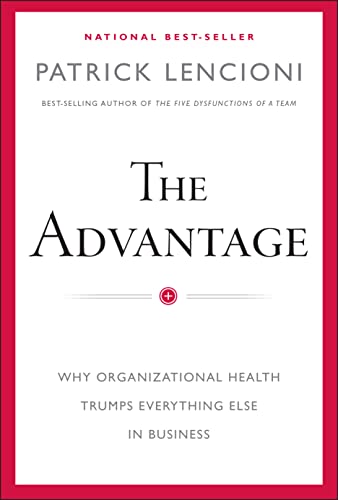
In plain words: when people know the plan, believe the plan, and work from the same plan, the whole business gets stronger.
Book facts
| Author | Patrick M. Lencioni |
|---|---|
| First published | 2012 |
| Publisher | Jossey-Bass / Wiley |
| Main topics | Organizational health, leadership, clarity, communication, and execution. |
| Core promise | A healthy organization can outperform a merely smart one because people spend less time fighting and more time doing useful work. [1][2][3] |
What the book is about
Lencioni says organizational health is the most underused advantage in business. A healthy company is one where the management, operations, strategy, and culture fit together. There is less politics, less confusion, and less wasted energy. That means better meetings, faster decisions, and a clearer path to results.
The book is not a theory book full of abstract language. It is a guide for leaders who want a business that works in real life. The idea is simple: if the top team is united and the rest of the company gets the same clear message, execution becomes much easier.
The four disciplines, explained simply
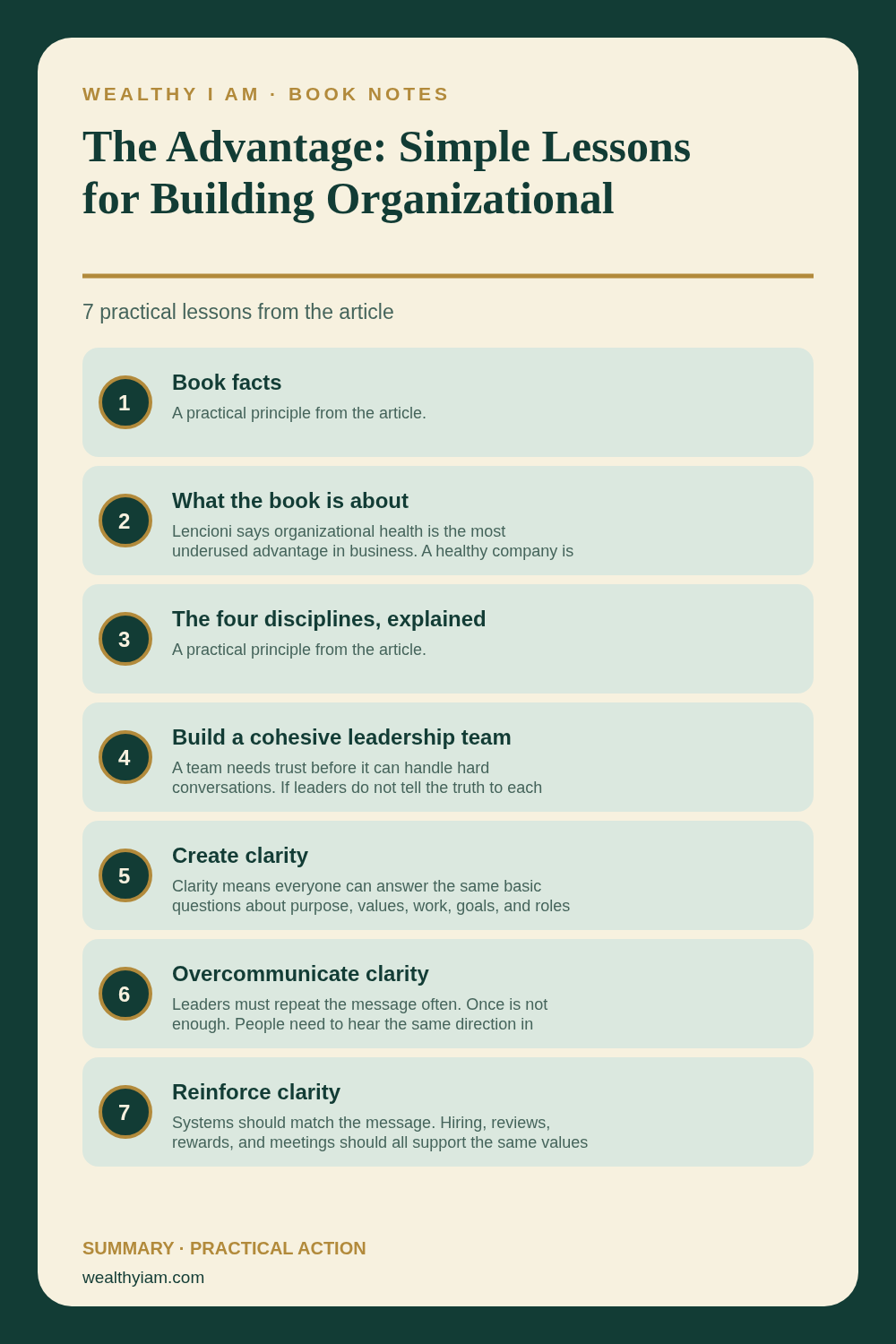
1. Build a cohesive leadership team
A team needs trust before it can handle hard conversations. If leaders do not tell the truth to each other, the rest of the company feels the tension.
2. Create clarity
Clarity means everyone can answer the same basic questions about purpose, values, work, goals, and roles without guessing.
3. Overcommunicate clarity
Leaders must repeat the message often. Once is not enough. People need to hear the same direction in different meetings and different formats.
4. Reinforce clarity
Systems should match the message. Hiring, reviews, rewards, and meetings should all support the same values and goals.
The six clarity questions
The book points leaders to six questions that can stop a company from drifting:
- Why do we exist?
- How do we behave?
- What do we do?
- How will we succeed?
- What is most important right now?
- Who must do what?
These questions matter because many companies look busy while still being unclear. They may have goals, but not agreement. They may have activity, but not focus. Lencioni’s point is that clarity saves time and money.
What the book gets right
- It treats health as a business asset. Good culture is not a bonus; it affects output.
- It connects leadership and execution. The top team sets the tone for everything else.
- It keeps the message practical. Readers can use the ideas in a real company, not just admire them on paper.
- It explains why meetings matter. Meetings can be useful when they create alignment instead of chaos.
Step by step: how to apply the book
If you want to use the book’s ideas in your own business or team, start here:
- Check whether the leadership team is honest. People should be able to disagree without hiding behind politeness.
- Write down the six clarity answers. Keep them simple enough that a new employee could understand them.
- Repeat the same message everywhere. Use meetings, documents, and one-to-one conversations to keep the focus consistent.
- Make the systems match the message. If the company says it values teamwork, the review process should reward teamwork.
- Fix meetings before they become a habit of frustration. Short, clear, useful meetings beat long sessions with no decisions.
- Review the plan regularly. Health is not a one-time project. It has to be maintained.
Simple explanations of key terms
Organizational health means the business is working as one unit instead of several disconnected parts. Clarity means people understand what matters and how to act. Reinforcement means the company’s systems support the same values leaders talk about. Cohesive means united and able to work together without constant internal friction.
If those words sound abstract, think of a sports team. A talented team can still lose if players ignore each other and use different playbooks. The same is true in business.
What to be careful about
The book is strong, but it can feel very leadership-focused. If you are looking for a technical operations manual, this is not that kind of book. It is more about the habits and structures that make operations work better.
Also, the ideas are simple enough that it is tempting to skip them. That would be a mistake. The book’s power comes from actually doing the basics: alignment, communication, and reinforcement.
Kid-simple version: when the team rows in the same direction, the boat moves faster.
Bottom line
The Advantage argues that organizational health is not soft or optional. It is one of the most valuable things a company can build. If leaders create clarity and keep reinforcing it, they spend less time fixing confusion and more time producing real results. For anyone who wants a better business, this is a strong, useful book.
Wealthy I AM Action Card
Wealthy I AM Pinterest Copy
TITLE
The Advantage: Simple Lessons for Building Organizational Health and Better Business Results
DESCRIPTION
Patrick Lencioni’s The Advantage explained in simple language, with the four disciplines, the six clarity questions, and practical steps leaders can use to build a healthier.
KEYWORDS
The Advantage book summary, Advantage lessons, personal development, wealth building, productivity books
ALT TEXT
Wealthy I AM visual summary of The Advantage: Simple Lessons for Building Organizational Health and Better Business Results