Many businesses win a customer once and then begin the search for the next customer. The Automatic Customer asks what could happen if a business created value through an ongoing relationship. John Warrillow explains how subscriptions can turn occasional buyers into repeat customers and make revenue easier to understand.
This is not a demand that every business charge monthly. It is a way to notice recurring needs and serve them with a fair, convenient offer. The central lesson is simple: recurring revenue should begin with recurring value.

Book facts
- Title: The Automatic Customer: Creating a Subscription Business in Any Industry
- Author: John Warrillow
- Publisher: Portfolio
- Publication: 2015
- Topics: subscriptions, recurring revenue, retention, customer value, churn, and business models
What an automatic customer means
An automatic customer agrees to buy repeatedly, usually through a subscription or planned recurring arrangement. Streaming is an obvious example, but the idea also applies to maintenance, replenishment, memberships, education, software, professional advice, and curated products.
The business benefit is not just more frequent payment. A good subscription removes friction: it prevents a task being forgotten, sends a needed product on time, or provides continuing access to something useful. The company receives feedback and a clearer view of future demand.
Six major lessons
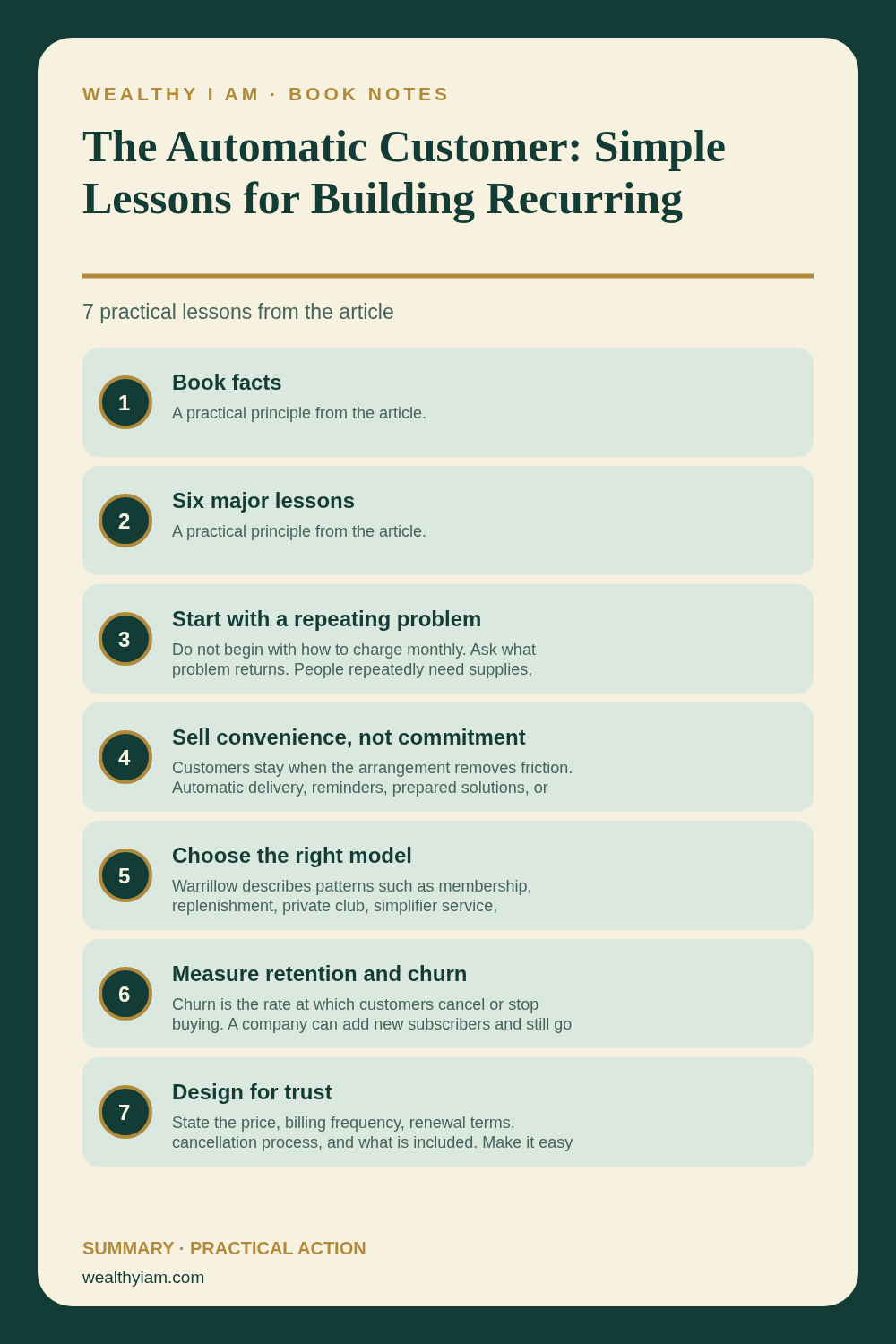
1. Start with a repeating problem
Do not begin with how to charge monthly. Ask what problem returns. People repeatedly need supplies, updates, maintenance, coaching, entertainment, access, or peace of mind. If the need does not recur, the subscription will feel artificial.
2. Sell convenience, not commitment
Customers stay when the arrangement removes friction. Automatic delivery, reminders, prepared solutions, or organized experiences can be valuable. A recurring charge without continuing benefit is recurring disappointment.
3. Choose the right model
Warrillow describes patterns such as membership, replenishment, private club, simplifier service, surprise box, network, and peace of mind. Choose the model that fits the customer habit rather than copying a fashionable company.
4. Measure retention and churn
Churn is the rate at which customers cancel or stop buying. A company can add new subscribers and still go backward if existing customers leave quickly. Track cancellations, reasons, usage, refunds, and support requests.
5. Design for trust
State the price, billing frequency, renewal terms, cancellation process, and what is included. Make it easy to leave. Customers who stay because the service is valuable are more durable than customers trapped by confusion.
6. Recurring revenue is not free money
Subscriptions create obligations. The company must deliver consistently, serve customers, manage capacity, and avoid promising more than it can provide. Recurring sales make weak operations visible quickly.
Step by step: test a subscription idea
- Interview ten customers. Ask what they buy repeatedly, what they forget, what feels inconvenient, and what they wish someone would handle.
- Map the need. Write the problem, when it appears, the current workaround, and the result the customer wants.
- Choose one narrow offer. Define exactly what arrives, happens, or becomes available, and how often. Start with one audience and one promise.
- Run a small pilot. Offer it to real customers before building a large system. Ask for payment; compliments alone do not validate a business.
- Check the economics. Calculate price, delivery cost, support time, payment fees, refunds, and expected retention. Revenue is not profit.
- Learn from cancellation. Ask respectfully what changed or failed. Use patterns to improve the offer.
- Earn each renewal. Show progress, remind customers of value, and improve the service. Every billing cycle is another chance to deserve trust.
Applications for small business
An accountant might offer monthly planning and reporting instead of only annual tax preparation. A fitness professional could provide membership and feedback instead of isolated sessions. A home service company might bundle seasonal inspections with priority scheduling. A writer could provide a focused library and live support.
In each case, the offer is more than a payment schedule. It packages an ongoing outcome. The customer should be able to explain in one sentence why continuing makes sense.
What to be careful about
Subscriptions can encourage waste when customers forget to cancel, and they create resentment when cancellation is difficult. Ethical design is practical design. Transparent pricing, useful reminders, easy cancellation, and honest promises protect the brand and the customer.
Predictable sales do not guarantee a valuable company. Healthy margins, reliable delivery, good service, and a product people want still matter. Recurring revenue magnifies a good experience and can magnify a bad one.
Simple takeaway: do not ask people to keep paying for something they no longer use. Build a service they are happy to renew.
One useful financial insight
Recurring revenue can also change how a founder thinks about growth. A one-time sale answers the question of what happened today. A recurring relationship asks whether the business can keep its promise next month and next year. That encourages better planning, clearer service standards, and more honest conversations with customers.
For a wealth-building entrepreneur, this distinction matters. Predictability can make it easier to budget, reinvest, hire carefully, and build reserves. But it should never become an excuse to ignore customer choice. The durable advantage comes from combining dependable operations with a product that remains useful as circumstances change.
Bottom line
The Automatic Customer gives entrepreneurs a useful lens: find needs that return, then serve them better over time. Subscriptions can strengthen cash flow and loyalty only when they are built around real value. Start with conversations, test a focused offer, measure retention, and keep earning the next renewal.
Sources and credits
- Penguin Random House publisher page for title, author, publication details, overview, and model descriptions.
- Amazon.com product page for product listing and cover reference.
- Internet Archive catalog record for bibliographic information and summary.
- Publisher cover reference.
This article is original educational commentary and is not affiliated with the author or publisher.
Wealthy I AM Action Card
Wealthy I AM Pinterest Copy
TITLE
The Automatic Customer: Simple Lessons for Building Recurring Revenue
DESCRIPTION
John Warrillow The Automatic Customer explains how subscriptions can create repeat business, predictable cash flow, and stronger customer.
KEYWORDS
The Automatic Customer book summary, Automatic Customer lessons, personal development, wealth building, productivity books
ALT TEXT
Wealthy I AM visual summary of The Automatic Customer: Simple Lessons for Building Recurring Revenue
ARTICLE URL
https://nappot.com/the-automatic-customer-simple-lessons-building-recurring-revenue/