Most people do not lose money or momentum because they lack intelligence. They lose it because a small but important step is forgotten when the day becomes busy, complicated, or stressful. In The Checklist Manifesto: How to Get Things Right, surgeon and writer Atul Gawande makes a persuasive case for a simple tool that helps capable people perform consistently: the well-designed checklist.
Gawande explores aviation, medicine, construction, disaster response, and business to show that expertise alone is not enough in complex environments. The practical lesson for wealth building is equally useful: create a repeatable process for decisions that matter, then use it even when you feel confident.

Book facts
- Title: The Checklist Manifesto: How to Get Things Right
- Author: Atul Gawande
- Original publication: 2009
- Verified U.S. product: Metropolitan Books hardcover, ISBN 9780805091748; Amazon.com also lists the paperback ISBN 9780312430009.
- Core topics: Complexity, human fallibility, teamwork, communication, safety, and reliable execution.
The central idea: expertise needs support
A checklist is not a replacement for judgment. It is a safety net for weaknesses that affect everyone: memory slips, interruptions, overconfidence, fatigue, and the temptation to skip a step that seems obvious. Gawande distinguishes errors caused by not knowing something from errors caused by failing to use what we already know. A checklist is especially powerful against the second kind.
That distinction matters financially. You may understand that spending should be planned, high-interest debt is expensive, diversification reduces concentration risk, and important contracts deserve review. Yet knowing a principle does not guarantee that it will be followed during a rushed purchase, an exciting investment pitch, or a stressful business quarter.
What makes a checklist useful?
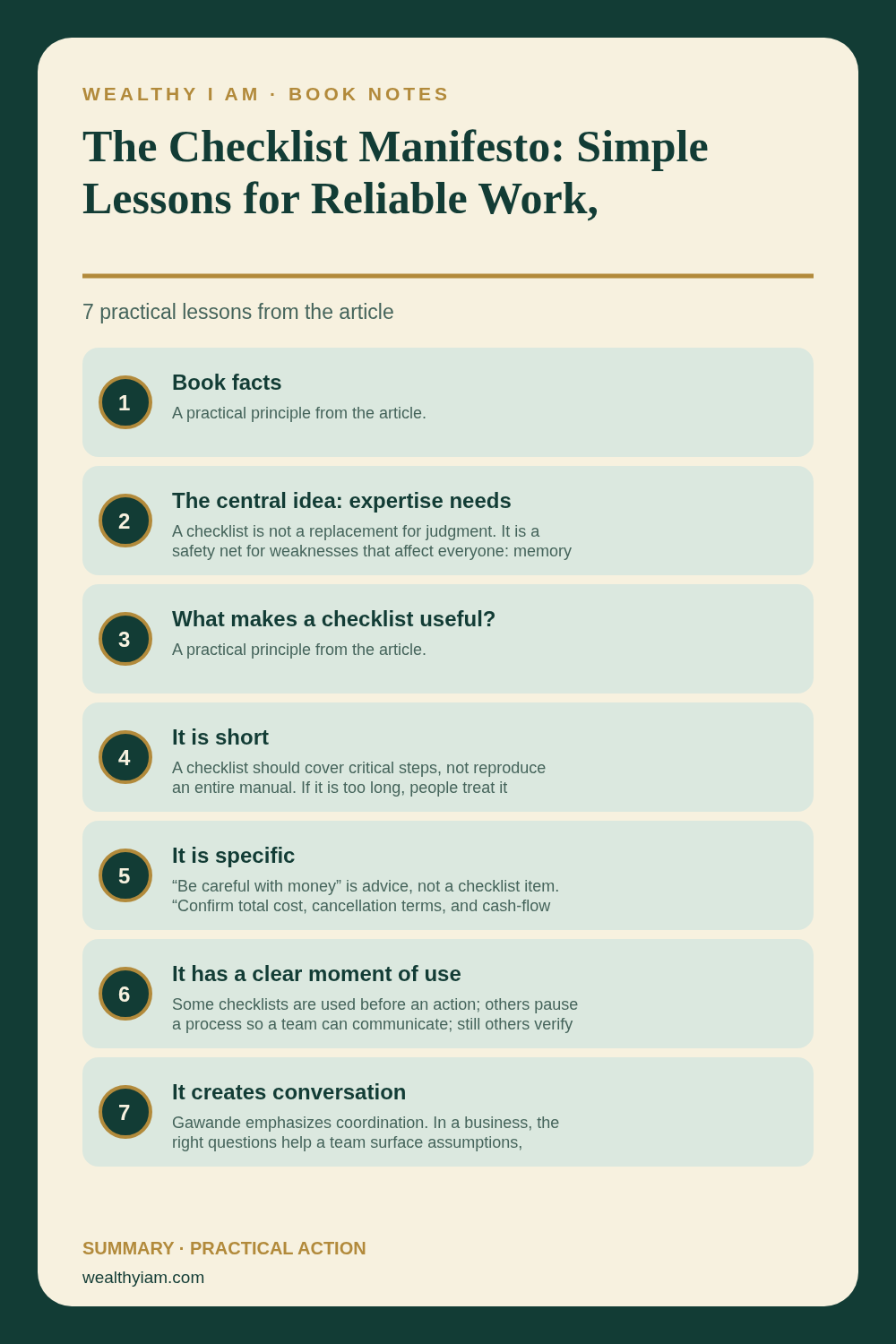
1. It is short
A checklist should cover critical steps, not reproduce an entire manual. If it is too long, people treat it like paperwork and stop using it. The goal is a quick prompt that protects the points most likely to be missed.
2. It is specific
“Be careful with money” is advice, not a checklist item. “Confirm total cost, cancellation terms, and cash-flow impact before signing” is observable. Good items tell you what to check, not merely how to feel.
3. It has a clear moment of use
Some checklists are used before an action; others pause a process so a team can communicate; still others verify completion. Decide when yours belongs in the workflow. A checklist hidden in a folder cannot protect a decision.
4. It creates conversation
Gawande emphasizes coordination. In a business, the right questions help a team surface assumptions, ownership, deadlines, and risks before they become expensive surprises.
Five practical lessons for building wealth
Lesson 1: Turn goals into systems
A goal such as “build wealth” is directionally helpful but operationally vague. Convert it into recurring actions. A monthly money checklist might ask: Did income arrive as expected? Were essential bills covered? Was the planned saving or investing transfer completed? Did any subscription, fee, or debt balance change? Are upcoming large expenses visible? Its value comes from making a good behavior easier to repeat than to forget.
Lesson 2: Use a pre-decision checklist for purchases
Before a significant purchase, pause and ask: Is this a need, durable value, or short-lived impulse? What is the full cost, including maintenance, interest, taxes, and time? Does it support my priorities? What will I give up by buying it? A sixty-second pause can prevent a recurring expense from competing with an emergency fund or investment.
Lesson 3: Create an investment checklist
A checklist cannot eliminate investment risk or tell you what will happen next. It can force a disciplined review. Before buying, write down what the asset is, how it is expected to create value, what could make the thesis wrong, what fees and taxes apply, how large the position will be, and how it fits your allocation. If you cannot explain the decision plainly, slow down. Add a behavior check: Am I buying because of a researched plan or because the price is moving?
Lesson 4: Put quality control into the business
In a small business, create short checklists for moments where mistakes damage trust: onboarding a client, sending an invoice, publishing an offer, processing a refund, and closing a month. Include the person responsible and final verification. Reliability becomes a competitive advantage when customers experience fewer surprises.
Lesson 5: Review and improve the checklist
After a mistake, ask whether a missing prompt, unclear ownership, or poor timing contributed. Remove items that never help. Rewrite vague language. Test the revised version with the people who use it. Improvement comes from learning, not defending the first draft.
A seven-day checklist-building exercise
- Day 1 — Choose one process: Pick a recurring activity with financial consequences, such as weekly planning, investing, sales follow-up, or monthly close.
- Day 2 — Map the steps: Write the process from start to finish without trying to make it elegant.
- Day 3 — Find failure points: Mark steps most likely to be forgotten, misunderstood, or skipped under pressure.
- Day 4 — Cut the list: Keep only critical prompts. Aim for a tool readable in under two minutes.
- Day 5 — Make items observable: Replace “review carefully” with a question or action producing a clear yes, no, number, or note.
- Day 6 — Place it in the workflow: Put the checklist where the decision happens: calendar, project template, spreadsheet, or client system.
- Day 7 — Run and revise: Use it once, record what was awkward or missing, and improve it immediately.
What the book gets right—and what it does not promise
The book’s strongest message is humble: better outcomes often come from making essential actions visible. Checklists support experts; they do not insult them. This transfers well from operating rooms to personal finance and entrepreneurship.
But a checklist cannot provide knowledge, ethics, or judgment. A neat list can still contain bad assumptions. It cannot guarantee an investment return, eliminate business uncertainty, or replace professional advice for tax, legal, or medical questions. Use it to strengthen thinking, not outsource responsibility.
Bottom line
The Checklist Manifesto is a practical book about turning good intentions into reliable execution. For wealth builders, identify the decisions that compound, define the few steps that protect them, and make those steps routine. A short checklist will not make every choice easy, but it can help you do the right things consistently—especially when memory, attention, and confidence are least dependable.
Sources & credit
- Atul Gawande’s official book page — author and book context.
- Amazon.com matched product page — U.S. listing and bibliographic details.
- Amazon.com hardcover listing — matched hardcover edition, ISBN 9780805091748.
- Open Library high-resolution cover image — cover image credit.
Wealthy I AM Action Card
Wealthy I AM Pinterest Copy
TITLE
The Checklist Manifesto: Simple Lessons for Reliable Work, Better Decisions, and Wealth
DESCRIPTION
Atul Gawande’s The Checklist Manifesto shows how short, well-designed checklists improve execution, money decisions, and the reliable habits behind wealth.
KEYWORDS
The Checklist Manifesto book summary, Checklist Manifesto lessons, personal development, wealth building, productivity books
ALT TEXT
Wealthy I AM visual summary of The Checklist Manifesto: Simple Lessons for Reliable Work, Better Decisions, and Wealth
ARTICLE URL
https://nappot.com/checklist-manifesto-simple-lessons-reliable-work-better-decisions-wealth/