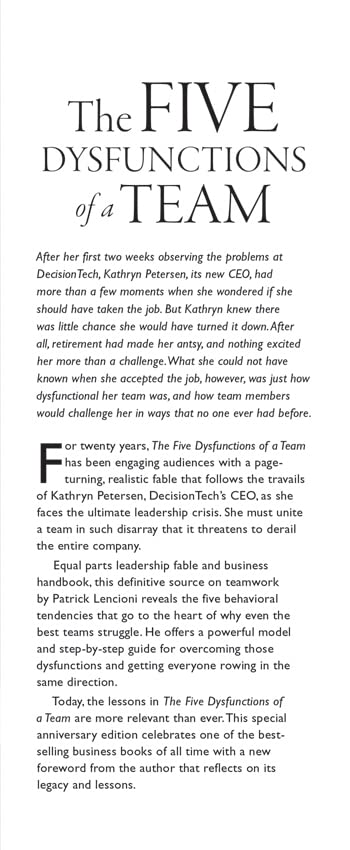
The Five Dysfunctions of a Team: A Leadership Fable by Patrick Lencioni is a short business story with a serious lesson: talented people do not automatically become a high-performing team. When trust is missing, disagreement is hidden, decisions stall, standards slip, and individual priorities can quietly outrank the mission.
That matters to wealth building because a business, department, or client-facing project creates value through coordinated effort. Better teamwork can improve execution, customer service, retention, and the quality of decisions that compound over time. Lencioni’s model is useful because it treats team health as a sequence. The higher problems are usually symptoms of lower ones.
The central model: five connected breakdowns
Lencioni presents five dysfunctions in a pyramid. At the base is absence of trust. Without trust, people avoid fearless conflict, so important issues remain unspoken. Without healthy conflict, teams struggle to reach commitment. Without commitment, colleagues avoid accountability. And without accountability, the group drifts into inattention to results.
This is not a claim that every team problem has one cause. It is a practical diagnostic: begin with the foundation instead of demanding better results from a group that cannot speak honestly or make clear decisions.
Lesson 1: Build vulnerability-based trust
Trust in this framework is more than believing that someone will keep a secret. It means team members can admit a mistake, ask for help, say “I do not know,” and disclose a concern without spending energy protecting their image. That kind of vulnerability makes useful information visible early.
Step by step:
- Start a project meeting with a brief personal or professional check-in.
- Have each person name one strength they bring and one area where they need support.
- When a mistake appears, separate learning from blame: ask what happened, what was assumed, and what will change.
- As the leader, model the behavior first. A leader who pretends to have every answer teaches everyone else to hide uncertainty.
For a small business, this protects cash and time. Problems raised in week one are usually cheaper than problems discovered after a missed deadline, lost customer, or unnecessary expense.
Lesson 2: Make conflict productive
Healthy conflict is a direct debate about ideas, priorities, and trade-offs. It is not personal hostility. Lencioni’s point is that artificial harmony can be more dangerous than respectful disagreement because a team may leave a meeting appearing aligned while privately holding objections.
Use this sequence:
- State the decision that must be made.
- Invite the strongest argument against the current proposal.
- Ask what evidence would change each person’s mind.
- Critique the idea, not the character or motives of its owner.
- End with a decision and a date for reviewing the result.
Owners can apply this to pricing, hiring, marketing spend, and investment in new products. A candid conversation may feel slower, but it reduces the hidden cost of weak assumptions and passive resistance.
Lesson 3: Create commitment through clarity
Commitment does not require unanimous enthusiasm. It requires that people know what was decided, why it matters, who owns the next action, and when progress will be reviewed. Ambiguity creates rework: each person acts on a different version of the plan.
At the end of every important meeting, record four items:
- Decision: What are we doing?
- Reason: What outcome are we pursuing?
- Owner: Who has the next move?
- Deadline: When will the work or result be visible?
Then communicate the decision in one short written note. This is especially valuable for wealth-building work, where delays in launching an offer, following up with prospects, or reviewing finances can quietly become missed opportunities.
Lesson 4: Practice peer accountability
Accountability means team members are willing to address a missed standard with one another. It is not a manager’s private system for correcting everyone. When only the leader notices problems, the organization becomes dependent on one person and capable people learn to wait for supervision.
Make standards observable. “Improve customer service” is vague; “reply to every qualified inquiry within one business day” can be reviewed. Choose a small set of commitments, publish them, and ask peers to raise gaps early and specifically. A useful sentence is: “We agreed to X; I see Y; what is blocking the commitment?”
Accountability should be fair. Check whether the target was realistic, the person had the needed resources, and the priority has changed. The goal is not public embarrassment. The goal is reliable execution and a culture where promises mean something.
Lesson 5: Put collective results first
The final dysfunction is losing sight of the shared result. Individuals may protect a department, a commission, a favorite project, or their own status while the company misses its real objective. A team can be busy and still be losing.
Translate the mission into a visible scoreboard. Depending on the organization, that might include cash collected, gross margin, customer retention, completed work, or qualified leads. Use a few measures rather than a wall of numbers. Review them on a predictable rhythm and ask:
- What result matters most this period?
- Which activity is helping it?
- Which activity is consuming resources without enough return?
- What must we stop, start, or improve next?
Results are not only financial. Sustainable wealth also depends on reputation, customer trust, learning, and the ability to develop future leaders. The scoreboard should reflect the value the organization intends to create, not merely whatever is easiest to count.
A practical 30-day team reset
Put the model into action without turning it into a complicated program. In week one, ask each team member to identify one strength, one current obstacle, and one behavior that would make collaboration easier. In week two, hold a structured debate about the most important current decision. In week three, publish three measurable commitments with owners and dates. In week four, review the results and discuss where trust, conflict, commitment, or accountability broke down.
Repeat the cycle. Team health is not a workshop that can be completed once. It is a management practice reinforced by what leaders reward, tolerate, and discuss.
What to take from the book
The Five Dysfunctions of a Team is not a promise that every group can be fixed with better meetings. Some problems require a role change, a clearer strategy, new skills, or a difficult personnel decision. The model’s value is that it gives leaders a shared language for diagnosing the human side of execution.
The wealth lesson is straightforward: value is created by people who can trust one another enough to be honest, disagree well, decide clearly, keep promises, and measure the result. Build those behaviors deliberately, and your team becomes more than a collection of talented individuals—it becomes an asset that can keep producing value.
Sources and credit
- Penguin Random House Canada: book listing — bibliographic and publisher reference.
- Google Books: The Five Dysfunctions of a Team — title and author reference.
- Amazon.com: The Five Dysfunctions of a Team — verified product page and cover reference.
This article is an original educational interpretation and is not affiliated with or endorsed by the author or publisher.