Personal finance can feel like a maze of products, predictions, and competing opinions. In The Index Card: Why Personal Finance Does Not Have to Be Complicated, Helaine Olen and Harold Pollack argue that most households do not need a secret strategy. They need a short list of durable rules followed consistently. Save a meaningful share of income, control costly debt, use tax advantages, diversify, protect against major risks, and refuse to let financial noise replace a plan.
This is not a promise of instant riches. It is a practical case for clarity. The lessons below turn the book’s framework into a repeatable wealth-building routine.

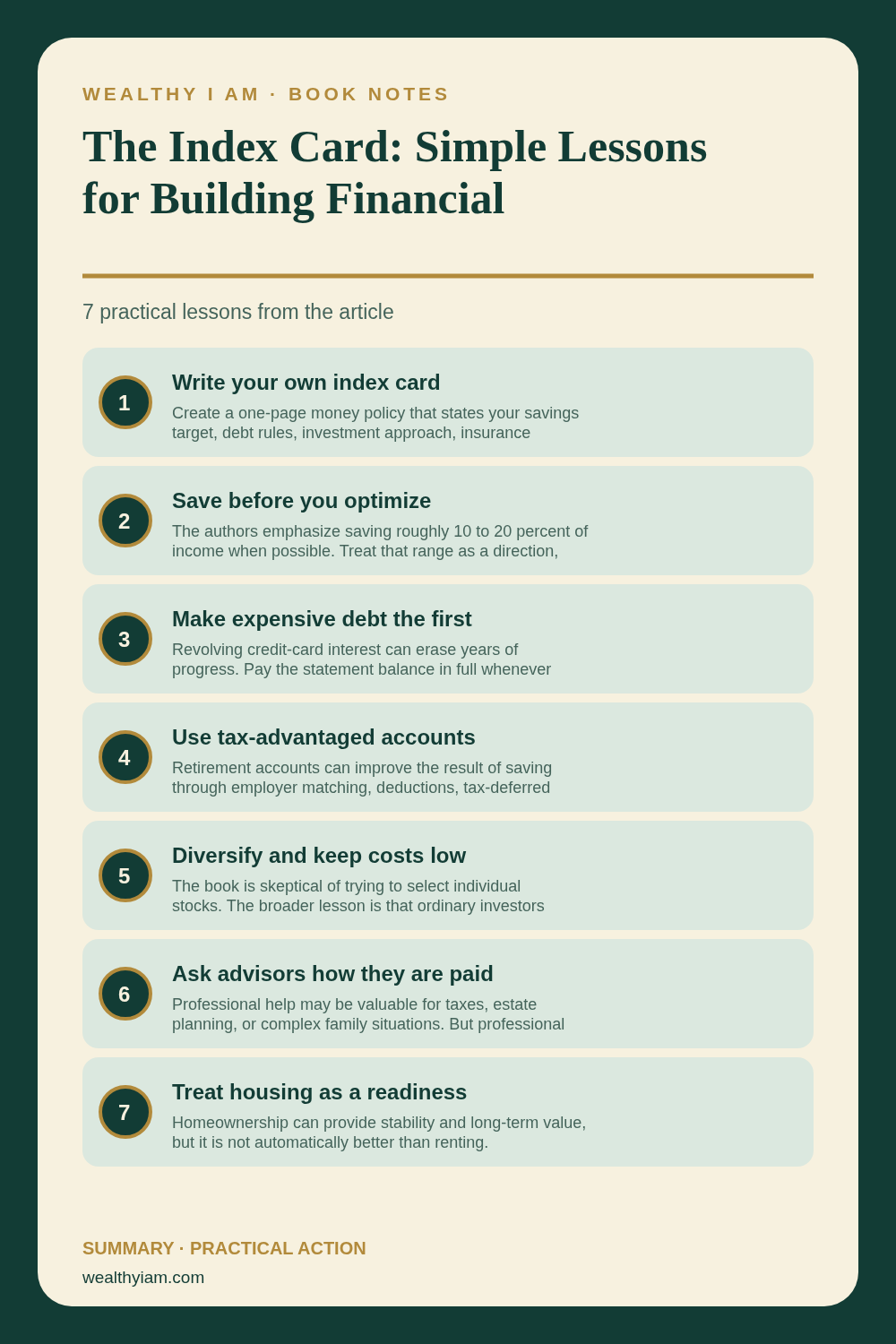
1. Write your own index card
Create a one-page money policy that states your savings target, debt rules, investment approach, insurance priorities, and conditions for major purchases. The purpose is not to predict the economy. It is to decide how you will behave when markets fall, a salesperson creates urgency, or a new trend promises easy returns.
Keep the policy visible and review it every quarter. A written baseline reduces decision fatigue and makes progress measurable. Change it deliberately when your life changes instead of abandoning it because of one frightening headline.
2. Save before you optimize
The authors emphasize saving roughly 10 to 20 percent of income when possible. Treat that range as a direction, not a moral test. If your margin is small, start with an amount you can sustain and increase it after raises, bonuses, or debt payoffs.
- Calculate normal take-home income.
- Automate a transfer on payday.
- Raise the percentage whenever your cash flow improves.
Automation turns intention into a default. Wealth comes not only from earning more, but from keeping and investing part of what you earn.
3. Make expensive debt the first emergency
Revolving credit-card interest can erase years of progress. Pay the statement balance in full whenever possible, and stop adding new charges while you build a payoff plan. List each debt, interest rate, balance, and minimum payment. Keep every minimum current, then direct extra cash toward the highest-cost balance unless another method is the one you can actually sustain.
Do not treat all debt as identical. A manageable low-rate loan and high-interest revolving debt create different risks. Understand the cost, protect cash flow, and avoid borrowing for consumption that will not improve your future options.
4. Use tax-advantaged accounts
Retirement accounts can improve the result of saving through employer matching, deductions, tax-deferred growth, or tax-free withdrawals depending on the account and local rules. Capture any employer match first. Then compare tax treatment, contribution limits, investment choices, and total costs before directing additional savings.
Choose a contribution percentage, automate it, and set an annual review date. The best account is useless if you never fund it, so favor a system you understand and can maintain.
5. Diversify and keep costs low
The book is skeptical of trying to select individual stocks. The broader lesson is that ordinary investors should not need a crystal ball to participate in economic growth. Broad, low-cost index funds can spread exposure across many companies and reduce the damage caused by one bad business or one confident guess.
Before buying any fund, check what it owns, its expense ratio, transaction costs, tax implications, and whether it fits your intended allocation. Diversification cannot prevent losses, but it limits the consequences of being wrong about one company or sector. Align risk with your time horizon and ability to tolerate a decline, not with the mood of the market.
6. Ask advisors how they are paid
Professional help may be valuable for taxes, estate planning, or complex family situations. But professional does not automatically mean conflict-free. Ask whether an advisor commits to a fiduciary standard, how they are compensated, what products they can sell, and what total costs you will pay.
Request clear answers in writing. A transparent fee structure and a willingness to explain recommendations are healthy signs. If an offer depends on urgency, secrecy, or guaranteed returns, step back and seek another opinion.
7. Treat housing as a readiness decision
Homeownership can provide stability and long-term value, but it is not automatically better than renting. Consider the down payment, reserves, maintenance, taxes, insurance, interest, mobility, and the time you expect to stay. Buy when the full cost fits your life and budget, not because social pressure says ownership is the only responsible choice.
Run a conservative scenario that includes repairs and a period of lower income. A home should support resilience rather than consume every available dollar.
8. Protect against catastrophic setbacks
Insurance protects wealth because it transfers risks that could erase years of saving. Review health, disability, life, renters or homeowners, auto, and liability coverage according to your responsibilities. The right amount depends on your household, dependents, assets, and ability to absorb a loss.
Use an emergency reserve for ordinary disruptions and insurance for events that would be financially devastating. Revisit coverage after marriage, parenthood, a home purchase, a career change, or a major increase in assets.
9. Create a short money check-in
Once a week, review balances, upcoming bills, debt payments, savings transfers, and one spending category that drifted. Once a month, compare actual saving with your target. Once a quarter, review fees, insurance, investment allocation, and goals.
This is not about obsessing over every purchase. It is about noticing problems while they are small: missed payments, unwanted subscriptions, and silent lifestyle inflation are easier to correct early.
10. Let simplicity compound
The lasting lesson of The Index Card is that clarity beats complexity. You do not need to know every product, predict every market move, or optimize every decision. You need sustainable saving, manageable debt, diversified investments, appropriate protection, and enough patience to let time work.
Choose one action today: automate a transfer, cancel a costly account, check an investment fee, pay down a balance, or schedule an insurance review. Then repeat it. Financial freedom is less about discovering a hidden trick than making ordinary good decisions consistently.
Sources and credit
Book: The Index Card: Why Personal Finance Does Not Have to Be Complicated by Helaine Olen and Harold Pollack, Portfolio, 2016, paperback ISBN 978-0143130529.
Verification and product page: Amazon.com. Bibliographic reference: Better World Books.
This article is educational and is not individualized financial, tax, or insurance advice.
Wealthy I AM Action Card
Wealthy I AM Pinterest Copy
TITLE
The Index Card: Simple Lessons for Building Financial Confidence and Wealth
DESCRIPTION
The Index Card by Helaine Olen and Harold Pollack turns personal finance into a simple plan for saving, debt, investing, and.
KEYWORDS
The Index Card book summary, Index Card lessons, personal development, wealth building, productivity books
ALT TEXT
Wealthy I AM visual summary of The Index Card: Simple Lessons for Building Financial Confidence and Wealth
ARTICLE URL
https://nappot.com/index-card-simple-lessons-financial-confidence-wealth/