Building wealth through investing is less about finding the next exciting story and more about learning to recognize businesses that can defend their profits over time. In The Little Book That Builds Wealth: The Knockout Formula for Finding Great Investments, Pat Dorsey presents a practical framework for studying those defenses—what he calls economic moats.
Dorsey’s central idea is straightforward: a company may be able to earn attractive returns for years when it has a durable advantage that competitors cannot easily copy. But a strong business is not automatically a strong investment. The price still matters. This article translates the book’s framework into a repeatable research process for long-term investors.

Book facts
- Title: The Little Book That Builds Wealth: The Knockout Formula for Finding Great Investments
- Author: Pat Dorsey
- First published: 2008
- Core subject: Economic moats, business quality, competitive advantage, and valuation
What is an economic moat?
A moat is a structural advantage that protects a company from competition, much as a moat once protected a castle. The useful question is not simply whether a company is popular today. It is whether the company can continue earning strong returns when rivals try to take its customers, copy its products, or undercut its prices.
Dorsey emphasizes four common sources:
1. Intangible assets
Brands, patents, licenses, and trusted reputations can give a business pricing power or access that others lack. A brand is valuable when customers choose it consistently and the company can charge enough to justify the cost of maintaining it. A patent or regulatory license matters only while it meaningfully limits competition.
2. Cost advantages
Some companies can deliver the same value at a lower cost because of scale, location, process expertise, or a distinctive operating model. They may pass the savings to customers to gain share, or keep higher margins. The test is whether competitors can reproduce the cost structure—not merely whether the company is efficient this year.
3. Switching costs
Customers may stay because changing providers would be expensive, disruptive, or risky. Software embedded in a company’s workflow, specialized training, data migration, and operational dependence can create this protection. Switching costs are strongest when they reduce customer churn without trapping customers through poor service.
4. Network economics
A network can become more useful as more people use it. More users attract more users, partners, or data, creating a reinforcing advantage. Yet network effects are not guaranteed: investors should ask whether the network is genuinely difficult to displace and whether participants can move elsewhere easily.
Why a moat is not enough
A durable advantage can improve a business’s economics, but investors can still lose money by paying too much. Dorsey therefore connects moat analysis with industry structure, management, financial performance, and valuation. A wonderful company bought at an unreasonable price may produce disappointing returns. Conversely, a cheap stock with weak economics may be cheap for a good reason.
The practical lesson is to separate three judgments: How good is the business? How durable is its advantage? and What price gives me a reasonable margin of safety? Keeping those questions separate reduces the temptation to let admiration for a company override valuation discipline.
A step-by-step moat research process
- Describe the business plainly. Write one paragraph explaining what the company sells, who pays, and why customers choose it. If you cannot explain the business, you are not ready to assess its moat.
- Identify the advantage. Classify the suspected moat: intangible asset, cost advantage, switching cost, or network effect. If none fits, do not force the label.
- Look for evidence in the numbers. Review multi-year returns on invested capital, operating margins, cash generation, and market share. One excellent year is not proof of durability.
- Test the customer’s alternatives. Ask what would happen if a competitor offered a similar product tomorrow. How hard would it be for customers to switch? What would they lose?
- Study the industry. Check rivalry, supplier power, regulation, capital intensity, and the threat of substitutes. A company’s advantage exists inside an industry, not in isolation.
- Assess whether the moat is widening or eroding. Watch for falling retention, discounting, new technology, changing regulation, or competitors taking share. A moat is a hypothesis that must be monitored.
- Evaluate management and capital allocation. Leaders can strengthen an advantage through reinvestment and disciplined decisions, or destroy it through acquisitions, debt, and short-term thinking.
- Estimate a sensible value. Use conservative assumptions about revenue, margins, reinvestment, and growth. Compare your estimate with the market price and define what would make you walk away.
Practical lessons for building wealth
Study businesses, not ticker symbols. A stock price is a quote; ownership is a claim on a company’s future cash flows. Reading annual reports, competitor filings, and customer commentary can reveal more than reacting to daily headlines.
Prefer durability over drama. A predictable business with a modest growth rate may compound more reliably than a fashionable company whose future depends on perfect execution. The aim is not to predict every event; it is to improve the odds.
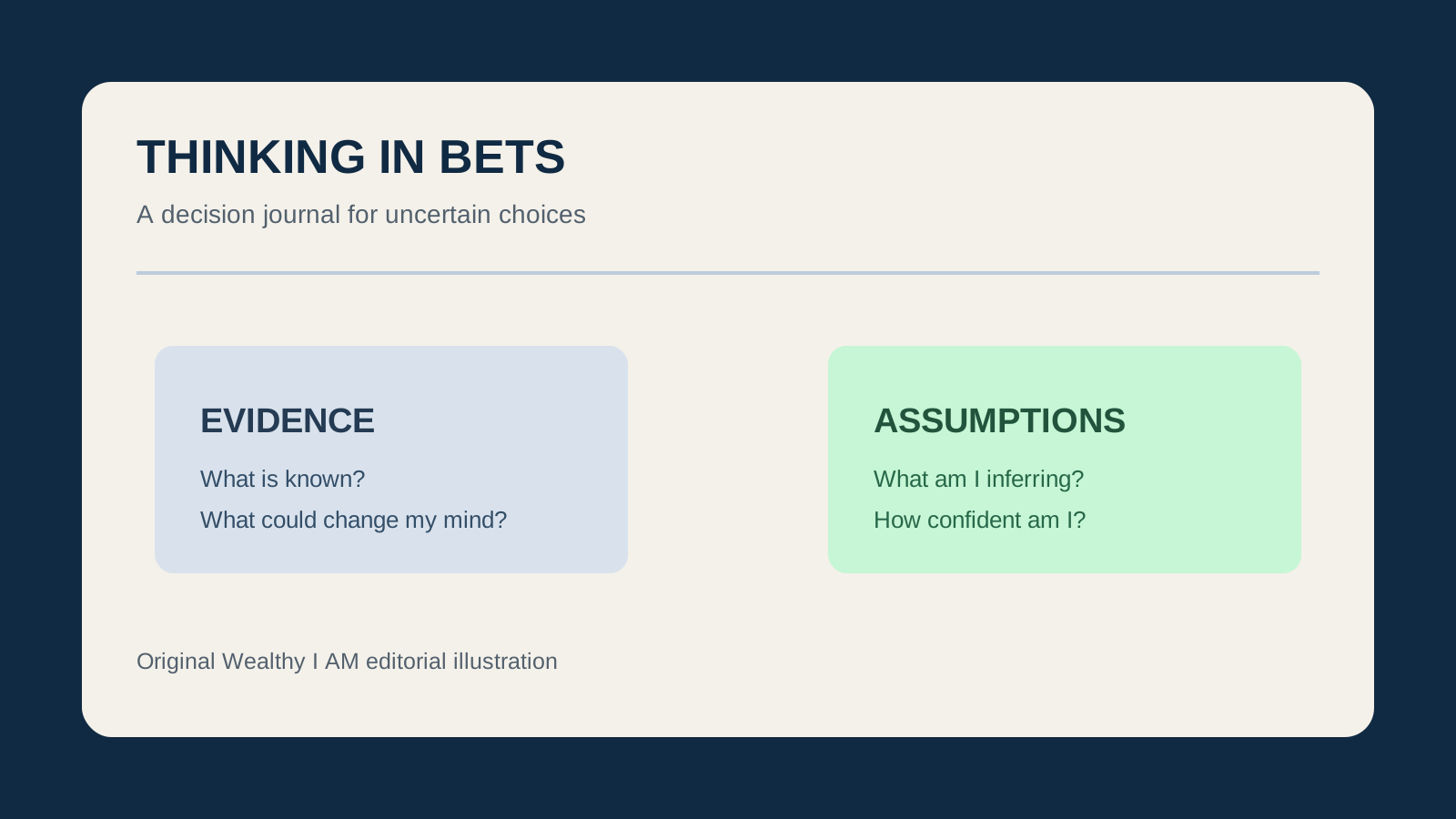
Keep a written thesis. Before buying, record the moat source, supporting evidence, key threats, valuation assumptions, and conditions that would invalidate the idea. This turns investing into a learning process rather than a collection of impulses.
Use patience as an advantage. If the research is sound, short-term price movement need not dictate every action. Patience does not mean ignoring bad news; it means distinguishing temporary volatility from permanent impairment.
Remember diversification. Even careful analysis can be wrong. Position sizing and diversification protect a portfolio from one mistaken moat assessment, accounting surprise, or industry disruption.
A simple checklist
- What exactly is the company’s competitive advantage?
- Why can’t a well-funded competitor copy it?
- Is the advantage visible in long-term economics?
- Is it strengthening, stable, or eroding?
- What could permanently damage it?
- What price am I paying relative to conservative value?
- What would prove my thesis wrong?
Bottom line
The Little Book That Builds Wealth offers a durable investing lens: look for companies protected by real competitive advantages, verify that those advantages produce attractive economics, and refuse to ignore valuation. Its framework is not a promise of market-beating returns and is not a substitute for personal financial advice. Its value is in improving the questions investors ask before committing capital.
Sources and credits
- Wiley official book page — title, author, ISBN, publication details, and description.
- Amazon.com product page — matched U.S. product listing and edition reference.
- Open Library cover image — cover asset used in this article.
This article is an original educational interpretation and is not investment advice.