Growth becomes dangerous when a company treats every new idea as a large bet. Teams spend months building features, leaders defend forecasts, and customers are asked to validate a plan they never helped shape. By the time the results arrive, the market may have moved. In The Startup Way: How Entrepreneurial Management Transforms Culture and Drives Growth, entrepreneur and author Eric Ries argues that established organizations can learn to innovate with the discipline of a startup without abandoning the accountability of good management.
The book extends the build-measure-learn thinking associated with The Lean Startup into larger companies, public organizations, and teams inside existing businesses. Its practical message is valuable for wealth builders: durable growth comes from learning quickly, allocating resources carefully, and turning evidence into better decisions—not from confusing activity with progress.

What the book is about
Ries focuses on entrepreneurial management: a system that allows people to test uncertain ideas while giving leaders a way to measure learning, stop weak projects, and scale successful ones. A startup is not merely a small company. In the book’s sense, it is a human institution trying to create a new product or service under conditions of uncertainty. That can describe a two-person venture, a new division inside a corporation, or a public-sector team designing a better service.
The tension is familiar. Traditional management is excellent at repeating a known process efficiently, but innovation begins before the process is known. The answer is not to replace discipline with improvisation. It is to use a different kind of discipline: clear assumptions, small experiments, customer feedback, measurable milestones, and decisions that distinguish genuine progress from impressive-looking busyness.
Five ideas worth carrying forward
1. Innovation is a management responsibility
Innovation should not be left to a special lab while the rest of the organization protects the present. Leaders shape incentives, budgets, reporting systems, and the tolerance for honest learning. If every team is rewarded only for predictable short-term output, uncertain but important opportunities will be neglected.
2. Test assumptions before scaling
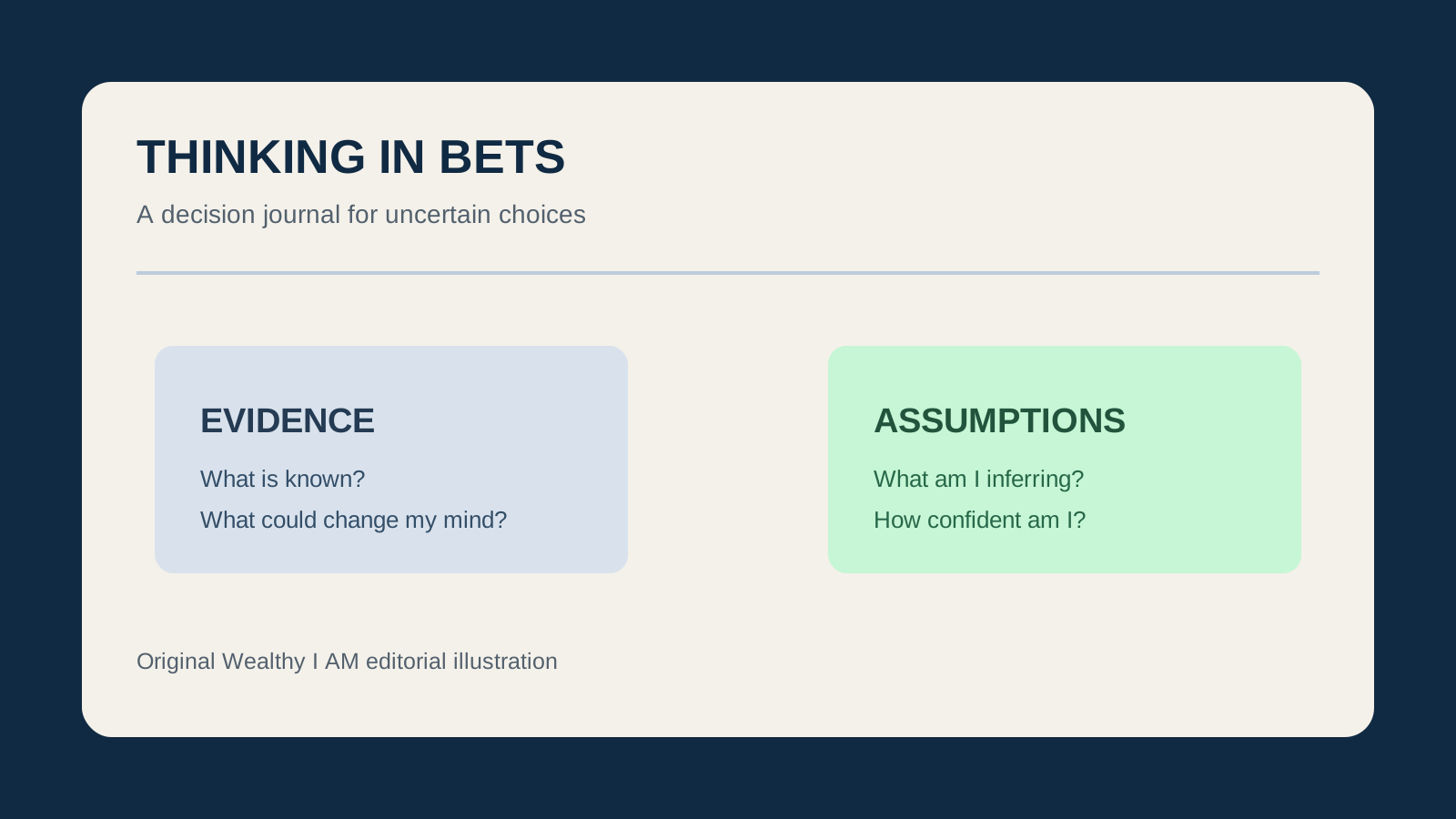
Every new product contains guesses: who needs it, what problem matters, which behavior will change, and what people will pay for. A minimum viable product is not a careless or unfinished product. It is the smallest responsible experiment that can produce useful evidence about an important assumption.
3. Measure learning, not vanity
Downloads, meetings, features shipped, and press coverage may be interesting, but they do not automatically prove value. A useful metric shows whether customers are receiving a meaningful result. Ries’s approach encourages teams to connect a hypothesis to a measurable behavior and then ask what the result actually teaches.
4. Pivot or persevere deliberately
Perseverance means continuing because evidence supports the direction, not because a team has already invested time. A pivot is a structured change to the strategy based on what has been learned. Both choices require courage. The goal is to protect the mission while remaining willing to change the method.
5. Build a repeatable innovation engine
One successful experiment is not the same as an innovative organization. Sustainable growth requires a portfolio of teams, a common language for evidence, leaders who remove obstacles, and a resource-allocation process that can fund promising work without writing blank checks.
Seven practical steps for building wealth through better execution
- Write the risky belief: Before starting a project, state the single assumption that could make it fail. For a business, it might be “freelancers will pay for a faster way to reconcile invoices.” For a career, it might be “clients value this specialized service enough to recommend it.”
- Define the customer outcome: Replace vague goals such as “increase engagement” with a result a real person can recognize: time saved, errors reduced, revenue generated, or a problem solved.
- Design the smallest ethical test: Build only what is needed to learn. A landing page, concierge service, interview, prototype, or manual workflow may reveal more than months of speculative engineering.
- Choose one actionable metric: Track the behavior that would confirm value. Pair it with a guardrail such as refund rate, support burden, quality, or margin so growth does not hide damage.
- Set a decision date: Decide in advance when you will review the evidence. This prevents projects from surviving indefinitely because nobody wants to make the call.
- Separate learning from ego: A failed hypothesis is an asset if it prevents a larger loss. Reward teams for surfacing reality early, not for making every presentation look successful.
- Reinvest in what works: When evidence is strong, document the process, improve the economics, and allocate more resources gradually. Profitable repetition turns an experiment into a durable business capability.
How this connects to personal wealth
The Startup Way is about organizations, but its logic applies to an individual financial life. Treat a new income stream as an experiment rather than a fantasy. Test an offer with a few customers before buying expensive equipment. Learn a valuable skill through a small project before paying for a large program. Track net income, time spent, repeat demand, and the quality of the work. Then decide whether to improve, change direction, or stop.
This approach protects capital and attention. A person who runs small, honest tests can discover what the market values while keeping downside manageable. The aim is not to turn every part of life into a spreadsheet. It is to replace unexamined assumptions with feedback, so money is directed toward skills, relationships, products, and assets that create real value.
A 30-day implementation plan
- Week 1 — Observe: Interview customers, coworkers, or potential users. List recurring frustrations and the workarounds people already use.
- Week 2 — Hypothesize: Pick one problem, write one value proposition, and select one metric that would show meaningful progress.
- Week 3 — Test: Deliver the smallest useful version manually or with a lightweight prototype. Ask for behavior and payment where appropriate, not compliments alone.
- Week 4 — Decide: Review results, economics, and customer feedback. Persevere, pivot, or stop—and record the lesson so the next project begins smarter.
What to be careful about
Experimentation is not an excuse to lower quality, ignore privacy, or ship unsafe products. A minimum viable product must still be honest, usable, and appropriate to the stakes. Financial, health, and security-related services need strong safeguards even when the team is learning. Likewise, a metric can be optimized while the customer experience gets worse, so pair numbers with direct feedback and long-term outcomes.
The framework also requires patience. Not every valuable idea produces immediate results, and not every early signal is reliable. Use small tests to reduce uncertainty, but keep the larger mission and time horizon in view.
Bottom line
The Startup Way offers a practical bridge between entrepreneurial energy and responsible management. Its central lesson is simple: when the future is uncertain, do not spend your way toward confidence. Create a small test, learn from real behavior, measure what matters, and allocate resources based on evidence. For a founder, manager, or individual building financial independence, that habit can reduce waste, improve judgment, and turn steady learning into sustainable growth.
Sources and credits
This is an original educational article about the book’s ideas and is not affiliated with Eric Ries, Penguin Random House, Penguin Books, or Amazon.
- Penguin Random House publisher page — author, publication details, premise, and book description.
- Penguin Books edition page — paperback ISBN 9780241197264 and edition verification.
- Amazon.com product page — verified U.S. product listing for the hardcover ISBN 0241197260.
- Open Library cover image — matched paperback cover image used in this article.
Book credit: The Startup Way was written by Eric Ries. Cover image credit belongs to the respective publisher/rightsholder.