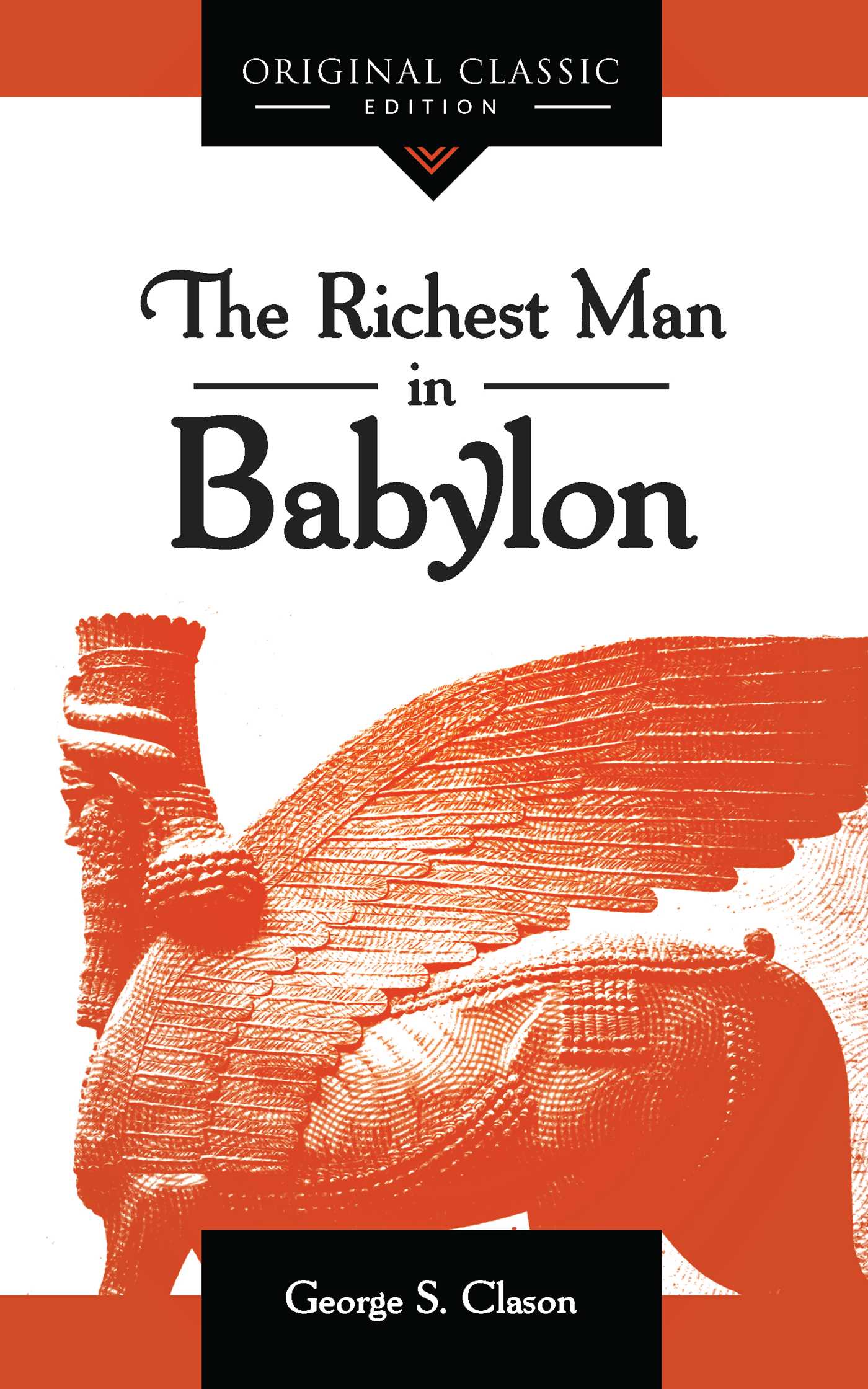
The Richest Man in Babylon is a personal-finance classic by George S. Clason. First published in 1926, it teaches money lessons through short stories set in ancient Babylon. The setting is old, but the questions are familiar: How do I keep more of what I earn? How do I avoid losing it? How can I make it grow? [1][2]
The book’s central lesson in plain language: save part of every payment, spend with care, and make your saved money useful.
What the book is about
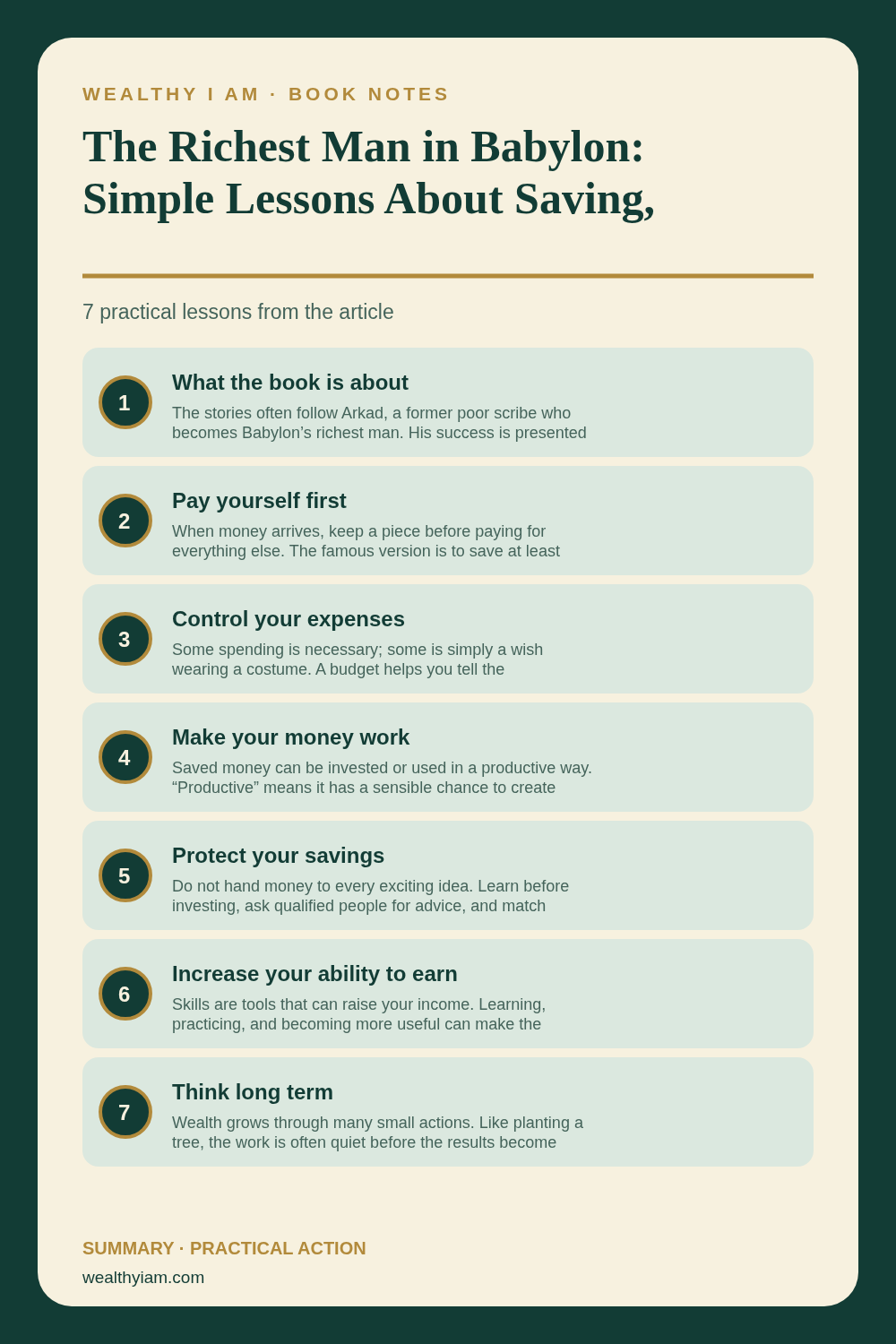
The stories often follow Arkad, a former poor scribe who becomes Babylon’s richest man. His success is presented not as magic or luck, but as the result of repeated habits. The book groups these habits into ideas such as the “Seven Cures” for an empty purse and the “Five Laws of Gold.” [1][2]
Clason’s method is memorable because each lesson is attached to a person facing a real money problem. That makes the advice feel less like a lecture and more like a conversation.
Main ideas explained simply
Pay yourself first
When money arrives, keep a piece before paying for everything else. The famous version is to save at least one-tenth, but the important point is to begin with a repeatable amount.
Control your expenses
Some spending is necessary; some is simply a wish wearing a costume. A budget helps you tell the difference so your wants do not quietly eat your future.
Make your money work
Saved money can be invested or used in a productive way. “Productive” means it has a sensible chance to create more value, income, or ownership over time.
Protect your savings
Do not hand money to every exciting idea. Learn before investing, ask qualified people for advice, and match risk to what you can actually afford to lose.
Increase your ability to earn
Skills are tools that can raise your income. Learning, practicing, and becoming more useful can make the money-saving job easier.
Think long term
Wealth grows through many small actions. Like planting a tree, the work is often quiet before the results become easy to see.
A simple plan inspired by the book
- Track what comes in and what goes out for one month.
- Choose a savings percentage that you can keep doing. Start small rather than making a promise you will abandon.
- Build an emergency fund, which is money set aside for surprises such as a repair or lost income.
- Before investing, understand the product, its fees, its risks, and how easily you can get your money back.
- Raise your savings or earning power when your income improves instead of automatically raising every expense.
What the book gets right
- Habits beat wishes. Wanting wealth is not a plan; automatic saving turns an idea into an action.
- Keeping money matters. Earning more does not help if every extra dollar disappears.
- Risk deserves respect. The book warns against following exciting schemes without understanding them.
- Time is an ally. Saving and investing early gives money more years to grow.
What to be careful about
The book is wise about discipline, but it is not a complete modern financial plan. A fixed savings rule may be difficult for someone facing very low income, high-interest debt, or urgent needs. Investment choices also depend on taxes, fees, inflation, time horizon, and personal risk.
Its advice about owning a home or using particular investments should not be treated as a universal command. The right choice depends on the person and the price. Use the stories as principles, then check the details with current, trustworthy information.
Kid-simple takeaway: keep some cookies, do not spend every cookie, and do not give your cookie jar to a stranger who promises a mountain of cookies.
Simple explanations of key terms
Parable means a short story with a lesson. Thrift means careful use of money. Assets are things that can help put money in your pocket over time. Liabilities are things that take money out. These words matter because the book turns big money ideas into simple, memorable language.
Bottom line
The Richest Man in Babylon remains useful because it makes wealth-building feel manageable. Its strongest message is not “get rich quickly.” It is “do the small, sensible things again and again”: save, control spending, protect your money, invest carefully, and keep learning. Those habits cannot guarantee riches, but they can make your financial life stronger and less confusing.
How to apply the lessons in real life
The value of Clason’s advice is not in memorizing a slogan. It is in turning the slogan into a system that works on an ordinary Tuesday. Start by giving your money clear jobs. One part can cover current bills, one part can build a buffer, and one part can support long-term goals. When every dollar has a purpose, spending becomes a choice instead of a surprise.
Next, make the good choice easy. A scheduled transfer on payday can move savings before temptation appears. A separate account can create a small wall between everyday spending and future plans. Review the arrangement monthly, but do not redesign it every time your mood changes. Consistency is more powerful than financial drama.
Then use a simple decision filter before committing money. Can you explain how the opportunity works? What could make it lose value? What fees will you pay? How long might your money be unavailable? If you cannot answer those questions, pause. Protecting money often means declining an opportunity that you do not understand.
Finally, invest in your earning ability. A course, certification, portfolio project, sales skill, or better professional habit may increase future income more reliably than chasing a lucky trade. The book’s “increase your ability to earn” lesson is especially important because a stronger income can make saving, debt repayment, and investing less painful.
A balanced wealth-building checklist
- Know your monthly take-home income and essential expenses.
- Automate a sustainable amount toward savings or debt reduction.
- Build a cash reserve before taking unnecessary investment risk.
- Pay attention to high-interest debt, because interest can work against you.
- Choose diversified, understandable investments appropriate to your time horizon.
- Increase skills and earning power instead of relying only on cutting expenses.
- Review progress on a schedule, then return to patient execution.
This checklist keeps the book’s timeless principles while adding modern caution. No book can remove uncertainty, and no savings rule fits every household. The goal is a stronger process: keep part of what you earn, protect it from avoidable mistakes, and give it time to become useful.
Sources
Wealthy I AM Action Card
Wealthy I AM Pinterest Copy
TITLE
The Richest Man in Babylon: Simple Lessons About Saving, Spending, and Building Wealth
DESCRIPTION
George S. Clason’s classic personal-finance parables explained simply: pay yourself first, control spending, protect your money, and grow your ability to.
KEYWORDS
The Richest Man in Babylon book summary, Richest Babylon lessons, personal development, wealth building, productivity books
ALT TEXT
Wealthy I AM visual summary of The Richest Man in Babylon: Simple Lessons About Saving, Spending, and Building Wealth
ARTICLE URL
https://nappot.com/the-richest-man-in-babylon-simple-lessons-saving-spending-building-wealth-2/