Many goals fail quietly. A founder has a promising idea but never makes enough offers. A professional wants a higher income but delays the difficult skill-building work. Someone decides to improve their finances, then spends months researching instead of taking the first useful step. In each case, the problem may not be ambition. It may be an underestimation of the action required.
In The 10X Rule: The Only Difference Between Success and Failure, Grant Cardone argues that people commonly set goals too low, misjudge the effort needed, and stop after ordinary action produces ordinary results. His central challenge is to aim higher and create a much larger activity plan—while using judgment to keep that activity ethical, sustainable, and connected to real value.
Book facts
Title: The 10X Rule: The Only Difference Between Success and Failure
Author: Grant Cardone
First publication: 2011
Edition reference: Wiley hardcover, ISBN-13 9780470627600
Core themes: goal-setting, massive action, responsibility, persistence, problem-solving, and entrepreneurial execution.
The central idea: estimate bigger, then act deliberately
Cardone’s “10X” concept has two parts: set a target substantially larger than your first estimate, and plan substantially more action than your first calculation suggests. The point is not that every goal literally requires ten times the effort. The useful insight is that people often budget for an ideal path: quick customer decisions, no setbacks, steady motivation, and perfect timing. Reality is more expensive.
A larger activity estimate creates room for rejection, delays, learning curves, and changing conditions. For a business, that may mean more conversations before a sale. For a career, it may mean more applications, projects, and practice sessions before a breakthrough. For wealth building, it means recognizing that income growth, saving, investing, and business ownership are processes rather than single lucky events.
This is best used as an execution question: “What activity level would make progress likely even if several attempts fail?” That question is more practical than treating a large number as a guarantee.
Five lessons for building wealth and opportunity
1. Set a meaningful target, not a vague wish
“Make more money” is too unclear to guide behavior. Define the outcome, time frame, and reason. A stronger target might be to increase annual income by $20,000 in twelve months through a specific service, promotion, or skill. The reason matters because a goal that supports freedom, family security, or meaningful work is easier to evaluate than a number chosen only for status.
2. Translate the target into controllable activity
Outcomes are influenced by markets and other people. Inputs are closer to your control. Convert the target into weekly actions: ten qualified conversations, five proposals, three hours of deliberate practice, or one published portfolio project. Measure the work you can repeat, then review whether it produces evidence of demand or progress.
3. Expect obstacles before they arrive
Cardone’s framework is a reminder to plan for friction. A customer may say no, a campaign may underperform, or a new skill may take longer than expected. Build a reserve of time and cash, keep a second way to test an idea, and define what you will learn from a failed attempt. Preparation turns disappointment into information instead of a reason to quit.
4. Use massive action to test, not to ignore judgment
More activity is valuable only when it is aimed at a real problem. Sending hundreds of irrelevant messages, buying unnecessary tools, or working without rest is not wealth creation. Start with a clear customer or career hypothesis, take enough action to collect meaningful feedback, and adjust the offer. Volume should accelerate learning and value delivery—not replace them.
5. Treat responsibility as a daily practice
The book’s strongest motivational message is that progress requires ownership. You cannot control interest rates, a hiring decision, or a competitor’s move. You can control preparation, follow-up, honesty, spending discipline, and the quality of your service. Taking responsibility does not mean blaming yourself for every outcome; it means identifying the next useful response.
A practical seven-step 10X action plan
- Choose one high-value objective. Pick a result that would materially improve your income, business, or financial resilience.
- Write the ordinary estimate. List the number of calls, applications, study hours, sales, or savings contributions you initially think are required.
- Stress-test it. Add realistic allowance for rejection, delays, learning, and follow-up. Do not assume every attempt succeeds.
- Set a 30-day activity goal. Choose a challenging but measurable number of weekly actions. Keep the goal within your actual capacity.
- Block the calendar. Protect recurring work sessions before lower-value tasks consume the day.
- Track quality and results. Record activity, response rates, revenue, skill improvement, and lessons. If results remain weak, improve the strategy rather than blindly multiplying effort.
- Review and refine each week. Keep what creates value, remove what does not, and raise the standard gradually as your capability grows.
Wealth connection: bold goals become useful when paired with repeatable actions that create income, ownership, skills, trust, or investable surplus. Activity is the engine; good judgment steers it.
Where the idea needs balance
The book’s energetic style can motivate a reader who is stuck in hesitation, but “more” is not automatically better. An aggressive target can encourage learning and persistence, yet it can also produce reckless borrowing, burnout, manipulative selling, or neglect of health and relationships. Sustainable wealth requires a long time horizon, emergency reserves, ethical treatment of customers, and decisions that remain sound when motivation fades.
Use 10X thinking as a planning challenge, not as a promise of guaranteed success. Test assumptions with small experiments before committing significant money. Set boundaries for work hours and risk. If an approach requires deception, unsafe leverage, or abandoning essential responsibilities, it is not a sound wealth strategy.
Bottom line
The 10X Rule offers a simple corrective to timid goals and underpowered execution: define what you want, assume the first estimate is incomplete, and create enough consistent activity to learn and make progress. The lasting lesson is not to chase motion for its own sake. It is to replace vague ambition with a visible plan, enough attempts to overcome friction, and a weekly habit of reviewing evidence. Start with one meaningful objective, schedule the next action today, and let disciplined effort—not wishful thinking—build the next layer of your wealth.
Sources and credits
- Amazon.com product page — verified title, author, and ISBN-13 9780470627600
- Google Books — edition and cover reference
- Grant Cardone official website
Article interpretation and practical applications are original commentary by Wealthy I AM. This article is educational and is not individualized financial advice.
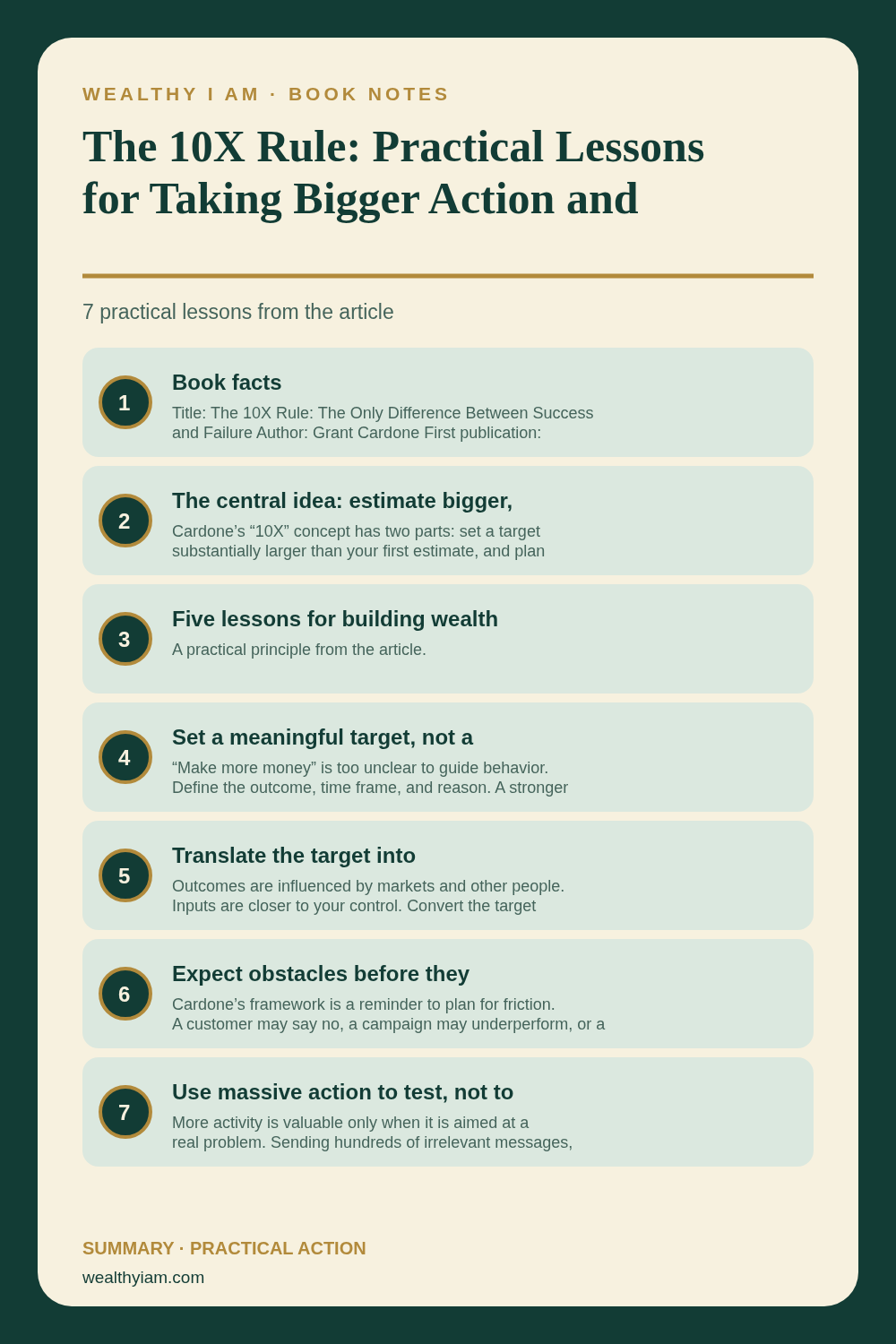
Wealthy I AM Action Card
Wealthy I AM Pinterest Copy
TITLE
The 10X Rule: Practical Lessons for Taking Bigger Action and Building Wealth
DESCRIPTION
Grant Cardone’s 10X Rule turns ambitious goals into a practical activity plan for building skills, income, and wealth—without confusing motion with.
KEYWORDS
The 10X Rule book summary, Rule lessons, personal development, wealth building, productivity books
ALT TEXT
Wealthy I AM visual summary of The 10X Rule: Practical Lessons for Taking Bigger Action and Building Wealth
ARTICLE URL
https://nappot.com/10x-rule-practical-lessons-bigger-action-building-wealth/