Money is not only a math problem. It is also a story we repeat about what we deserve, what is possible, and how safe it feels to want more. In You Are a Badass at Making Money, Jen Sincero combines personal stories, mindset prompts, and practical encouragement to help readers examine those stories and take deliberate action.
The book is not a substitute for a budget, investment plan, or professional advice. Its contribution is different: it asks readers to notice the beliefs and habits that shape earning, saving, and spending. Read it as a motivational framework, then connect its energy to sound financial decisions.

Book facts
- Title: You Are a Badass at Making Money: Master the Mindset of Wealth
- Author: Jen Sincero
- First published: 2017
- Focus: money mindset, earning, limiting beliefs, and intentional action
The central message
Sincero argues that financial change often begins before the bank balance changes. If someone assumes wealthy people are selfish, that earning more is impossible, or that money conversations are shameful, those assumptions can influence choices. The practical invitation is to replace vague fear with honest observation: What do I believe about money? Where did it come from? Is it helping me act wisely today?
This is mindset work, not magical thinking. A positive statement cannot pay a bill by itself. But a clearer relationship with money can make it easier to ask for a raise, learn a valuable skill, sell a useful service, create a savings system, or stop avoiding financial information.
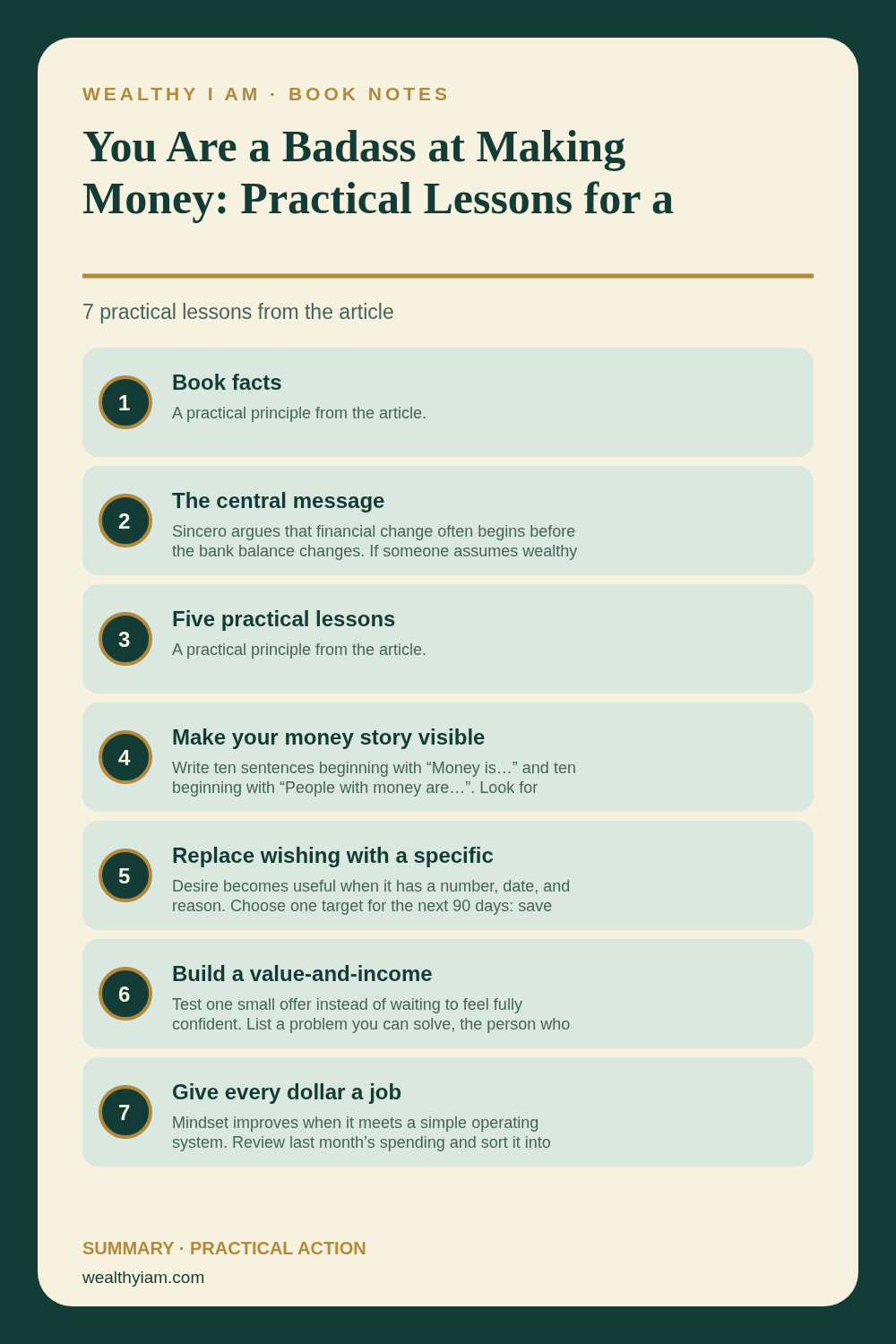
Five practical lessons
1. Make your money story visible
Write ten sentences beginning with “Money is…” and ten beginning with “People with money are…”. Look for inherited rules such as “wanting wealth is greedy” or “I am bad with numbers.” Separate facts from interpretations. “I have credit-card debt” is a fact; “I will always have debt” is an interpretation. That distinction creates room for a plan.
2. Replace wishing with a specific target
Desire becomes useful when it has a number, date, and reason. Choose one target for the next 90 days: save $1,000, pay down a balance, earn an extra $500 monthly, or complete a course that improves your value. Put it somewhere visible and define the next action. Specificity turns motivation into a calendar item.
3. Build a value-and-income experiment
Test one small offer instead of waiting to feel fully confident. List a problem you can solve, the person who has it, the outcome they want, and a fair price for your time or product. Speak with potential customers or colleagues and listen for evidence. The goal is to learn what people value and improve the offer.
4. Give every dollar a job
Mindset improves when it meets a simple operating system. Review last month’s spending and sort it into essentials, goals, commitments, and optional purchases. Automate a realistic transfer to an emergency fund or investment account after payday. If high-interest debt is pressing, prioritize a repayment plan. Progress should be sustainable enough to repeat.
5. Practice receiving and stewardship
Become more comfortable with money without becoming careless. Receive payment without apology and manage it without drama. Charge clearly, negotiate respectfully, track results, and use part of an increase to strengthen your safety and future choices. Wealth is not only income; it is the gap between what you receive and what you intentionally keep or invest.
A seven-day implementation plan
- Day 1: Complete the money-belief exercise and circle one belief you want to test.
- Day 2: Calculate your monthly baseline: income, essential costs, debt payments, savings, and discretionary spending.
- Day 3: Choose one 90-day target and write its first three actions.
- Day 4: Identify a skill that could raise your value and schedule two focused learning sessions.
- Day 5: Ask for one concrete opportunity: a sales conversation, raise discussion, project, or referral.
- Day 6: Automate a transfer, cancel one unhelpful recurring expense, or make an extra debt payment if appropriate.
- Day 7: Review what happened. Keep the action that produced evidence, revise the one that did not, and set a weekly money appointment.
Where the book needs balance
Sincero’s energetic style can make financial change feel accessible, but readers should not treat wealth as a simple test of confidence. Income is affected by health, opportunity, education, discrimination, economic conditions, and responsibilities outside one person’s control. Mindset matters, but it is not a moral measure of financial outcomes.
Pair the encouragement with reliable basics: maintain an emergency reserve appropriate to your circumstances, understand debt costs, diversify investments, watch fees, and seek qualified advice for complex tax or investment questions. Confidence should lead to better questions, not reckless risks.
A practical weekly money review
Set aside twenty minutes once a week for a calm review. Check the balance of your spending account, confirm upcoming bills, and compare your real choices with the target you set. Look for patterns rather than judging yourself: a costly week may reflect travel, a celebration, or a problem that needs a better system. Decide one adjustment for the next seven days. You might move a transfer date, prepare meals, follow up on an opportunity, or block time to improve a skill. Record the decision in the same place each week so the review becomes evidence of progress. This habit connects the book’s emotional message with practical stewardship. It also keeps ambition grounded: the goal is not to perform wealth, but to make choices that increase resilience, options, and peace of mind over time.
Bottom lineYou Are a Badass at Making Money is most useful when it helps you stop treating money as a forbidden subject. Its lasting lesson is to examine the beliefs behind your behavior, choose a measurable goal, and take a repeatable action. Use the inspiration to start the conversation; use evidence and discipline to build the result.
Sources & credit
- Penguin Random House book page — bibliographic details and publisher description.
- Amazon.com product page — exact book/product reference.
- Amazon cover image — cover image credit.
This article is an original educational interpretation, not individualized financial advice.
Wealthy I AM Action Card
Wealthy I AM Pinterest Copy
TITLE
You Are a Badass at Making Money: Practical Lessons for a Wealthier Mindset
DESCRIPTION
Jen Sincero’s energetic guide to changing money beliefs, pursuing value, and turning wealth goals into practical.
KEYWORDS
You Are a Badass at Making Money book summary, Badass Making Money lessons, personal development, wealth building, productivity books
ALT TEXT
Wealthy I AM visual summary of You Are a Badass at Making Money: Practical Lessons for a Wealthier Mindset
ARTICLE URL
https://nappot.com/you-are-a-badass-at-making-money-practical-lessons-wealthier-mindset/