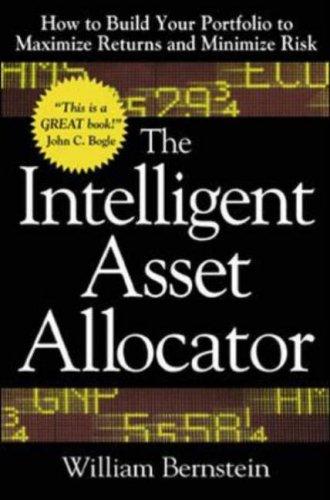
Investing can look mysterious because markets move every day and financial commentary is full of forecasts. The Intelligent Asset Allocator: How to Build Your Portfolio to Maximize Returns and Minimize Risk takes a calmer approach. William J. Bernstein explains how risk, return, diversification, and portfolio design fit together—and why a durable plan matters more than a confident prediction.
First published in 2000 by McGraw-Hill, the book is aimed at readers who want to understand the structure behind a long-term portfolio. It is more analytical than a basic personal-finance guide, but its main message is practical: accept that the future is uncertain, spread risk intelligently, control costs, and implement a plan you can live with. [1][2][3]
Book facts
- Title: The Intelligent Asset Allocator: How to Build Your Portfolio to Maximize Returns and Minimize Risk
- Author: William J. Bernstein
- Original publication: 2000
- Publisher: McGraw-Hill
- Core subjects: Risk and return, multiple-asset portfolios, asset allocation, market efficiency, and implementation
The central idea: allocation drives the journey
Asset allocation is the way an investor divides a portfolio among broad asset classes such as stocks, bonds, cash, and sometimes other diversifiers. Bernstein’s point is not that one mix is perfect for everyone. It is that the mix determines much of a portfolio’s behavior: how sharply it may fall, how much growth it may offer, and how difficult it will be to stay invested.
A portfolio is therefore a personal decision about both money and temperament. A theoretically attractive allocation is not useful if a large decline makes you panic and sell. The right plan balances expected return with the amount of risk you can financially and emotionally tolerate.
Five lessons explained simply
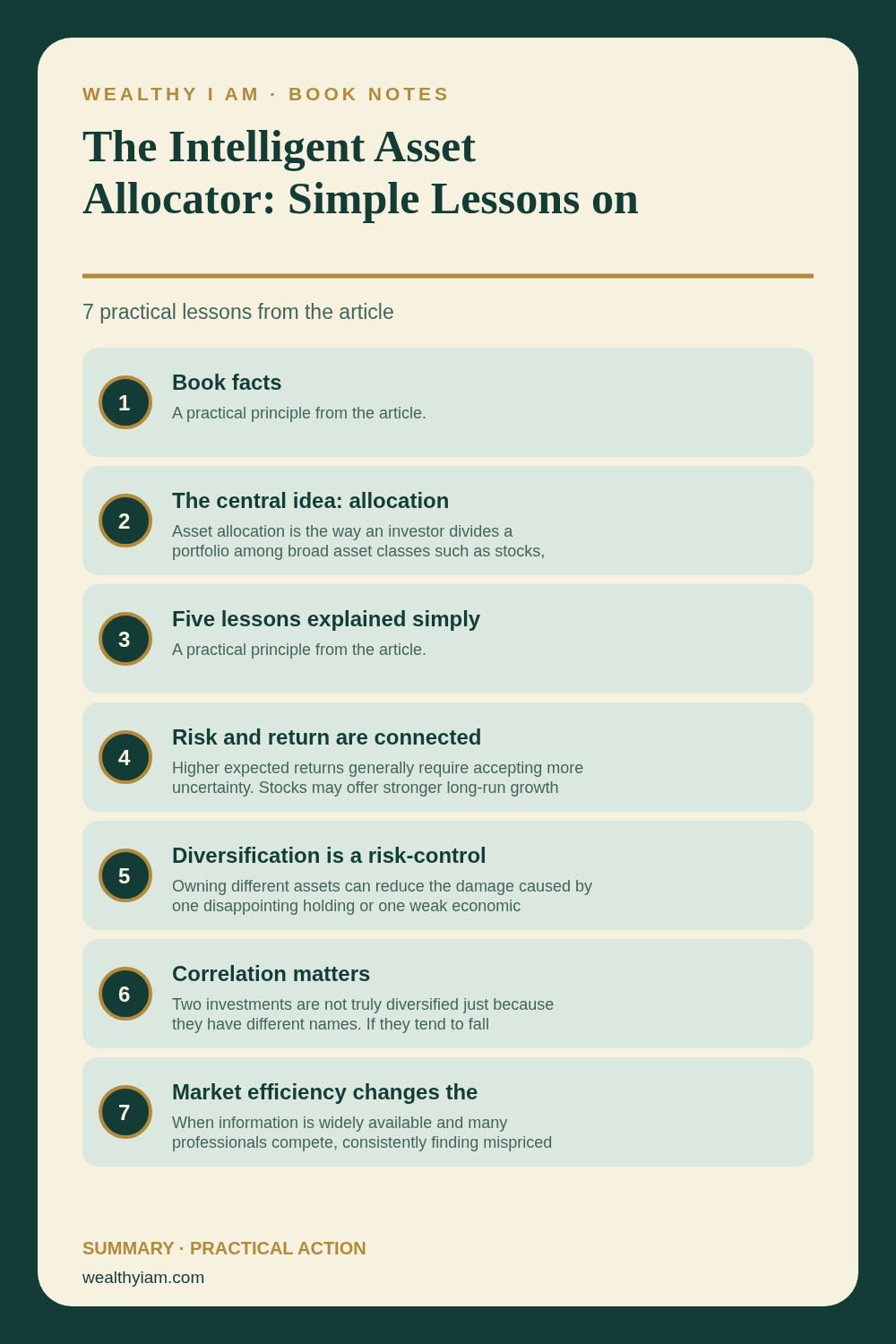
1. Risk and return are connected
Higher expected returns generally require accepting more uncertainty. Stocks may offer stronger long-run growth than cash, but their prices can fall substantially. There is no reliable investment that offers high return with no risk. Promises that suggest otherwise deserve skepticism.
2. Diversification is a risk-control tool
Owning different assets can reduce the damage caused by one disappointing holding or one weak economic environment. Diversification does not eliminate losses, and it cannot guarantee a profit. Its purpose is to avoid placing the whole plan on one company, sector, country, or prediction.
3. Correlation matters
Two investments are not truly diversified just because they have different names. If they tend to fall together, they may provide little protection when it matters. Looking at how assets behave relative to one another helps an investor build a portfolio with more than cosmetic variety.
4. Market efficiency changes the investor’s job
When information is widely available and many professionals compete, consistently finding mispriced assets is difficult. The book encourages humility: instead of trying to outguess every participant, focus on broad exposure, low costs, sensible risk, and disciplined behavior.
5. Implementation is part of the strategy
A sound allocation still needs a practical operating system. Contributions, rebalancing, taxes, account selection, fees, and record keeping all influence results. A plan is only real when you know what to buy, where to hold it, when to review it, and what would justify a change.
A step-by-step portfolio framework
- Define the goal: Identify the purpose, amount, and approximate date for the money. Retirement, a home purchase, and a short-term reserve require different levels of risk.
- Separate time horizons: Keep near-term spending needs away from assets that could be down when you need the cash.
- Measure your risk capacity: Consider income stability, debt, emergency savings, dependents, and how much loss your plan can withstand.
- Measure your risk tolerance: Imagine a significant market decline. If the thought would cause you to abandon the portfolio, choose a design you can actually hold.
- Choose broad building blocks: Prefer understandable, diversified funds or assets and learn what each one owns, costs, and risks.
- Set a contribution rule: Automate regular investing rather than waiting for a perfect entry point.
- Write rebalancing rules: Decide in advance how often you will review the allocation or what drift will trigger a rebalance.
- Review only what can change: Update goals, income, taxes, and life circumstances—not your entire strategy because of a frightening headline.
Why costs and behavior compound
Fees may look small in one year, but recurring costs reduce the capital available to compound over decades. Compare expense ratios, trading costs, account fees, and tax consequences before choosing an investment. Simplicity can be an advantage when it lowers friction and makes the plan easier to maintain.
Behavior is just as important. Chasing what recently performed well, reacting to news, and abandoning a strategy after a decline can turn a reasonable allocation into a poor result. Bernstein’s framework shifts attention from prediction to process: decide calmly, diversify, and keep following the rules.
What the book gets right—and where to be careful
The book’s strength is its refusal to offer magic. It treats portfolio construction as a trade-off among risk, return, time, and human behavior. That is useful for anyone who wants wealth-building to be repeatable rather than dependent on a lucky forecast.
Some mathematics and historical assumptions require careful reading, and no asset allocation is universally correct. Markets, taxes, fund products, and regulations differ by country and change over time. Use the book to understand principles, then confirm current details with reliable, local sources or a qualified adviser. This article is educational, not individualized investment advice.
Bottom line
The Intelligent Asset Allocator teaches that investing intelligence is less about predicting tomorrow’s winner and more about designing a portfolio that matches your goals, controlling avoidable risks, and staying disciplined. Know what you own, spread risk for a reason, keep costs visible, and make the plan strong enough to survive uncertainty.
Sources and credits
- Amazon.com product page — 2000 McGraw-Hill edition, ISBN 9780071362368
- McGraw Hill publisher page
- Internet Archive bibliographic record
- Open Library matched cover image
- Article credit: original educational synthesis by Wealthy I AM; book title, author, edition, and cover matched to the sources above.
Wealthy I AM Action Card
Wealthy I AM Pinterest Copy
TITLE
The Intelligent Asset Allocator: Simple Lessons on Diversification and Portfolio Risk
DESCRIPTION
William Bernstein’s guide to asset allocation explains diversification, risk, return, market efficiency, costs, and disciplined portfolio.
KEYWORDS
The Intelligent Asset Allocator book summary, Intelligent Asset Allocator lessons, personal development, wealth building, productivity books
ALT TEXT
Wealthy I AM visual summary of The Intelligent Asset Allocator: Simple Lessons on Diversification and Portfolio Risk
ARTICLE URL
https://nappot.com/intelligent-asset-allocator-simple-lessons-diversification-portfolio-risk/