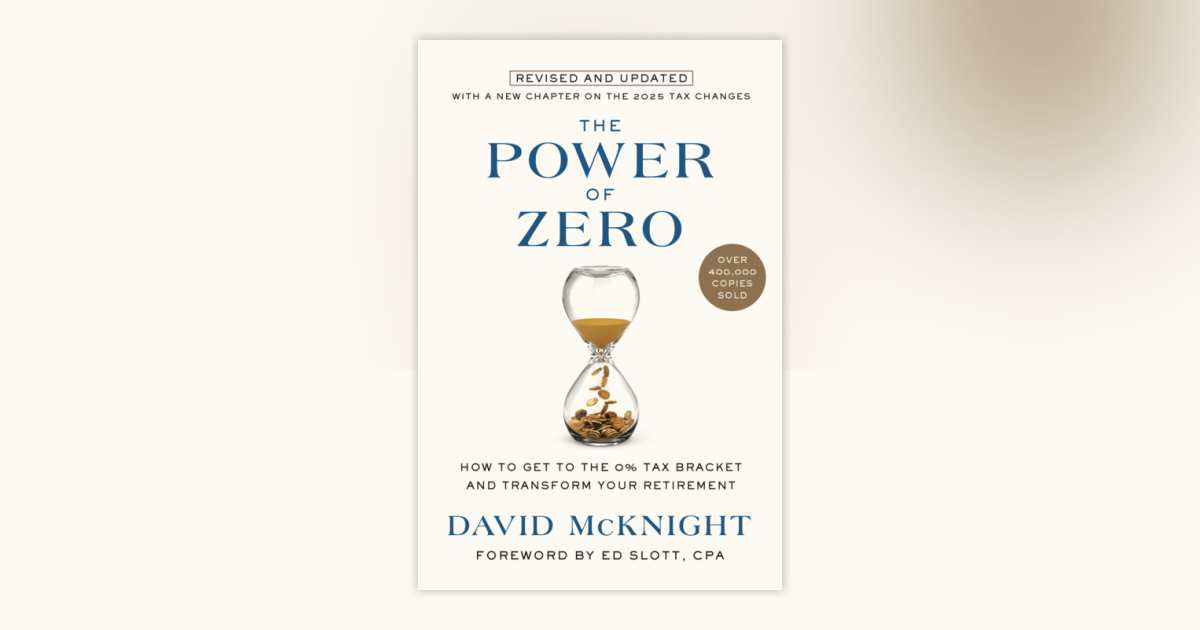
Retirement planning is not only about how much you accumulate. It is also about how much of that money you will actually keep. In The Power of Zero, Revised and Updated: How to Get to the 0% Tax Bracket and Transform Your Retirement, David McKnight asks readers to look beyond today’s tax bill and consider the tax character of their future income. His central idea is simple: a dollar saved in a tax-deferred account is not necessarily a dollar available to spend, because taxes may be due when that money is withdrawn.
That does not make traditional retirement accounts bad, nor does it mean anyone can literally avoid every tax. The useful lesson is to treat taxes as a planning variable. By understanding where retirement assets sit, when withdrawals occur, and which accounts may provide tax-free income, households can make more deliberate decisions instead of leaving their future tax rate entirely to chance. The framework below translates McKnight’s argument into practical steps, while recognizing that tax law and personal circumstances change.
What “the power of zero” means
McKnight’s phrase refers to building enough flexibility into retirement income that a person may be able to remain in a very low—or potentially zero—federal income-tax bracket in a given year. The strategy is presented as a response to tax-rate risk: the possibility that future rates could be higher than they are today, especially as governments address large long-term obligations.
The important takeaway is not a promise or a prediction. It is a question: What mix of taxable, tax-deferred, and tax-free assets gives me the most choices later? A diversified tax strategy can be as valuable as a diversified investment portfolio because it gives retirees more control over which account they draw from and when.
Seven practical lessons from the book
1. Separate investment risk from tax risk
Investors often focus on market volatility, inflation, and longevity while overlooking the tax cost attached to different accounts. Make a simple inventory of your assets and label each one: taxable brokerage, traditional 401(k) or IRA, Roth account, cash value or other relevant vehicle. Then note the likely tax treatment of contributions, growth, and withdrawals. This first map turns an invisible future liability into something you can discuss and manage.
2. Build a three-bucket view of retirement assets
Think in terms of taxable money, tax-deferred money, and tax-free money. Taxable accounts may offer access and flexibility but can create capital-gains or dividend taxes. Tax-deferred accounts can provide valuable deductions and tax-advantaged growth, yet withdrawals are generally taxable as ordinary income. Roth-style accounts are funded with after-tax dollars and may provide qualified tax-free withdrawals under the rules in effect at the time.
No single bucket is automatically best. The goal is balance. A household with only tax-deferred assets may have less control over future taxable income; a household with no tax-deferred assets may be passing up useful current benefits. The right mix depends on income, age, state, goals, and account eligibility.
3. Use low-income years intentionally
Tax planning is often most powerful when income is temporarily lower—for example, after leaving work but before required distributions or government benefits begin. During such windows, some investors may consider partial Roth conversions or other moves that recognize income now in exchange for potentially reducing future tax-deferred balances. The decision should be modeled carefully, because a conversion can affect tax brackets, credits, Medicare premiums, and other benefits.
Make this a calendar exercise rather than a one-time decision. Review projected income for each year, identify the space remaining in the desired bracket, and compare the cost of acting now with the potential value of future flexibility.
4. Treat Roth conversions as a tool, not a doctrine
McKnight strongly emphasizes conversions, but a sound application requires restraint. A conversion is not free; it generally creates taxable income in the year it occurs. Before considering one, estimate the tax payment, confirm where the money to pay that tax will come from, and test several future scenarios. A conversion may be less attractive if it forces a household into a much higher bracket or if the investor has a short time horizon.
Use ranges, not false precision. Compare a conservative future tax-rate assumption with a higher-rate assumption, and include the possibility that your spending, location, or heirs’ circumstances will differ from today’s plan.
5. Make withdrawals serve the plan
Retirement withdrawals should be coordinated with spending needs, account rules, and the tax picture. Instead of withdrawing mechanically from one account, ask which source best fits this year’s income target. Taxable cash, tax-deferred withdrawals, and tax-free withdrawals can be combined in different ways. The sequence may also change as markets move or life events occur.
Create a written withdrawal policy with annual checkpoints. Include a minimum cash reserve, a target income range, and a rule for when to revisit the mix. This reduces the chance that a stressful market or an unexpected bill forces an expensive decision.
6. Keep tax diversification beside investment diversification
Asset allocation answers, “What do I own?” Tax diversification adds, “Where do I own it?” Two portfolios with identical investments can have very different after-tax outcomes if the accounts differ. Consider how interest, dividends, gains, and withdrawals interact with each account type. Keep the approach understandable and avoid making tax location so complex that you cannot maintain it.
Fees, liquidity, legal protections, and investment quality still matter. A tax benefit should not justify an unsuitable product or an unnecessarily high cost.
7. Revisit the plan as laws and life change
The book’s argument is built around changing tax conditions, so the plan must be revisited whenever the conditions change. Review it after a job change, marriage, divorce, inheritance, business sale, relocation, or major health event. Also review it when Congress changes contribution limits, distribution rules, or tax rates.
Use qualified professionals for individualized advice. A tax professional can test the return-level consequences; a fiduciary financial planner can connect the tax plan to investments, insurance, cash flow, and longevity. Ask each advisor to explain assumptions clearly and show what would make the recommendation change.
A simple 30-day action plan
- Week one: gather account statements, beneficiaries, cost basis, expected benefits, and a rough retirement budget.
- Week two: classify each asset by tax treatment and estimate future income sources.
- Week three: model at least three scenarios: current-rate assumptions, higher future rates, and a lower-income transition period.
- Week four: choose one low-risk improvement—such as increasing tax diversification, updating beneficiaries, or scheduling a professional review—and document the next annual review date.
This process is deliberately modest. The point is not to predict legislation perfectly; it is to create choices. A retirement plan with multiple account types, a cash reserve, and a clear withdrawal policy can be more resilient than one that depends on a single tax outcome.
Final takeaway
The Power of Zero is a reminder that wealth is measured after taxes, fees, inflation, and real-life decisions—not only by an account balance on a statement. McKnight’s framework encourages readers to plan for tax flexibility early, use low-income windows thoughtfully, and coordinate withdrawals instead of improvising them. The strongest version of the lesson is not “avoid taxes at all costs.” It is “understand the cost, preserve options, and make decisions that fit your whole financial life.”
Sources and credits
- McKnight, David. The Power of Zero, Revised and Updated: How to Get to the 0% Tax Bracket and Transform Your Retirement. Crown Currency, 2018. ISBN 9781984823076 (hardcover).
- Penguin Random House official book page — bibliographic details and publisher description.
- Amazon.com product page — exact book/product reference.
- Cover image credit: Penguin Random House product image, used to identify the matched edition.
Educational content only, not tax, legal, or investment advice. Tax rules and individual results vary; consult qualified professionals before acting.
Wealthy I AM Action Card
Wealthy I AM Pinterest Copy
TITLE
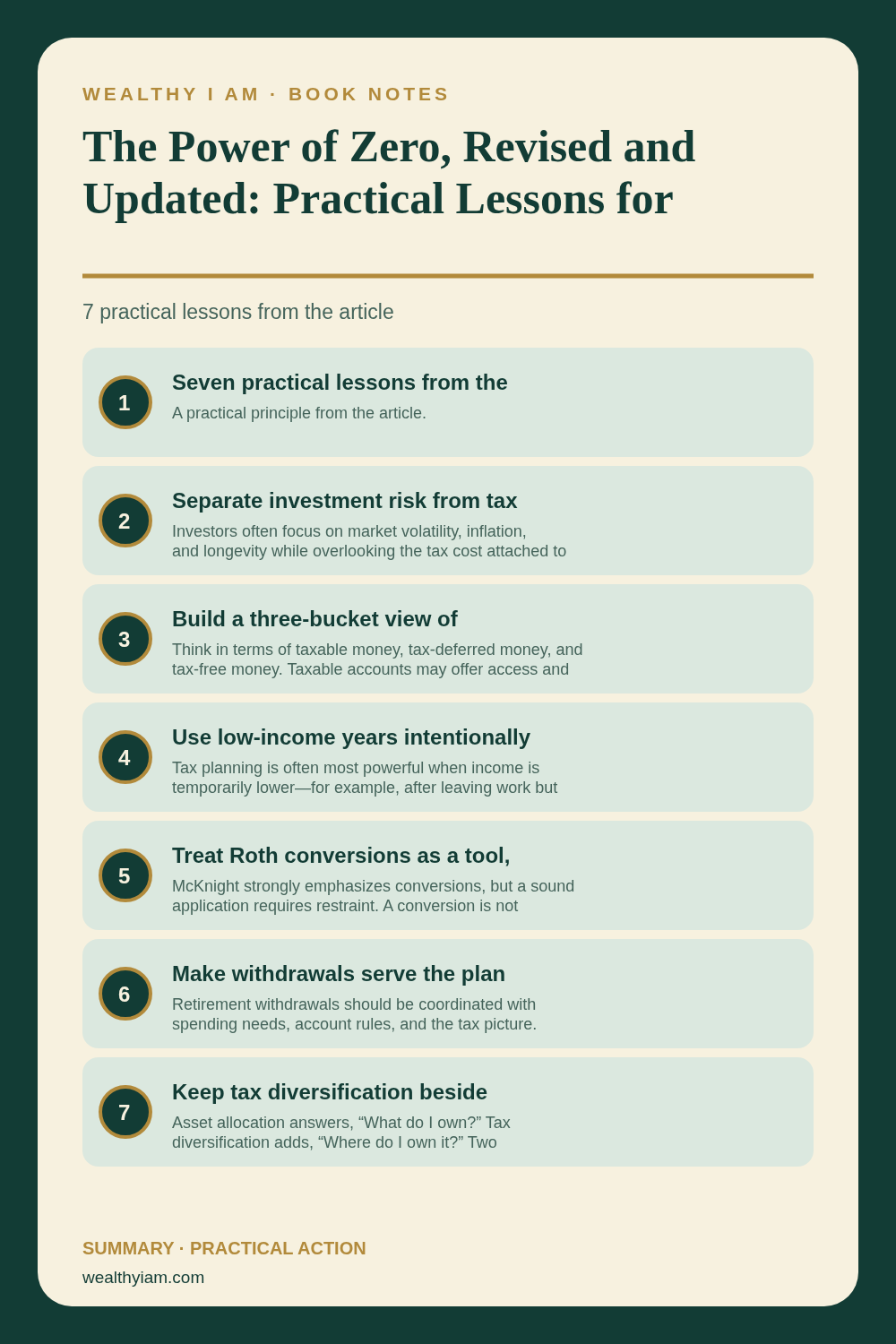
The Power of Zero, Revised and Updated: Practical Lessons for Tax-Smart Retirement Wealth
DESCRIPTION
David McKnight’s tax-diversification framework for building more flexible, resilient retirement.
KEYWORDS
The Power of Zero, Revised and Updated book summary, Power Zero, Revised Updated lessons, personal development, wealth building, productivity books
ALT TEXT
Wealthy I AM visual summary of The Power of Zero, Revised and Updated: Practical Lessons for Tax-Smart Retirement Wealth
ARTICLE URL
https://nappot.com/power-of-zero-revised-updated-tax-smart-retirement-wealth/