The Accidental Creative by Todd Henry starts with a reality many professionals know well: you are expected to produce useful, original ideas on schedule, even when inspiration is nowhere to be found. The book is written for both professional creatives and “accidental creatives”—leaders, marketers, entrepreneurs, analysts, teachers, and anyone whose work requires problem-solving.
Henry’s central promise is encouraging rather than mystical. Creativity is not only a lucky flash; it can be supported by repeatable practices. That matters for wealth because valuable ideas become products, better services, stronger careers, and businesses that solve important problems. The goal is not constant hustle. It is building a reliable creative rhythm that protects quality and energy.
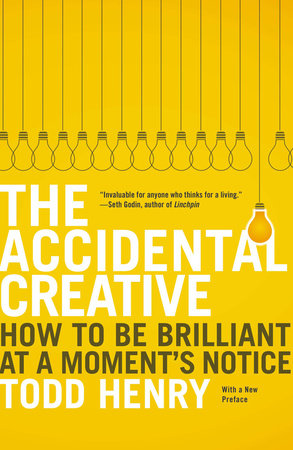
Book facts
| Author | Todd Henry |
|---|---|
| Full title | The Accidental Creative: How to Be Brilliant at a Moment’s Notice |
| Publisher | Portfolio |
| Edition referenced | Paperback, ISBN 9781591846246 |
| Core subject | Creative productivity, focus, energy, relationships, and sustainable performance |
The big idea: creativity needs a structure
When creative work feels unpredictable, people often respond by waiting for motivation or working longer hours. Henry suggests a better approach: create conditions in which good thinking is more likely to happen. You still cannot command a brilliant idea at 2:00 p.m., but you can improve the quality of your inputs, attention, relationships, and recovery.
His framework highlights five practical areas: focus, relationships, energy, stimuli, and hours. Together they form a personal operating system for doing demanding work without treating exhaustion as proof of commitment.
You do not build a valuable future from occasional inspiration; you build it from practices that make valuable work repeatable.
Five lessons that translate into wealth-building
1. Focus on the work that creates the most value
Not every task deserves equal attention. Focus means identifying the outcome that matters most and giving it protected time. For an entrepreneur, that may be speaking with customers or improving the core offer—not endlessly adjusting a logo. For an employee, it may be developing a scarce skill or solving a high-impact problem.
Focused work creates career capital: knowledge and results that make you more useful and more valuable. Income tends to follow value, so the first step is deciding what valuable output actually looks like.
2. Build relationships that stretch your thinking
Creative ideas rarely develop in isolation. Henry emphasizes relationships that provide encouragement, challenge, and fresh perspectives. This is not networking for collecting contacts. It is deliberately spending time with people who ask better questions and see possibilities you miss.
Choose three people whose judgment you respect. Share a work-in-progress, ask what problem they see, and listen without defending every choice. Better conversations can improve a product, reveal a customer need, or prevent an expensive mistake.
3. Manage energy instead of worshipping hours
Two people can work the same number of hours and produce very different results. Energy includes physical stamina, emotional steadiness, and mental clarity. A tired mind may spend an hour avoiding a decision that a rested mind resolves in ten minutes.
Track your energy for one week. Notice when you are best at analysis, writing, sales, or creative exploration. Put the hardest work in those windows, then use lower-energy periods for administration. Protecting energy is not laziness; it is resource allocation.
4. Curate your stimuli
Stimuli are the material your mind consumes: articles, conversations, experiences, books, data, and media. If every spare moment is filled with random noise, your attention becomes scattered. Henry’s lesson is to choose inputs that feed the kind of thinking you want to produce.
Create a small “idea diet.” Save two high-quality sources related to your field, take notes on what they teach you, and connect each insight to a real problem. This turns consumption into learning rather than passive scrolling.
5. Treat your hours as a design problem
Being busy is not the same as being effective. Look at your calendar and ask which commitments drain creative capacity without advancing an important goal. Batch shallow tasks, reduce unnecessary switching, and make space for recovery. A business that depends on frantic last-minute effort is fragile; a business with repeatable rhythms is easier to grow.
A step-by-step practice for this week
- Name one valuable outcome. Write the result that would make this week meaningfully better for your career, business, or finances.
- Schedule three focus blocks. Reserve 45–90 minutes with notifications off. Define the deliverable before you begin.
- Audit your energy. Rate your energy from 1 to 5 at the start and end of each block. Move demanding work toward your strongest period.
- Have one creative conversation. Ask a trusted person for a different interpretation of the problem, not merely approval of your solution.
- Capture ten ideas. List possible improvements, offers, content topics, or skills without judging them. Select one to test.
- Review the evidence. At week’s end, record what produced useful output, what created distraction, and what you will change next week.
The point is not to create a perfect routine immediately. It is to run small experiments until your personal system supports consistent, high-value work.
What the book gets right—and where to be careful
Henry is right that creative performance is affected by ordinary conditions. Sleep, attention, social input, and calendar design are not side issues; they shape the quality of decisions and ideas. The book is also valuable for people who do not call themselves creative but must solve novel problems every day.
Still, no system eliminates uncertainty. A well-designed routine cannot guarantee a hit product or a sudden promotion. Creativity also needs judgment, market feedback, and willingness to discard weak ideas. Use Henry’s practices as a foundation, then test your work in the real world.
Most importantly, do not turn the framework into another productivity contest. If your schedule leaves no room for rest, relationships, or reflection, it may increase output briefly while reducing your long-term capacity.
Bottom line
The Accidental Creative is a practical guide to becoming more dependable at valuable thinking. Its wealth lesson is indirect but powerful: build the habits that help you create useful work consistently, protect the energy required to keep creating, and surround yourself with people and inputs that improve your judgment.
When you can produce better ideas on purpose—and turn those ideas into tested solutions—you create more options. Those options may become a stronger career, a profitable business, or a life with greater freedom. Inspiration may open the door, but disciplined creative practice helps you walk through it.
Sources & credit
Book details, publication information, and the framework summarized here were checked against the following sources. The cover image is credited to the publisher’s official product image.