Wealth is rarely built by one brilliant idea working in isolation. It is built through people who can trust one another, solve problems quickly, and keep moving toward a shared goal. In The Culture Code: The Secrets of Highly Successful Groups, Daniel Coyle studies teams ranging from the San Antonio Spurs and Pixar to the U.S. Navy SEALs and draws out practical principles for making cooperation stronger.
Coyle’s central message is encouraging: culture is not a personality trait that a group either has or lacks. It is the result of repeated signals and behaviors. For an entrepreneur, manager, or professional, that means team culture is an asset that can be deliberately built—and a weak culture can quietly destroy time, morale, customer trust, and profit.

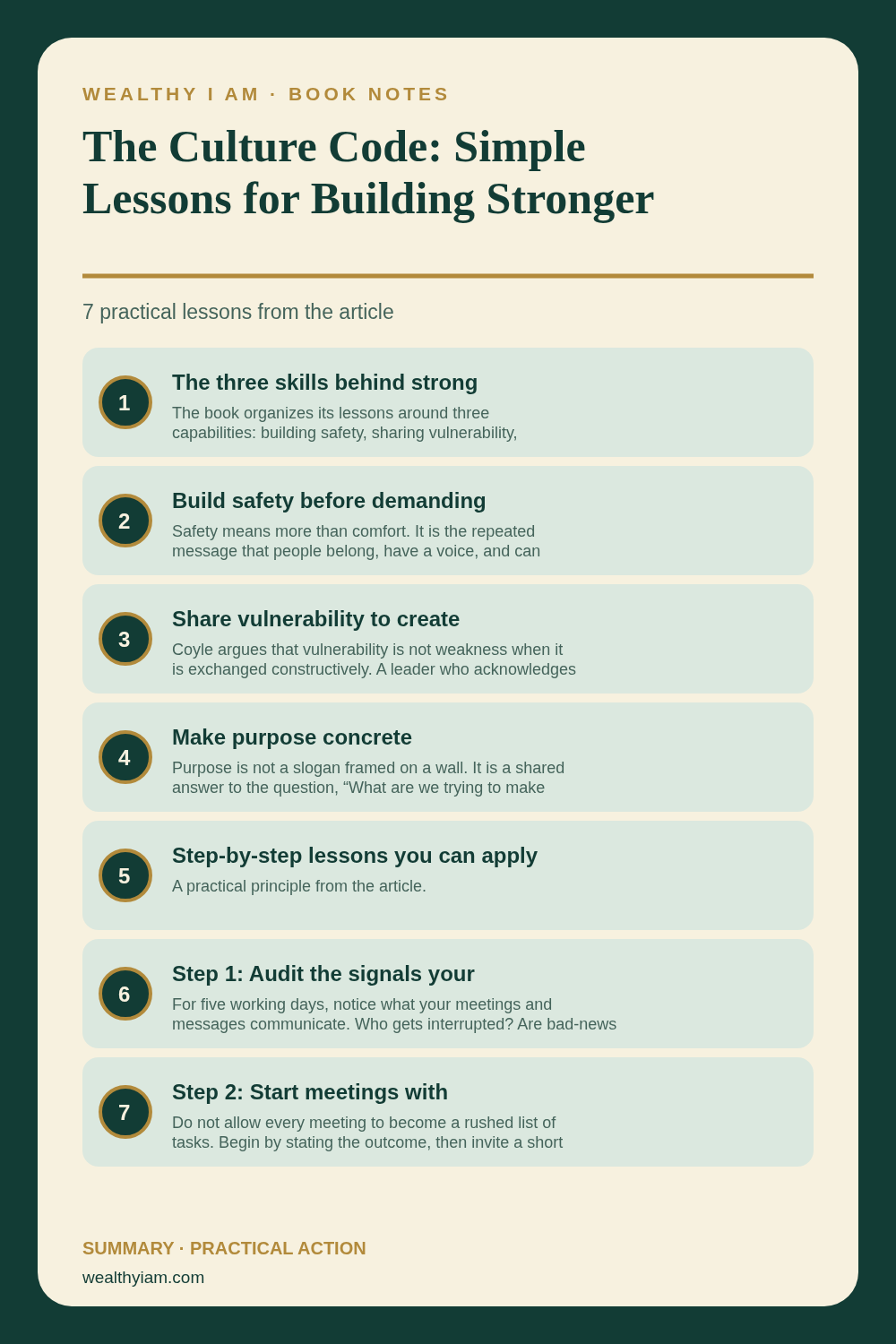
The three skills behind strong groups
The book organizes its lessons around three capabilities: building safety, sharing vulnerability, and establishing purpose. These are not soft extras. They shape whether people speak up early, ask for help, learn from mistakes, and spend their energy on the work that matters.
1. Build safety before demanding performance
Safety means more than comfort. It is the repeated message that people belong, have a voice, and can contribute without being humiliated. In a business, safety makes useful information visible. A team member who can say “I see a risk” before a project fails is protecting the company’s cash and reputation.
Safety is communicated in small moments: making eye contact, listening without interrupting, welcoming a question, giving credit, and explaining how someone’s work connects to the group. Leaders should not assume that silence means agreement. They should create regular opportunities for dissent and clarification.
2. Share vulnerability to create trust
Coyle argues that vulnerability is not weakness when it is exchanged constructively. A leader who acknowledges uncertainty, asks for help, or admits a mistake gives others permission to be honest. That honesty reduces the expensive habit of hiding problems until they become emergencies.
Vulnerability needs boundaries. It is not oversharing, lowering standards, or avoiding accountability. A useful pattern is: name the problem, state what you do not know, ask for a specific contribution, and agree on the next action. This turns openness into coordinated work.
3. Make purpose concrete
Purpose is not a slogan framed on a wall. It is a shared answer to the question, “What are we trying to make better, and how will we behave while doing it?” Strong groups repeat their priorities through stories, decisions, rituals, and visible trade-offs.
For wealth building, purpose keeps growth from becoming a purely numerical chase. A company that knows whom it serves can choose better customers, products, and partnerships. Individuals can also use purpose to decide which skills and opportunities deserve their limited attention.
Step-by-step lessons you can apply this week
Step 1: Audit the signals your team receives
For five working days, notice what your meetings and messages communicate. Who gets interrupted? Are bad-news updates punished? Do people know when they have done good work? Write down three signals that increase belonging and three that create hesitation. Choose one behavior to change immediately, such as responding to questions before moving to the next agenda item.
Step 2: Start meetings with connection and clarity
Do not allow every meeting to become a rushed list of tasks. Begin by stating the outcome, then invite a short check-in or a useful observation from each participant. The goal is not forced cheerfulness; it is to make participation normal. End by naming the decision, owner, and deadline.
Step 3: Make candor a process
Ask questions that make risk easier to report: “What are we missing?” “What could make this fail?” and “Where do you need support?” When someone raises a concern, thank them before evaluating it. A concern can be wrong and still be valuable because it gives the team something to test.
Step 4: Trade polished certainty for learning speed
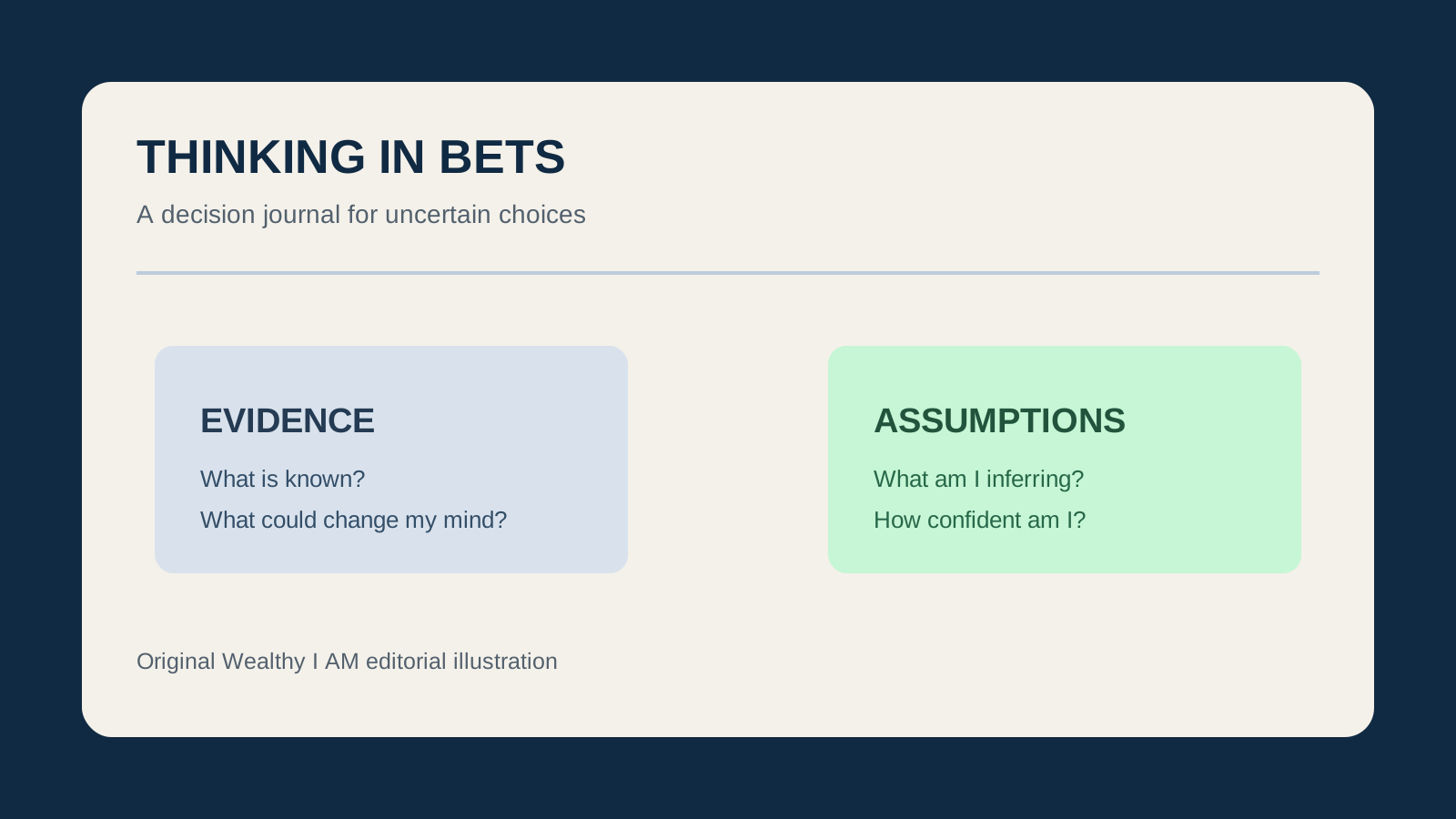
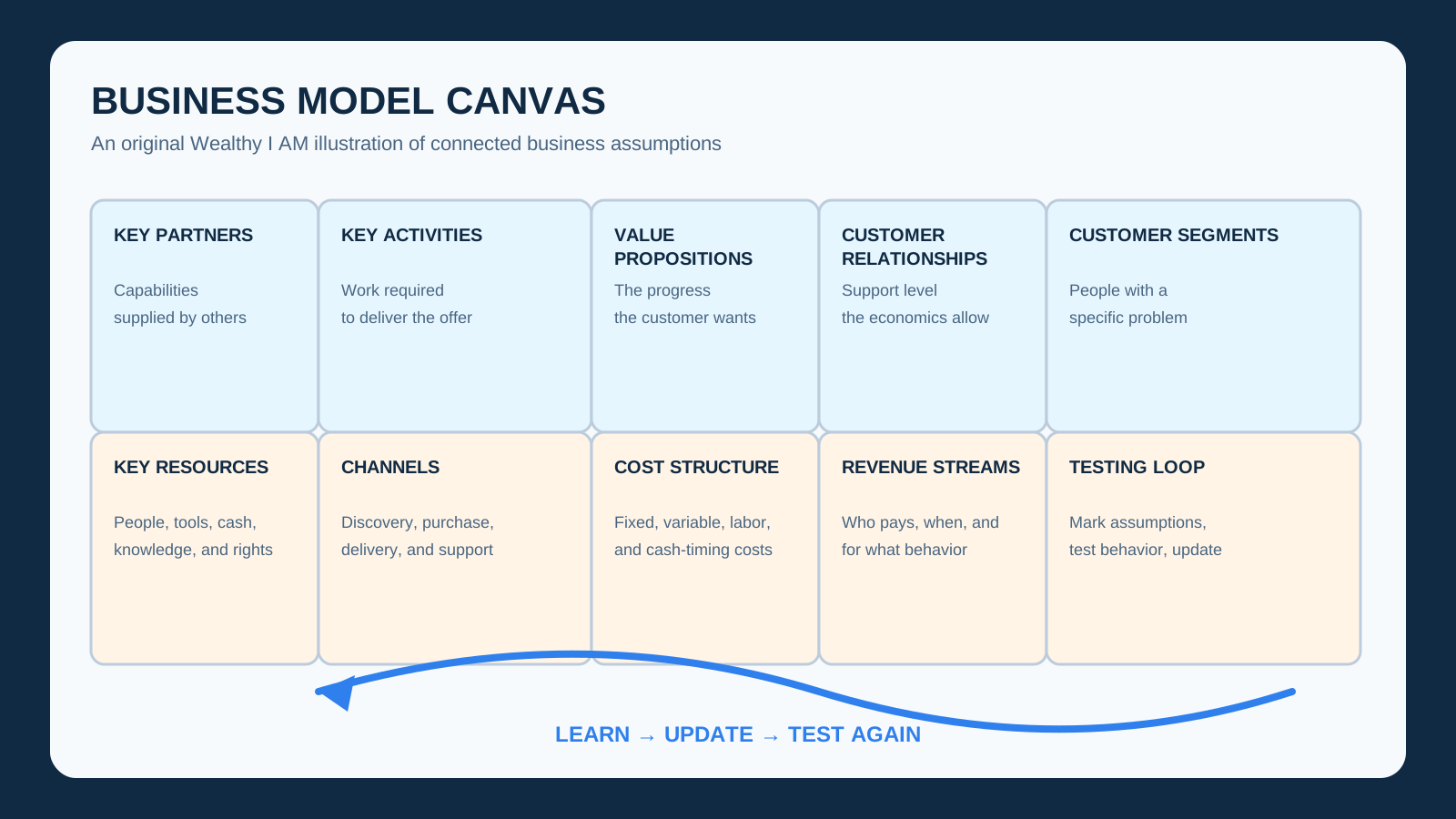
Before launching a product, campaign, or investment of company resources, list the assumptions underneath the plan. Mark which assumption is most dangerous and design the cheapest test. This habit converts vulnerability into evidence. It also prevents a team from spending months defending an idea that customers do not need.
Step 5: Translate values into decisions
Choose two or three behaviors that prove your stated purpose. If your purpose includes customer trust, publish realistic delivery times and disclose limitations. If it includes learning, schedule a short review after major projects. If it includes excellence, define what “good” means before work begins. Values become credible when they cost something.
Step 6: Tell the stories you want repeated
Every organization teaches through the stories it celebrates. Share examples of someone protecting a customer, helping a colleague, or stopping a preventable mistake. Explain why the action mattered. These stories are practical navigation tools: they show how abstract priorities look in real choices.
Step 7: Measure culture through outcomes and behavior
Culture should not be reduced to a happiness score. Track leading signals such as unresolved risks, employee participation, customer complaints, handoff delays, rework, and retention. Review the numbers alongside stories from the people doing the work. A healthy culture should make learning faster, coordination clearer, and execution more reliable.
How culture compounds into wealth
A strong culture can create financial advantages without being focused only on money. Clear communication reduces rework. Psychological safety surfaces mistakes while they are still affordable. Shared purpose improves prioritization. Trust makes it easier to delegate, retain capable people, and serve customers consistently.
These gains compound. A team that learns quickly improves its offer; a better offer creates stronger customer relationships; stronger relationships support healthier revenue; healthier revenue gives the organization room to invest in people and systems. Culture is therefore part of the operating system behind ownership and long-term wealth.
Important cautions
The book’s ideas do not mean every team should copy Pixar, the Spurs, or a military unit. Context matters. Safety does not remove the need for standards, and vulnerability does not excuse poor preparation. Leaders must also avoid using “culture” as a reason to demand emotional conformity or unpaid loyalty.
The practical test is simple: do the team’s norms help people tell the truth, do useful work, and make responsible decisions? If not, change the behavior and the system—not just the branding.
Bottom line
The Culture Code shows that extraordinary groups are built through ordinary interactions repeated with discipline. Start with belonging, make honest problem-solving safe, and connect daily work to a purpose people can see. Whether you are building a company, leading a department, or contributing to a small project, these practices can improve execution and protect the resources that wealth depends on: time, trust, attention, and productive relationships.
Sources and credits
- Daniel Coyle’s official book page — author, premise, and three core skills.
- Amazon.com product page — matched edition and product details.
- Cover credit: Amazon.com image for the matched edition; the image links to the corresponding product page.
Wealthy I AM Action Card
Wealthy I AM Pinterest Copy
TITLE
The Culture Code: Simple Lessons for Building Stronger Teams and Wealth
DESCRIPTION
Practical lessons from The Culture Code by Daniel Coyle for building stronger teams, better execution, and long-term.
KEYWORDS
The Culture Code book summary, Culture Code lessons, personal development, wealth building, productivity books
ALT TEXT
Wealthy I AM visual summary of The Culture Code: Simple Lessons for Building Stronger Teams and Wealth
ARTICLE URL
https://nappot.com/the-culture-code-simple-lessons-building-stronger-teams-and-wealth/