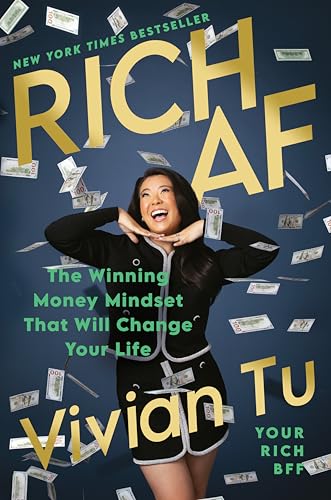
Money can feel like a private language: everyone seems to know the rules except you. In Rich AF: The Winning Money Mindset That Will Change Your Life, Vivian Tu makes that language more accessible. Drawing on her experience as a former Wall Street equities trader and her work as “Your Rich BFF,” Tu explains personal finance in a direct, conversational way. Her core message is not that wealth is reserved for insiders. It is that financial knowledge is learnable, and better decisions become easier when the basics are visible.
The book covers earning, saving, taxes, investing, and the beliefs that shape how people use money. It is especially useful for readers who are earning an income but still feel uncertain about what to do next. Rather than treating wealth as a personality trait, Tu presents it as a set of skills: understand the system, ask better questions, protect your future self, and put your money to work deliberately.
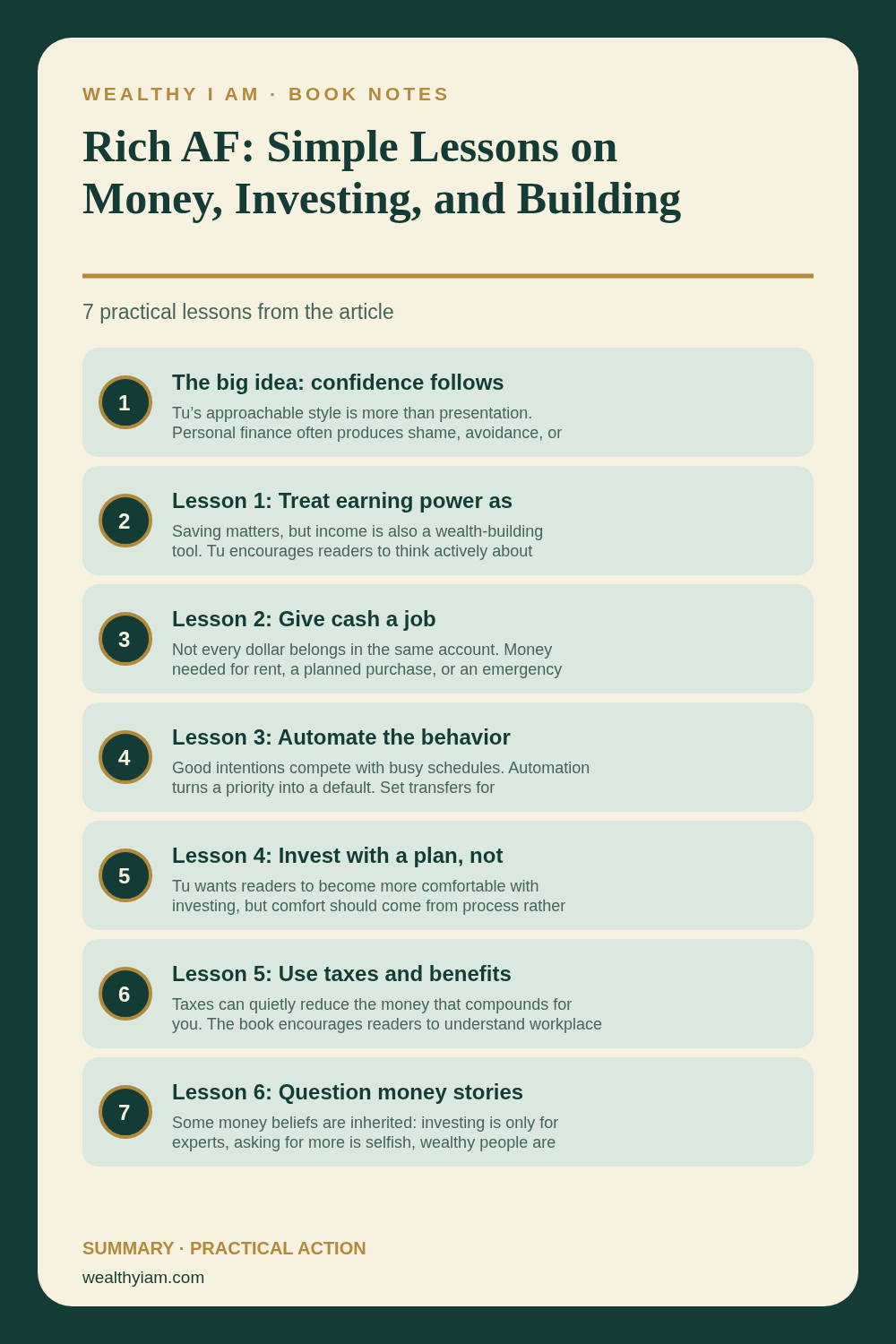
The big idea: confidence follows clarity
Tu’s approachable style is more than presentation. Personal finance often produces shame, avoidance, or fear of making an irreversible mistake. Those emotions can keep people from opening an account, asking about a workplace benefit, negotiating compensation, or learning how investing works. Tu’s practical tone lowers the barrier to entry without pretending that money decisions are consequence-free.
That leads to a useful distinction: confidence is not the same as certainty. You do not need to predict the market or understand every financial product before taking a sensible first step. You need enough information to match a decision to its purpose, time horizon, and risk.
Lesson 1: Treat earning power as an asset
Saving matters, but income is also a wealth-building tool. Tu encourages readers to think actively about compensation, career opportunities, and the value of skills. A higher income creates more room for saving, investing, giving, and handling setbacks—but earning more should not automatically mean spending more.
Action step: write down three ways your work creates measurable value, such as revenue generated, costs reduced, customers retained, or problems solved. Use that evidence in a compensation conversation, a job search, or a plan to develop a higher-value skill. Review your market value every six months instead of waiting for an annual ritual to decide your future.
Lesson 2: Give cash a job
Not every dollar belongs in the same account. Money needed for rent, a planned purchase, or an emergency reserve has a different job from money intended for a retirement goal decades away. Keeping short-term cash accessible and protected can prevent a market decline from forcing a bad sale.
Create three simple labels: now for bills and near-term needs, soon for goals within the next few years, and later for long-term investing. Then inspect whether each dollar is stored in an appropriate place. Compare interest rates, fees, access, and protections rather than choosing an account because its name sounds impressive.
Lesson 3: Automate the behavior you want
Good intentions compete with busy schedules. Automation turns a priority into a default. Set transfers for emergency savings, retirement contributions, or a diversified investment account shortly after payday. Start at a level you can sustain, then increase the amount when your income rises or a major expense disappears.
Automation is not a substitute for review. Check the destination, contribution limits, fees, and available investments. A quarterly review can answer simple questions: Is the amount still appropriate? Has my goal changed? Am I paying for a service I do not use? The goal is a system that is boring enough to continue.
Lesson 4: Invest with a plan, not a mood
Tu wants readers to become more comfortable with investing, but comfort should come from process rather than hype. Before investing, establish an emergency reserve and deal with high-cost debt according to your circumstances. Then identify the goal, time horizon, and level of loss you could tolerate without abandoning the plan.
For many long-term investors, broad diversification and low costs are more dependable starting points than trying to identify the next winning stock. Diversification spreads exposure across many holdings; it does not remove risk. A portfolio can still decline, and past performance is not a promise. Learn the tax rules and account choices where you live, and seek qualified advice when your situation is complex.
Lesson 5: Use taxes and benefits as part of the plan
Taxes can quietly reduce the money that compounds for you. The book encourages readers to understand workplace retirement plans, employer matches, tax-advantaged accounts, and the difference between gross and take-home pay. These details are not glamorous, but they can matter over many years.
Action step: open your latest pay statement and identify your retirement contribution, employer match, withholding, and benefits deductions. Read the official plan documents before changing anything. A match you are eligible for, a contribution you can increase, or an overlooked benefit may be more valuable than an elaborate financial product.
Lesson 6: Question money stories that keep you stuck
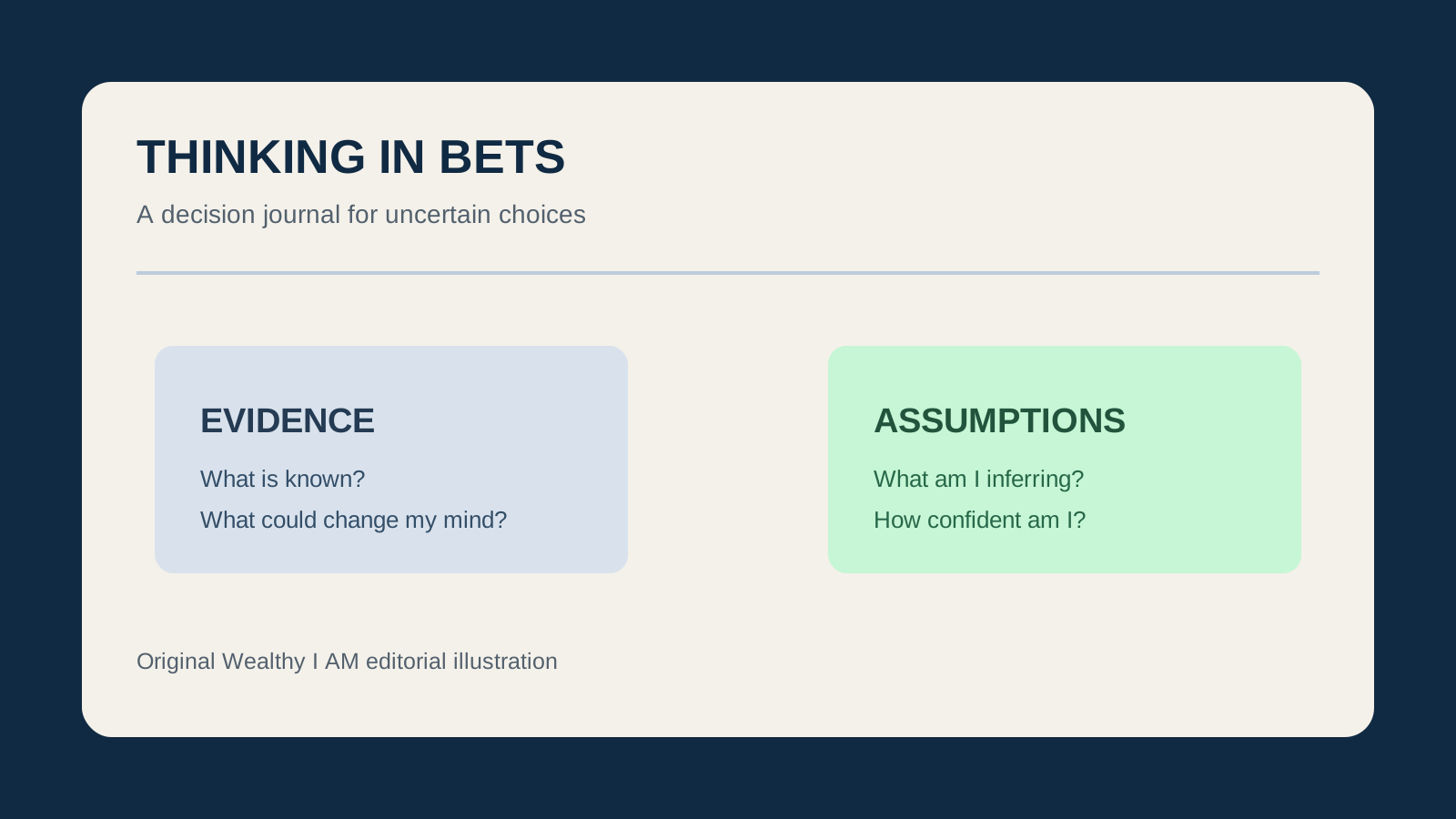
Some money beliefs are inherited: investing is only for experts, asking for more is selfish, wealthy people are simply lucky, or one mistake means you are bad with money. Tu’s approach is to replace vague stories with specific questions. What exactly do I not understand? What would a small experiment look like? Which source is reliable? What decision would help my future self?
This mindset is not magical thinking. It is a commitment to learning and agency. You can acknowledge unequal starting points and structural barriers while still improving the choices within your control. Progress might mean lowering fees, increasing income, asking for help, or avoiding a purchase that would create expensive debt.
A practical 30-day Rich AF reset
- Days 1–3: list income, accounts, debts, recurring bills, and savings. Do not estimate if you can check a statement.
- Days 4–7: choose one near-term priority: a starter emergency fund, high-cost debt, or capturing an available employer match.
- Week 2: automate one transfer and cancel or renegotiate one recurring expense that no longer earns its place.
- Week 3: learn the investment options in one account. Compare diversification, fees, taxes, and time horizon before acting.
- Week 4: schedule a money review and a career conversation. Decide how the next raise, bonus, or new income will be divided before it arrives.
What to take—and what to verify
Rich AF is an educational guide, not a personalized financial plan. Account rules, tax laws, insurance needs, and investment choices vary by country and individual circumstances. Some readers may need a fiduciary financial planner, tax professional, or debt counselor. Verify current information with official sources, understand fees, and do not treat a confident voice—or a social-media trend—as proof.
Bottom line
Vivian Tu’s most valuable lesson is that money confidence is built through informed action. Increase your earning power, separate short-term safety from long-term growth, automate sensible habits, invest according to a plan, and keep learning. Wealth is not created by one perfect decision. It is created when ordinary decisions become more intentional and are repeated long enough to compound.
Sources and credits
- Tu, Vivian. Rich AF: The Winning Money Mindset That Will Change Your Life. Portfolio, 2023. ISBN 9780593714911.
- Amazon.com product page — verified title, author, ISBN, and cover reference.
- Penguin Random House / Portfolio book page — publication and bibliographic details.
- Investor.gov: Investing Basics — general context on diversification and risk.
Wealthy I AM Action Card
Wealthy I AM Pinterest Copy
TITLE
Rich AF: Simple Lessons on Money, Investing, and Building Wealth
DESCRIPTION
Money can feel like a private language: everyone seems to know the rules except you. In Rich AF: The Winning Money Mindset That Will Change Your Life, Vivian Tu makes that language more accessible. Drawing on her experience as a former Wall Street equities.
KEYWORDS
Rich AF book summary, Rich lessons, personal development, wealth building, productivity books
ALT TEXT
Wealthy I AM visual summary of Rich AF: Simple Lessons on Money, Investing, and Building Wealth
ARTICLE URL
https://nappot.com/rich-af-simple-lessons-money-investing-building-wealth/